
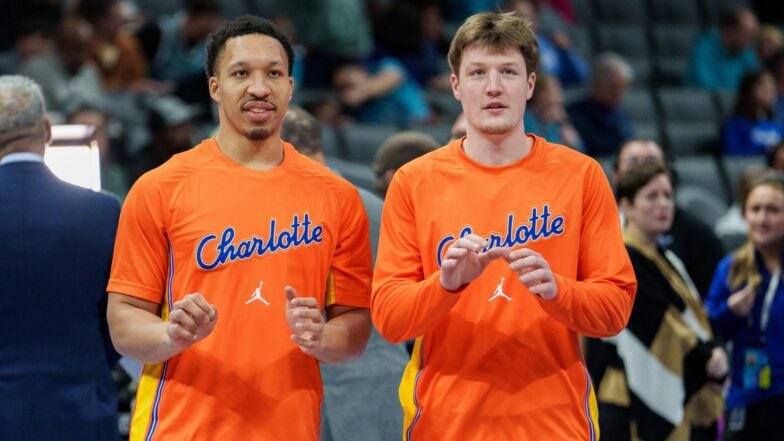
Veteran Grant Williams connects with rookie Kon Knueppel ahead of tipoff.
Lugging duffel bags is one of the most common. Driving across town to fetch a couple dozen donuts from a particular bakery, that’s standard-issue stuff too. So is gathering up the empty water bottles strewn about the practice court or towels left lying on the locker room floor.
Packing and providing a teammate’s favorite soap or lotion can be part of an NBA rookie’s “to-do” list, too. Occasionally, there will be pink “Hello Kitty” backpacks to tote on the road all season, more of an initiation than a helpful chore.
All of it is part of a tradition in sports that pre-dates even the Basketball Association of America’s arrival in 1946-47, a ritual for rookies repeated season after season as a way to (cough) welcome new guys into the group.
Typically, rookie duties are menial and simple, tasks that make for some light-hearted videos that players themselves or their teams post on social media. Sometimes they air on local game broadcasts.
Failure to comply? OK, that can turn a little harsh, veering into hazing of sorts. First-year guys who were delinquent in their duties have found the street clothes hanging in their missing or shredded or, er, otherwise fouled. Maybe the bed in their hotel room will be soaking wet.
Boston’s Jaylen Brown still sneers about fellow Celtics, led by guard Isaiah Thomas, filling up his vehicle with popcorn, leaving the interior “all buttered up” in his first season. Back in 2017-18, Milwaukee’s Giannis Antetokounmpo felt rookie Sterling Brown wasn’t properly providing the towels he wanted on his chair after games and imposed the same penalty. And just four months ago, in the preseason, Sixers big man Adem Bona (while still technically a rookie) suffered a similar fate – with a wheel removed from his SUV, too.
Golden State’s Draymond Green claims he and other Warriors rookies were stuck with an $18,000 dinner bill when some veterans invited them to dinner, then bolted. Then there was Lakers coach JJ Redick, who shared on his podcast several years ago what happened in Orlando in 2006 after he arrived late to practice.
Instructed to sit in front of his teammates to apologize, the situation quickly turned. “I was fully dressed … and as soon as I sat in the chair, three guys grabbed me,” Redick recounted. “They duct-taped me to the chair, they stuck me in the shower, and the water was running. It was super cold. … Everybody left practice, and the equipment manager found me an hour later.”
There’s a line between humility and humiliation that can get crossed, but here’s the good news for NBA rookies: It all seems to be toning down. A random sampling of first- and second-year players at All-Star Weekend in Los Angeles discussed required basic chores, but none complained about anything nasty.
“I’ve had rookie duties to get Chick-fil-A for the players, but nothing more than that,” Washington’s Tre Johnson said.
Miami center Kel’el Ware said his team’s widely touted culture never made him do any of anybody’s valet work.
“I never had to carry anybody’s bags. Nah,” Ware said. “The Heat is not really like that. Everywhere else I’ve been seeing ‘em carrying bags and stuff, but I didn’t have to do anything like that.”
The same with San Antonio guard Stephon Castle, the 2025 Rookie of the Year, who mostly dodged the new-guy chores with the young Spurs. “They didn’t make me do any rookie duties too bad,” Castle said. “They kind of let me slide. I caught a break – I came in at a good time.”
The flip side of a rookie running errands or toting bags for a veteran is a seasoned veteran taking a young fellow under his wing. Sharing wisdom, teaching tricks and accelerating development with insights an assistant coach might not have. Several of the young players who participated in the Rising Stars event last weekend have benefited from that.
“I definitely leaned on Khris [Middleton] a lot,” Wizards center Alex Sarr said of the two-time All-Star forward who was traded to Dallas earlier this month. “Picking his brain, asking him questions about the game, everything else.”
“Probably CP [Chris Paul]. He kind of coached up everybody. But just for me, because we played the same position, he kind of talked to me on the side,” said Castle.
There’s a pay-it-forward tradition on this side of the rookie/veteran dynamic. For example, Memphis’ Jaylen Wells, in his second year, is trying to do for the likes of Cedric Coward and Javon Small what other Grizzlies did for him a year ago. The cost – having to make sushi runs before team flights – was worth it, because those vets helped him earn All-Rookie status.
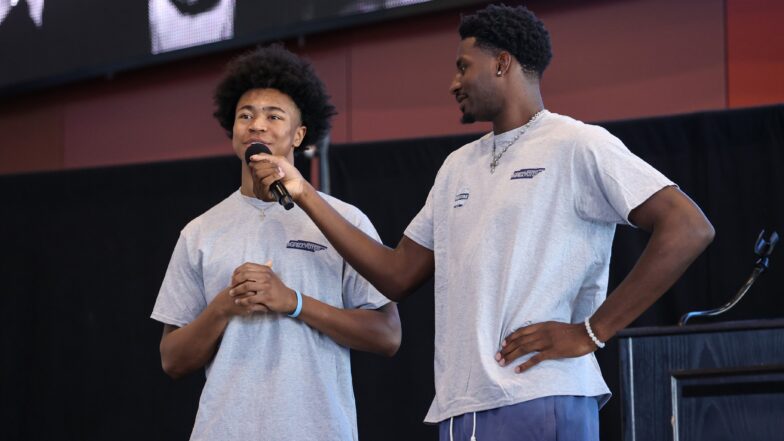
During his rookie season, Jaylen Wells partnered with Jaren Jackson Jr. at a community veteran event.
“I had two people,” Wells said. “Marcus Smart, before he was traded, was huge. He obviously is such a great defender and was always giving me tips. He always had my back on the refs, if one might have given me a bad foul.
“And Jaren [Jackson Jr.] helped me on and off the floor. He even bought me a camera, bought me a lens, the whole set-up just because I told him how much I liked photography.”
Charlotte harvested a bumper crop of rookies last June, with each – Kon Knueppel, Ryan Kalkbrenner, Sion James and Liam McNeeley – filling different roles in the Hornets’ improvement. The team’s veterans haven’t asked too much of them, while the new guys have gladly obliged with some small chores.
“The rookies we have are so humble,” forward Grant Williams said. “You can tell a lot about your rookies when they show up and they’re willing to do their rookie duties. Every single one of them, even Kon, being the fourth overall pick, will smile through it. This next generation we’ve drafted, one thing they’ve shown is coachability.”
Williams, Pat Connaughton and Mason Plumlee are relative elders in the Charlotte locker room, yet not long removed from their own lessons and duties.
“I was taught,” said Williams, 27. “That’s the benefit of playing those years in Boston and having a lot of great veterans. I give credit to Kemba Walker, who’s on our [Charlotte] staff now. Even Al Horford in my second year.
“I had Daniel Theis. Dan took care of me that entire rookie year. And anywhere I went, [the veterans] didn’t make me pay. I’ll remember to this day the last dinner we had was in Miami. I told ‘em, ‘Y’all been great to me. Please, I’ll take care of the wine tonight.’
“I knew nothing about wine. I was a 21-year-old kid, just guessing. I told the server, ‘Your most expensive wine, give that to me.’ So, I got this $2,000 bottle of wine. After the dinner was over, I went for the bill. But Theis smacks my hand away.
“‘You don’t pay for anything, you’re my rook.’ I said, ‘No, no, please.’ He looked and said, ‘Damn, you ordered a $2,000 bottle of wine!?’ But he still paid for it. I’m the one paying now, so I hope these rookies pass it along to the next generation of guys when they’re the vets.
***