
I am fascinated by the fact that I can read the same Torah portions every year and find new nuances and lessons depending on what I’m working on or thinking about at that particular time. The words of the parsha don’t change, but my mindset or perspective can certainly be different.
For the past several years, I have worked with many congregations on alternative dues models, fundraising, financial sustainability and internal controls. When we read the Torah portions about building the Mishkan (Tabernacle), the details can be somewhat overwhelming and even boring, but I have actually found valuable lessons in the text applicable to the financial management of our synagogues. I’ve listed 10 of these lessons below, including the relevant text and a brief explanation of the text’s application to today’s synagogue landscape.
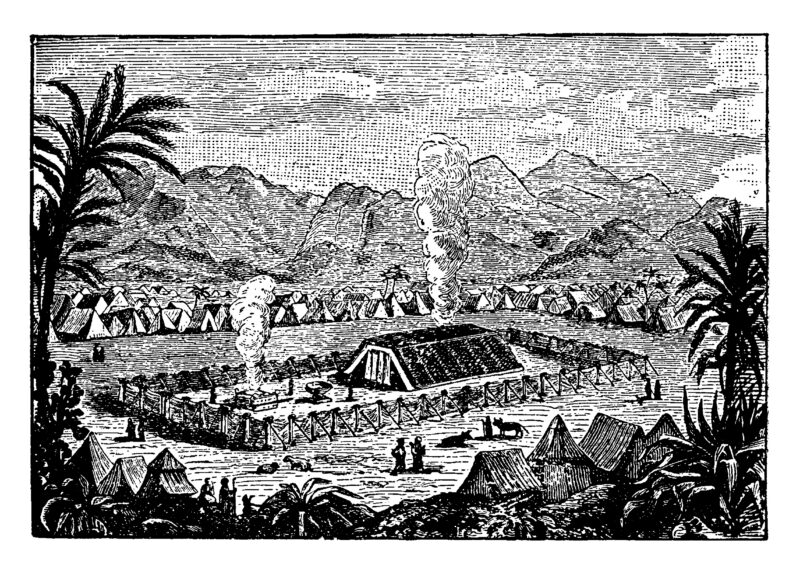
Illustration of the Tabernacle.
Lesson 1: Capital and development campaigns are most effective when people are inspired to give voluntarily.
“Take from among you gifts to God; everyone whose heart is so moved shall bring them — gifts for God.” (Exodus 35:5)
An important lesson about development that I have learned over many years is that people give to institutions and causes that matter to them. If they are approached and the ask feels more like a demand or a tax, they are less likely to respond generously; when people pledge on their own, they are generally much more philanthropic. Our job is to help connect our potential donors to our synagogues in a way that encourages their strong financial support.
Lesson 2: One size doesn’t fit all — give donors options.
“… gold, silver and copper; blue, purple and crimson yarns, fine linen, and goats’ hair; tanned ram skins; tachash skins, and acacia wood; oil for lighting, spices for the anointing oil and for the aromatic incense; lapis lazuli and other stones for setting, for the ephod and the breastpiece; and let all among you who are skilled come and make all that God has commanded.” (35: 5-10)
The Israelites received no shortage of options for possible donations to the Mishkan. We see that giving people choices of materials and price points allowed everyone to participate in building the Mishkan, provided they were interested.
Don’t be overly restrictive in your giving options, as that can alienate some of your donor base. Let everyone feel good about being part of the process.
Lesson 3: Discretionary money and discretionary resources are needed and welcomed.
“… the Tabernacle, its tent and its covering, its clasps and its planks, its bars, its posts and its sockets; the ark and its poles, the cover, and the curtain for the screen; the table, and its poles and all its utensils, and the bread of display; the lampstand for lighting, its furnishings and its lamps, and the oil for lighting; the altar of incense and its poles; the anointing oil and the aromatic incense; and the entrance screen for the entrance of the Tabernacle; the altar of burnt offering, its copper grating, its poles, and all its furnishings; the laver and its stand; the hangings of the enclosure, its posts and its sockets, and the screen for the gate of the court; the pegs for the Tabernacle, the pegs for the enclosure, and their cords; the service vestments for officiating in the sanctuary, the sacral vestments of Aaron the priest and the vestments of his sons for priestly service. So the whole Israelite community left Moses’s presence. And everyone who excelled in ability and everyone whose spirit was moved came, bringing to God an offering for the work of the Tent of Meeting and for all its service and for the sacral vestments.” (35:11-21)
While a tremendous amount of raw materials were donated to build the Mishkan, Moshe also needed volunteers with specific skill sets.
We should never overlook the fact that some people have more discretionary funds and are willing and able to be more philanthropic. Others might not have the same financial capacity, but are willing to share their discretionary time and professional skills, which can also be very valuable.
Lesson 4: Be aware of donor burnout.
“Every single one of the artisans who were engaged in the tasks of the sanctuary came from the task in which they were engaged, and said to Moses, “The people are bringing more than is needed for the tasks entailed in the work that God has commanded to be done.” (36: 4-5)
When you have met and exceeded your goal, know when it’s time to stop. I know it sounds like a foreign concept, but most successful campaigns and fundraising projects have starting points and end dates.
When we keep repeatedly asking for donations from the same group, we risk donor burnout and fatigue, no matter how passionate and supportive the donor or member might be. And of course, don’t forget to say thank you!
Lesson 5: When the building stops, the giving stops.
“Moses thereupon had this proclamation made throughout the camp: “Not a single man or woman should make further effort toward gifts for the sanctuary! So the people stopped bringing.” (36:6)
Note the language Moses uses here. He doesn’t ask the people to stop donating; instead, he asks them to stop doing the work. (Here’s one more important lesson about timing: Once the construction is finished and you’ve moved into your new facility, contributions will slow to a trickle.)
Lesson 6: Contingency planning for extra maintenance expenses is very important.
“Their efforts had been more than enough for all the tasks to be done.” (36:7)
When the builders say to Moses v’hoter, which translates to “more than enough,” they are in effect saying “We have all that we need to build the Mishkan, and extra.”
Over the years, I have often seen synagogues conduct major capital and renovation campaigns without budgeting for contingencies or maintenance. Significantly, Moses didn’t tell the people to stop giving until there was enough material to build the Mishkan plus extra for maintenance and repairs.
Lesson 7: Transparency is very important.
“These are the records of the Tabernacle, the Tabernacle of the Pact, that were drawn up at Moses’s bidding — the work of the Levites under the direction of Ithamar son of Aaron the priest.” (38: 21)
This verse may record the Israelites’ first internal audit. According to the midrash, Moses insisted on a complete accounting and audit of everything collected for the Mishkan campaign. Our sages imagined that the people were gossiping about Moses, saying, “Moses looks well-fed. He must be dipping into the money from the campaign.” and that the audit was a way he might have countered such false rumors.
False rumors can easily start in congregations when there is no transparency. In addition, many donors today want to know how money is to be spent before they give. Being open, organized and transparent with regular accounting is therefore very important.
Lesson 8: Always use two signatures.
From this same verse, we learn that Moses was smart enough to know he shouldn’t do the counting and audit of the Mishkan capital campaign funds by himself. He had Itamar, one of Aaron’s sons, do the audit with him. It is never a good idea to leave all of the accounting, reporting and reconciliation to one person.
Lesson 9: Every gift and volunteer hour is appreciated, important and needed.
“And when Moses saw that they had performed all the tasks–as God had commanded, so they had done — Moses blessed them.” (39:43)
When he saw that all the work had been completed as requested and that everything was beautiful, “Moses blessed [those who participated in the effort].” What a wonderful sentiment. A lot of time, money, skill, and effort went into the completion of the Mishkan, and Moses was grateful and appreciative. He blessed the people. He thanked them for a job well done!
Never forget to appreciate and thank your donors and volunteers. Failure to do so can lead to a donor’s alienation and a sense that their generosity is being taken for granted by the congregation.
Lesson 10: Develop and identify your potential volunteer base.
See text for Lessons 2 and 3, above.
Frequently, people wonder about the workers who helped build the Mishkan. How did the people develop all of these skills, given their status as slaves in Egypt?
Against all odds, it would seem, people stepped forward to perform all kinds of work needed, from metalwork to weaving.
We often never know or realize the skills that many of our members have and could contribute to the congregation. We should always be on the lookout for prospective volunteers, monitoring the members of our community to identify those with skills who may be able to help! Almost everyone has the capacity to be a productive volunteer in some way. Just as important, remember that the skills people possessed when they first joined our communities may evolve considerably as they age, change careers or develop new interests and passions.
I hope that as you listen and learn about the building of the Mishkan and especially the parshiyot of Vayakhel and Pikudei, you will recognize these lessons and how they can assist you as a leader in your synagogue or institution.
Barry Mael is the senior director of synagogue affiliations and operations for the United Synagogue of Conservative Judaism.