
With new partnership between the league and NBC, workflows distinguish more between live, broadcast sound
There’ll be a lot new for the 75th NBA All-Star Weekend (Feb. 13–15, NBC) at the Intuit Dome in Inglewood, CA, starting with the broadcaster. This year, the event comes to NBC even as the Peacock network is up to its tail plumage in other stuff, such Super Bowl LX last Sunday and the Winter Olympics, during which NBA All-Star gives viewers a sort of sports-media palate cleanser. It’s a period NBC is referring to internally as “Legendary February” — part of an $8 billion string of high-profile live television events to maintain broadcast sports’ critical relevance in the streaming era.
Big Game, Big Sound
“It’s a big game, and the entertainment part of the package has to match that in production values,” says Mark Dittmar, VP, Firehouse Productions, which has handled the game’s live sound, comms, and wireless-RF management for more than a decade.
Like every major sports event these days, the NBA All-Star Weekend has a major entertainment component. Like the Super Bowl, the NBA event will have a halftime entertainment production. Firehouse Productions will provide the in-venue sound for the entire production, including the Celebrity Game, Rising Stars, Slam Dunk, a 3-Point contest, and the main game on Sunday featuring three teams — two U.S. and one international — in a round-robin tournament.
The music will be just as densely packed as the Super Bowl’s. Shaboozey, Ludacris, and CORTIS are set to headline the All-Star Weekend music lineup, with a performance by one of them on each of the event’s three days. CORTIS will be the celebrity game’s halftime performer, and John Tesh will reprise his “Roundball Rock” anthem.
Hybrid Sound System
According to Dittmar, this year’s sound system in the venue will be slightly smaller than last year’s, which assembled 114 boxes of JBL VTX PA systems (which Dittmar described at the time as “a beast of a system”), or slightly larger, depending upon how you look at it. That’s due, he explains, to the Intuit Dome’s video halo installation, which serves as the venue’s scoreboard and rings the arena interior, limiting placement possibilities for the temporary flown speakers.
“The halo makes audio coverage very complicated, visually and acoustically,” he says. “Instead of a [central] scoreboard facing out, it’s a giant circle, all facing in. It complicates flying a system because you can’t hang speakers in front of it. It looks amazing, but it is certainly challenging to work with.”
As a result, the temporary music system this year comprises six hangs of eight JBL VTX speaker enclosures each, strategically located and positioned for coverage. It also connects with the venue’s existing installed sound system, with its 18 clusters of six JBL A8 speakers each, creating a total box count of 156. The design extends each hang vertically, and the boxes’ waveguides will be tuned to broaden their lateral reach. The system will also use the venue’s existing installed subwoofers.
The NBA usually mandates an 86-dB maximum for arena sound-pressure levels (SPLs). This year, Dittmar says, there’s some flexibility in that number, since many of the loudspeakers will be farther away from the seating. But any additional SPL does not come at the expense of speech intelligibility, he emphasizes.
“It’s all in how you design the system,” he explains. “Where you place the speakers, how you tune the system — it all still relates to intelligibility, which is a huge focus for us.”
He notes that the increased SPL will make achieving intelligibility slightly easier, including for the few times during play that an official uses the house PA for announcements from the courtside officiating table. “When we are forced to be quieter, when we’re closer to the level of the audience, that makes it harder to have good intelligibility because you’re closer to the noise of the audience.”
Nearly 1,000 channels of audio will be delivered for domestic and international versions of the shows and games, including wired and wireless microphones, comms, and music-specific channels, such as for track playback, which are integral to hip-hop performances.
“There is the game show that is doing a mix, there is the studio show that is doing a mix,” he points out. “There is not one central mix that goes out. There are lots of different shows, all with independent mixes.”
The house mixes will be done through DiGiCo live-sound consoles, which will handle music in the venue; a Yamaha PM10 console will be used for production mixing there. The broadcast music mix will be done on the Music Mix Mobile truck’s 48-fader Lawo mc²56 console, the same one used for the Grammy Awards on-air mix.
New Network, New Workflow
Whereas the Super Bowl consolidates its entertainment into a tight 13 or so minutes, the NBA All-Star Weekend spreads its out.
“These aren’t long performances, a few minutes each,” says Dittmar. “Part of the challenge in this show is the speed at which things move. The rehearsals are especially challenging because we are often moving out of order within the day, and we have three days of events and three days of show.
“On Wednesday, for instance,” he continues, “we might rehearse two Sunday elements, a Saturday element, and a Friday element. We just have to be set to rehearse anything at any time.”
Fortunately, the shift to NBC has streamlined the production workflow considerably, even as the headcount has increased.
“NBC is doing things quite differently,” Dittmar says. “It has increased the number of users in the venue — producers, audio people, etc. — but has decreased the number of trucks, and that has cut the user count down quite a bit. Workflows that were shared are now split up.
“This is our first year,” he continues, “and we’re sort of feeling out how each other works and what their expectations are. With Turner, we had spent 14 years eliminating redundancies. Now we’re looking at things and sort of deciding what makes the most sense, because the basketball game is only a piece of what goes on here.”
On-Air Audio Changes
On the broadcast side, Ben Majchrzak, who had done plenty of NBA on Bally’s and other RSNs, is in his first year as A1 for NBC’s return to the court, working from NEP Supershooter 10’s Calrec Argo desk. He’s backed by submixer Jeremy Katz aboard Supershooter 4 on a Calrec Apollo, with Aaron Lang managing RF audio, assisted by Rick Newstreet.
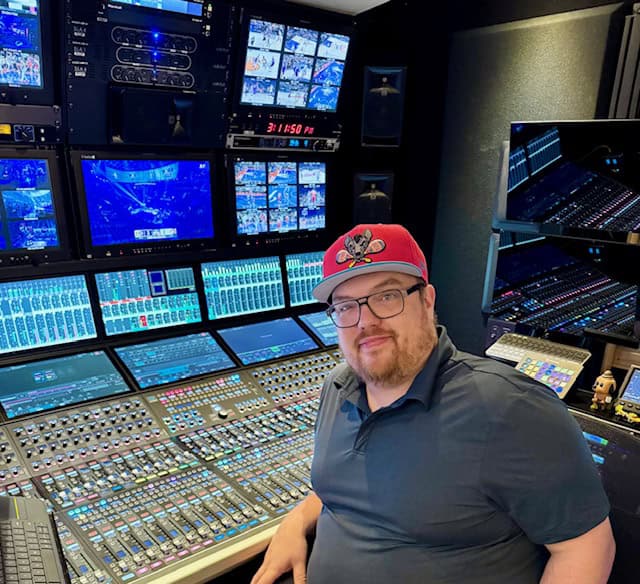
“I think the biggest challenge is the difference between the way we’re doing this and how Turner did it,” says Majchrzak (pronounced “MAY-zak”). “Turner would bring in an entire truck just for the Skills competition on Saturday. It’s much more of an entertainment show than it is a game, so trying to design a show in which the mics on the court can help us in both ways has been a challenge.
“We’re also working on figuring out placement for some of the [Q5X] PlayerMics that we won’t need on Saturday to use in other ways,” he continues. “We might, for instance, put them on the ball racks for the Shooting Skills competition. The challenge has been finding the right design that works for what’s essentially a chameleon between a game and a skills exhibition. It’s our first time doing it, so we’re excited.”
Other workflow changes include signal-path directionality. Majchrzak notes that, in the past, Firehouse Productions would build the audio booths for the show and hand them to Turner’s A1, and the audio would route to Atlanta.
This time, he says, it’s all NBC’s infrastructure. “We’re building and controlling everything that’s ‘ours’ and distributing only what is needed elsewhere, essentially.
“It’s one booth for every show, one truck for every show,” he continues. “Turner had multiple trucks: Friday night, Saturday night, Sunday night were all different trucks and different A1s. This year, we’re handling all our talent mics, handling the player mics, anything that hits our air. It’s more of an NBC world, with more need for control in terms of where sources are. That way, it’s always our people and our workflow, which helps for troubleshooting as well.”
SFX Audio
Viewers will get plenty of close-up sound. In total, a dozen PlayerMics will be deployed: six on players (two on each of the three teams), three or four on officials, and the rest as spares. The network will be testing a newer version of that now-foundational transducer that has been used on NBA players for over a decade. At Friday night’s Rising Stars game, a lavalier and an IFB on players and coaches will enable two-way conversations between the court and NBC announcers.
More SFX will come from more than two dozen microphones around the court. They include AKG C411 contact microphones on the backside of the boards, for a stereo image there, and some Dante-connected Audio-Technica AT-ND971 PCC transducers, which are in beta stage, on the near side of the court. A pair of Sennheiser 416’s, deployed as main-lane mics, will catch players as they drive down the court.
Underscoring NBC’s ambitious audio effort, Majchrzak says, the mics are all part of its regular-season kit, with an additional pair of Sennheiser ME66 shotgun mics placed behind the baskets to establish a wide audio key that reaches to the three-point line.
“With that, we’re trying to capture the three-point shooting and a little bit more, just to make the field of play feel a little bit bigger,” he says.
Turner/TNT’s various broadcast-sports iterations were the on-air home to the league and its annual midseason event from 1989 to 2025 — literally, the network’s longest-running regular program — even as the All-Star Game grew from an evening’s match into a three-day weekend event. This edition has a “global” cachet, featuring a new “U.S. vs. World” format.
Adapting to new workflows might have been complicated by NBC Sports’ brutal broadcast schedule in Legendary February, but Dittmar says the new partnership has gone smoothly.
“As much as I thought it would have been overwhelming [for them], their people are on it. It is impressive,” he says, adding, “I’m sure they haven’t slept in a couple of weeks.”