
My alarm went off at 5 a.m., which is not a time I usually greet with enthusiasm.
As I reached the windward slopes of Mauna Kea, dawn was just breaking. Mist hovered in the grass, and ʻōhiʻa trees rose into a clear blue sky. The grass was cold from the night. No traffic, no machines, no distant leaf blowers.
Just birds.
The sound came first — a chorus of native birds echoing through the koa trees. It was exactly as Patrick Hart described in the opening of the documentary Na Leo O Hakalau: “When you hear the chorus of birds, the dawn chorus at Hakalau, that’s probably the closest you can get to what Hawai‘i used to sound like.”

Ideas showcases stories, opinion and analysis about Hawaiʻi, from the state’s sharpest thinkers, to stretch our collective thinking about a problem or an issue. Email news@civilbeat.org to submit an idea or an essay.
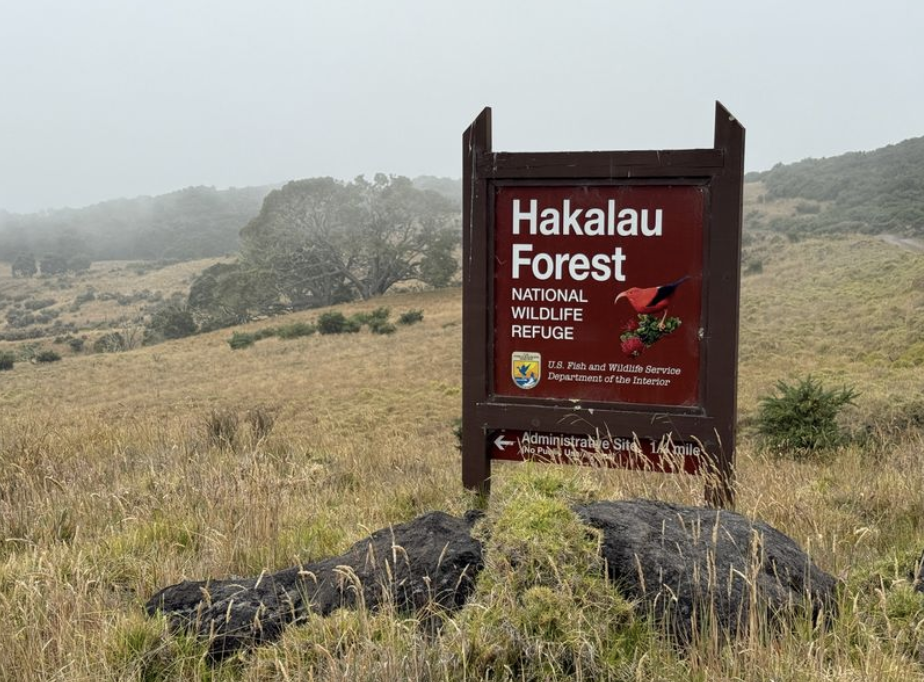
Hakalau Forest National Wildlife Refuge is a rare sanctuary on Hawai‘i island, where decades of community-led reforestation have restored habitat for some of the world’s rarest native birds and plants.
Standing with my small party of four, listening to the living forest — proof of successful preservation — felt magical.
I quickly discovered I’m not a patient birder. Within minutes, I was fiddling with binoculars, distracted from actually searching for birds.
And yet, even I saw them.
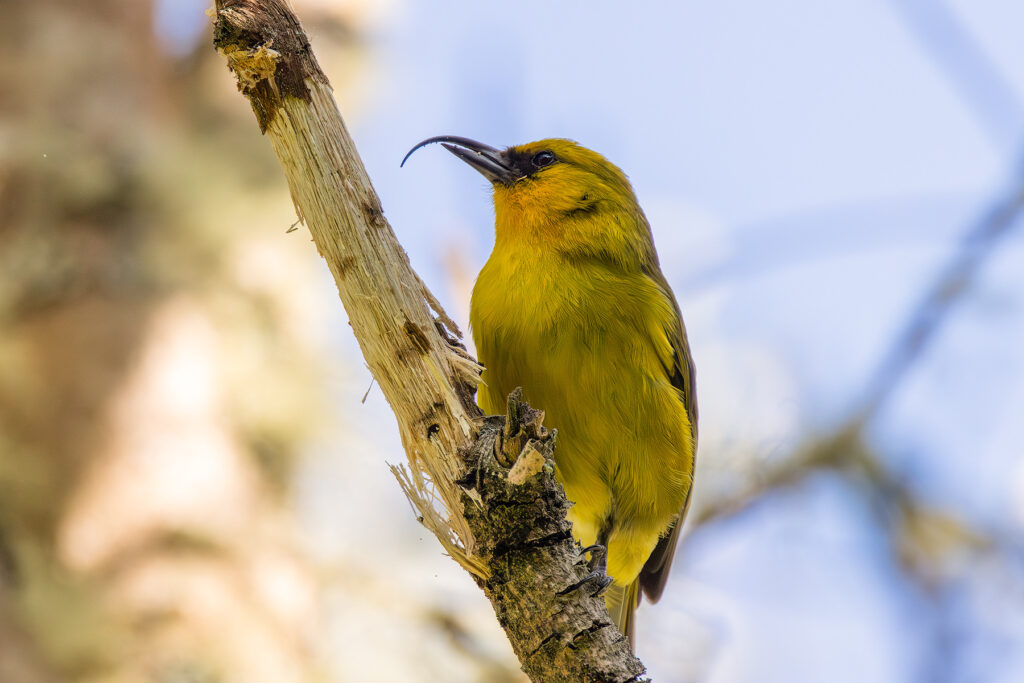
A flash of red against the dark canopy. The ʻiʻiwi’s curved beak distinguished it immediately. Later, a bright Hawaiʻi ʻamakihi darted between blossoms. Someone had spotted an ʻakiapōlāʻau earlier—a bird whose mismatched bill seems fictional until you see it.
Its lower bill is straight and strong, used to chisel bark; the upper is long and curved, for probing and hooking larvae. This specialization exists nowhere else — and requires a healthy, native forest.
That is the quiet power of Hakalau Forest National Wildlife Refuge.
We are used to climate stories that feel overwhelming. Sea level rise. Drought. Wildfire. The slow march of extinction statistics. And, Hawaiʻi has the unfortunate distinction of being the extinction capital of the United States. According to the U.S. Fish and Wildlife Service, Hawaiʻi once had roughly 142 endemic bird species. Nearly 100 are already gone. Of those that remain, most are threatened or endangered.
It is easy to hear those numbers and feel helpless.
Peter Stine, who helped design the refuge in the 1980s when he was the endangered species recovery coordinator for the U.S. Fish and Wildlife Service, described Hawaiʻi to me as a global “poster child” for endemism and suggested that Charles Darwin would have “skipped over the Galapagos” entirely if he had visited Hawaiʻi because he would have found “greater, more impressive examples of speciation.”
Species here evolved in isolation, without predators, without grazing mammals. Honeycreepers radiated from a single ancestral finch into nearly 60 distinct species. And then we introduced pigs, cattle, rats and mosquitoes.
“Invasive plants and invasive animals are working 24/7,” Stine said. “We can’t relax.”
Hakalau exists because people refused to.
The refuge was established in 1985 after surveys revealed that some of the last remaining populations of critically endangered birds were clustered on private ranch land owned by the Shipman family. The recovery plan was clear: protect habitat, or lose the birds.
So federal agencies partnered with The Nature Conservancy, worked with willing landowners, secured funding with the support of the late Sens. Daniel Inouye and Daniel Akaka, and acquired the land.
That was the beginning.
Since then, over 600,000 native plants have restored 12,000 acres of pasture. Remote sensing shows the koa canopy recovering. Native birds can’t survive in the invasive gorse overwhelming the mountain. They need koa and ʻōhiʻa trees, which restoration has focused on.
In addition to replanting the forest, fences now stretch for miles to keep out feral pigs and cattle. Staff inspects them monthly.
The work is relentless because the threats are relentless.
Jack Jeffrey, a wildlife biologist and photographer who’s spent 50 years observing Hawai‘i’s birds, joined the original surveys in the 1970s and later became the refuge’s biologist. He described the grazed land as “a giant salad bar.”
Cattle and pigs stripped the understory. As temperatures warm, mosquitoes now bring avian malaria into higher elevations that were once safe for birds.
Jeffrey calls this the “vertical battle.” In the 1970s, mosquitoes carrying avian malaria were rarely above 3,000 feet, creating a natural safety zone in the cool, high air.
“Slowly, that zone of death is moving uphill,” Jeffrey told me. Today, mosquitoes are found between 4,500 and 5,000 feet. On islands with lower mountains, like Kaua‘i, the disease “overtopped” the peaks, wiping out species with nowhere left to go. Hakalau’s elevation keeps it a fortress — for now — but the disease line is rising.
And yet.
“We used to see one or two Hawaiʻi creepers in a day,” Jeffrey said. “Now we might see 15.”
Hakalau is not a fairy tale. It is a management strategy. It is fencing, eradication, propagation, monitoring, budget requests, and volunteer weekends. It is also, increasingly, proof.
Unlike most places where birds decline, Hakalau has seen stabilization and even increases. Jeffrey calls it one of the few places with “population turnarounds.”
But success is fragile.
“The funding goes up, staff goes up, pigs go down,” he told me. “Funding goes down, staff goes down, pigs go up.”
Eradicating pigs is expensive. “The first pig is cheap,” Jeffrey said. “The last pig might cost you $100,000.”
That isn’t hyperbole. That’s what it costs if we don’t consistently maintain progress — and funding.
To buffer against unpredictable federal budgets, Friends of Hakalau Forest created an endowment. As Stine, now their president, explains: “The endowment is meant to be able to provide a steady, reliable stream of support funding on an annual basis to address whatever the most critical needs are.” They hope to reach $3.5 million this year to start dispersing funds.
The goal: keep fences maintained, invasives controlled, and restoration moving even when politics shift. Because if we step back, the forest won’t pause. Invasives don’t take a funding holiday.
There is something psychologically important about standing in a place like Hakalau.
We are saturated with narratives of decline — climate change accelerating, biodiversity loss compounding, the window closing.
All of that is true. And it is also true that intervention works.
When I stood under those lichen-draped trees and heard the dawn chorus, I was not hearing nostalgia. I was hearing policy, philanthropy, science and community effort translated into sound.
Hakalau does not erase the extinction crisis. It does not solve avian malaria. It does not eliminate climate change. What it does is demonstrate that restoration is possible at scale when we commit to it.
If we want Hawaiʻi’s forests to keep singing, we cannot treat places like Hakalau as finished projects. They are ongoing commitments. They require funding, volunteer energy, and attention — even from impatient birders like me.
Civil Beat’s coverage of environmental issues on Hawaiʻi island is supported in part by a grant from the Dorrance Family Foundation.
