

The eastern part of the Mediterranean has entered a phase of deepened geopolitical reconfiguration. The arrangement, which initially functioned as a pragmatic and ad hoc cooperation between Cyprus, Greece, and Israel, is gradually evolving into a multidimensional agreement of growing strategic significance.
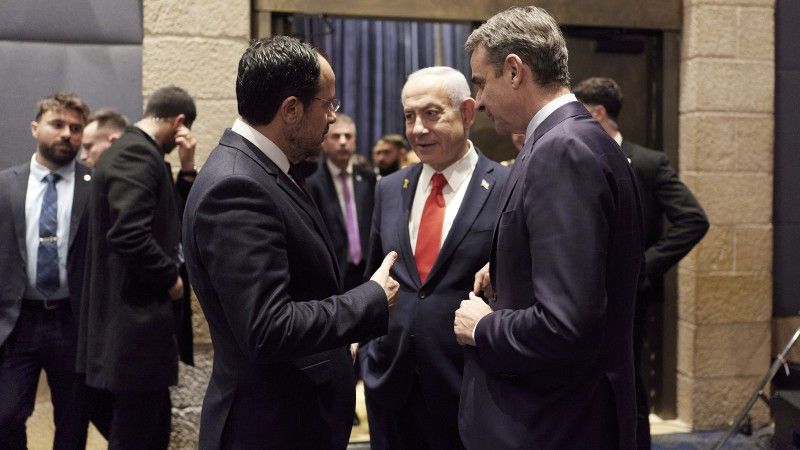
Photo. Prime Minister GR / X
Ankara increasingly interprets this process as part of coordinated transnational activity, potentially aimed at Turkish regional interests. The latest agreements, combined with the implementation of multi-billion defense contracts, indicate a systemic shift towards the creation of an interoperable security bloc capable of responding to both conventional and asymmetric threats.
On December 22, 2025, the tenth trilateral summit was held in Jerusalem. Prime Minister Benjamin Netanyahu hosted Greek Prime Minister Kyriakos Mitsotakis and Cypriot President Nikos Christodoulides in Israel. The meeting aimed to revive and deepen the existing mechanisms of cooperation. Although it did not lead to the formal creation of a military alliance, the agreement on joint military exercises announced on December 29 had strategic significance that went beyond its declarative nature. It marked the normalization of a cooperation axis, integrating defense planning, energy coordination, diplomatic collaboration, and, what seems crucial, a convergent perception of threats.
This initiative is simultaneously part of the development of the existing Mediterranean security framework in the „3+1” format with the United States, functioning as an informal energy-defense partnership between the three regional countries and Washington. Cooperation within this arrangement currently includes joint naval exercises, the transfer and sharing of defense technologies, and counter-terrorism programs.
From the perspective of countries sharing maritime space in the eastern Mediterranean, it is hard to overlook the fact that the deepening coordination also has a reactive character in response to Turkey’s strategy of expanding maritime claims, formulated within the framework of the ”Blue Homeland” (Turkish: Mavi Vatan) doctrine. It envisages the expansion of Ankara’s sovereign ambitions in the Aegean Sea and the Mediterranean Sea, as well as the projection of power through the deployment of armed unmanned systems and maintaining an extensive military presence in Northern Cyprus.
Intensification of cooperation
The roots of the Cyprus–Greece–Israel triangle date back to the period preceding the current regional crisis. Initial cooperation, developed in the early 2010s, was largely driven by the discoveries of energy deposits in the eastern Mediterranean and the deterioration of Turkish-Israeli relations – which remains one of the key determinants of today’s rapprochement. Over time, however, this cooperation has evolved, clearly going beyond the narrowly understood energy dimension and encompassing security issues.
Both Greece and Cyprus attach great importance to their partnership with Israel, seeing it as one of the key elements of their own strategic security. This was evident even during periods when the country was under strong international pressure due to its actions in the Gaza Strip. However, the decisive period came after the Hamas attack on Israel on October 7, 2023, and the subsequent war in Gaza. Unlike most European Union member states, which took a critical stance toward Israel, Athens and Nicosia opted for a more moderate and balanced approach. Greek Prime Minister Kyriakos Mitsotakis was able to effectively fend off criticism from the opposition, including comments from Nikos Androulakis, the leader of the main opposition party PASOK.
However, these exceptionally close relationships between the governments of the three mentioned countries were not limited solely to their response to the conflict in Gaza. During the Israeli-Iranian war in June 2025, Greece and Cyprus served as key logistical hubs for Israeli civilians who were unable to return to their country. For a time, Israeli commercial planes were also stationed at Greek and Cypriot airports. The subsequent ”Operation Safe Return,” coordinated by all three governments, strengthened operational-level trust, which then translated into specific procurement decisions and further planning of a joint regional security architecture.
The Greek and Cypriot refusal to join in the harsh condemnation of Israel in any of the cases described above was not the result of ideological motivations, but rather the outcome of cool strategic calculation. The pragmatic approach of Athens and Nicosia toward Jerusalem—both during the Gaza war and the Israeli-Iranian conflict—primarily served to advance their national interests. Both countries seek to deepen cooperation with Israel’s defense and energy sectors, viewing Israel as a key partner in long-term stabilization and balancing the power structure in the eastern Mediterranean.
Defense
In the defense sector, Greece and Cyprus have for years looked favorably at the Israeli arms market, seeing it as an attractive and reliable source of military capabilities. Athens is currently finalizing an agreement with Israel to purchase 36 PULS rocket artillery systems worth $757.84 million, which has been approved by both the parliament and the Government National Security Council.
Almost simultaneously with Ankara’s announcement of the „Steel Dome” concept, Greece revealed its own multilayer air defense project called „Achilles Shield,” which can be interpreted as a response to Turkish actions. As part of this project, Athens is negotiating with Israel for the purchase of medium- and long-range air defense and missile systems, as well as solutions designed to counter unmanned aerial systems. The entire program, also referred to as Ash Angeles, is estimated to cost around 3 billion euros (3.5 billion dollars).
The key objective of Greek-Israeli cooperation remains interoperability, including regular joint exercises, particularly in disputed maritime areas where Greek-Turkish tensions remain high. In this context, Greece seeks to impose a 12-mile limit and extend its maritime jurisdiction, citing the UN Convention on the Law of the Sea, which is at odds with Turkey’s „Blue Homeland” doctrine. In an escalation scenario, Athens assumes the possibility of blocking the actions of the Turkish navy and drilling units, with the assumption of support from the Israeli air force. In Athens« plan, expanding international cooperation in a trilateral format (Greece–Israel–Cyprus) is intended to strengthen collective deterrence.
Cyprus has taken a similar path, implementing (according to media reports) the Barak MX air defense system produced by Israel Aerospace Industries, and also considering further purchases to modernize the National Guard.
The joint air and naval exercises planned for 2026 are intended to further improve interoperability and the ability to respond to both »symmetric« and »asymmetric« threats. These phrases leave no doubt as to the perceived source of risk.
Perception of regional threats
In the past, Greek-Israeli maneuvers conducted in the area between Israel and Crete allowed Israeli pilots to train in bombing and aerial refueling over distances corresponding to those between Israel and Iran’s uranium enrichment facility in Natanz. Cooperation with Greece enables Israel to conduct long-range operations training under conditions similar to potential scenarios against Iran, while Cyprus serves as an advanced logistical and surveillance hub in the eastern Mediterranean. As a result, this arrangement provides Israel with strategic depth, which the country—mainly for geographical and structural reasons—lacks in its immediate surroundings.
For Athens and Nicosia, Israeli technology and operational experience are an important factor compensating for Turkey’s numerical advantage, whose current policy in the Aegean Sea and the eastern part of the Mediterranean, as well as its uncompromising stance on the Cyprus issue, remain a lasting source of mistrust.
Energy and infrastructure
Although the energy dimension still constitutes the structural foundation of trilateral cooperation, the expectations accompanying it have clearly moderated. The return to discussions on the EastMed pipeline, undertaken on the sidelines of the meeting of energy ministers in the „3+1” format in Athens, with the participation of US Energy Secretary Chris Wright, as well as the concept of related subsea connections between Israeli gas fields and Cypriot LNG infrastructure, reflect a joint effort to reduce dependence on Turkish transit routes.
At the same time, Energean, a company conducting drilling operations in Israeli waters, has proposed the construction of an underwater gas pipeline connecting its floating production storage and offloading unit (FPSO) with the planned power plant of Cyfield on Cyprus. According to media reports, the project is expected to cost around 400 million dollars, with an estimated capacity of 1 billion cubic meters of gas per year.
Theoretically, Israel, Greece, and Cyprus are also involved in the Great Sea Interconnector project, but the position of the Cypriot government indicates growing doubts about its economic viability. However, it should not be overlooked that both this project and the previously mentioned EastMed pipeline are costly, technically complex, and increasingly questionable in the context of Europe’s gradually decreasing demand for hydrocarbons. As a result, many infrastructure initiatives in the region are now more a matter of geopolitical statements than actual economic ventures, with their long-term profitability remaining an open question.
An example of such an approach is the India–Middle East–Europe (IMEC) trade corridor, supported by Israel, Greece, and Cyprus, designed as an alternative to transit routes passing through Turkey. However, this project encounters significant limitations already at the planning stage, primarily regarding real and tangible investment commitments, while the Turkish market remains too significant to be permanently overlooked in long-term infrastructure calculations.
In summary, although initiatives of this kind do not have a direct impact on the current situation in the region, their symbolic dimension retains significant political importance. From Ankara’s perspective, any such initiative that alters the regional connectivity structure while bypassing Turkey reinforces the narrative of a strategic »encirclement.« In this view, cooperation between Cyprus, Greece, and Israel is seen not as a defensive project but as a revisionist endeavor. Turkish officials and pro-government media consistently describe this arrangement as a clearly anti-Turkish formation, reinforced by support from the United States and the broader Western security architecture.
The exclusion of Turkey from the EU’s SAFE defense funding mechanism has further intensified this narrative. Although this instrument – which should be clearly emphasized – formally applies only to EU member states (with certain exceptions), Ankara interprets its exclusion as a politically motivated decision, largely driven by opposition from Greece and Cyprus stemming from unresolved disputes over the Aegean Sea, the Cyprus issue, and maritime jurisdiction.
Indirect effects
While the spokesperson of the Turkish Ministry of Defense, Zeki Akturk, downplayed the significance of the trilateral format, claiming that it does not pose a military threat to Turkey, pro-government media in Ankara consistently sounded the alarm about the growing phenomenon of strategic »encirclement.« This discrepancy between the official message and the media narrative reflects a broader tension in Turkey’s perception of the developing Israel–Greece–Cyprus axis.
In the diplomatic dimension, Ankara seems to seek to undermine the cohesion of this bloc by normalizing relations with Egypt and strengthening cooperation with Libya, Syria, and Lebanon. These actions fit into a broader Turkish concept of counter-encirclement, based on the doctrine of strategic depth (Turkish: Stratejik Derinlik), which became one of the key pillars of Turkish foreign policy as early as 2000–2010. Instead of direct confrontation with the tripartite axis, Turkey aims to expand its own presence and influence in the region, thereby forcing Greece, Cyprus, and Israel to take the Turkish factor into account across multiple arenas and theaters of action simultaneously.
With regard to the recent agreements of this tripartite bloc, it should be expected that Ankara will most likely respond with increased maritime patrols, intensified military exercises, and diplomatic pressure. However, this set of measures increases the risk of accidental escalation in the Aegean Sea or the eastern part of the Mediterranean Sea.
At the same time, deepening cooperation within the Israel–Greece–Cyprus axis may pose a challenge to NATO cohesion, given the fact that Greece and Turkey are members of the Alliance, while Israel remains outside its structures. In the longer term, this dynamic may complicate crisis management mechanisms on NATO’s southeastern flank, particularly in situations requiring de-escalation between allies.
Conclusions: a stable axis or a lasting dividing line?
The Cyprus–Greece–Israel arrangement, although it seems to be gradually maturing into a more structured partnership that goes beyond a temporary convergence of interests, remains constrained by harsh geopolitical realities. Turkey’s demographic potential, its military-industrial capacity, and its geographical location mean that this country cannot be permanently marginalized in regional security arrangements. At the same time, Ankara’s assertive – and sometimes even confrontational – stance paradoxically acts as a factor that encourages further strengthening of cooperation among its neighbors.
The result of all these actions is not, however, a classic balance of power, but a security environment based on multilayered deterrence, encompassing overlapping alliances, competing infrastructure corridors, and parallel, often conflicting visions of the future regional order. In this context, the Cypriot and Greek presidencies of the European Union in 2026–2027 could create space for recalibrating relations in the eastern Mediterranean. This will be particularly important in the context of the EU’s relationship with Turkey, which is increasingly seen not only as a source of tension but also as a potential—even if problematic—guarantor of European security.