
Greece has emerged as a European leader in artificial intelligence adoption among young people. According to Eurostat data released in February 2026, an impressive 83.5% of Greeks aged 16 to 24 used generative AI tools in 2025, placing the country at the very top of the European Union rankings, significantly outperforming the EU average of 63.8%. According to the Eurostat data, young people across the EU are primarily leveraging AI for private purposes (44.19%) and formal education (39.27%) and work (15.77%).
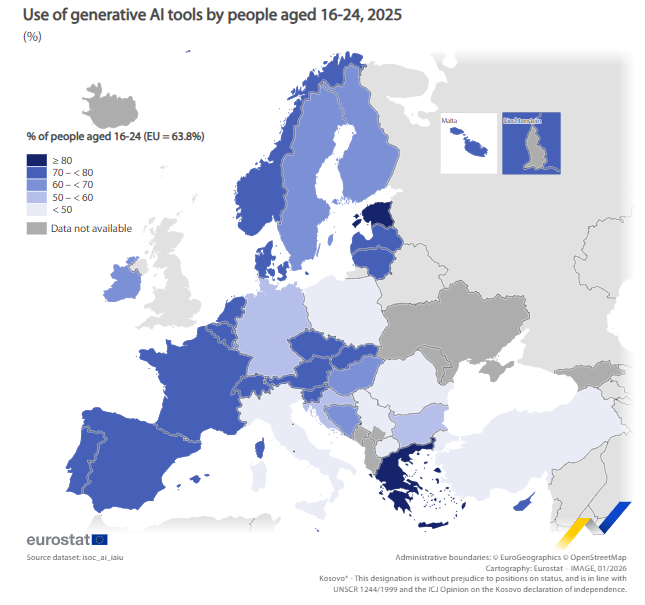
Image Credit: Eurostat
But what looks like a positive story of technology adoption hides a darker side. Heavy use of LLMs, especially amongst young people is correlated with increased loneliness as these tools displace human connections. The tools’ sycophantic nature creates echo chambers, unrealistic real-world expectations and social deskilling, leading to fewer and less fulfilling human connections.
According to an October 2025 survey by the Center for Democracy and Technology, nearly 1 in 5 students have had, or have friend who have had romantic relationships with LLMs. Lastly, there is concern regarding how personal details shared on LLMs by users of all ages are stored, analyzed and used to train AI systems.
Meanwhile Deputy Minister of Development Stavros Kalafatis highlighted Greece’s pivotal role in the global AI revolution, presenting the national plan for innovation, new infrastructure, and the creation of an autonomous Ministry of Higher Education, Research and Innovation.
Speaking at the 9th Thessaloniki Development Conference held last Sunday, Kalafatis detailed the Greek government’s plans that include the Pharos AI Factory and the DAEDALUS supercomputer in Lavrio and the Green Data Center in Western Macedonia.
The Deputy Minister also emphasized the importance of extroversion through strategic collaborations with tech giants such as OpenAI, Google, and Mistral AI, while also referring to support for the EU Inc. initiative facilitating European innovation.