

While fast fashion dominates global markets, a small workshop in the Pindus Mountains of Northern Greece continues to create garments the traditional way—by hand, with careful measurements, and guided by time-honored techniques. In Metsovo, master tailors locally known as “Ellinoraptes” maintain a craft that weaves together ritual, identity, and technical precision, surpassing mere clothing production.
Veteran tailor Evangelos Malambekos, one of the last practitioners of this method in Greece, works alongside his apprentice, Evdokia Bissa, in a studio filled with heritage pieces. The walls display rare handmade garments: a fermeli vest like those worn by the Greek Presidential Guard today, a black-braided vest, sleeveless women’s coats from the Zagori and Kalarrytes regions, and a museum-quality vest fully embroidered in gold thread—what Malambekos describes as the most exceptional piece in the room.
Master tailors of Greece keep Metsovo craft alive
Malambekos began his apprenticeship in 1963 at just twelve years old, training under master tailor Georgios Nakas, at a time when Metsovo supported roughly thirty working tailors. Many of them traveled from village to village, serving remote mountain communities in Greece.
“We walked to Chaliki, a nearby mountain village, two or three hours on foot,” Malambekos told Greek Reporter. Tailors often stayed at clients’ homes until garments were completed. Their work was closely tied to the rhythms of livestock life and the harsh mountain weather of the region, making clothing that was both warm and durable essential.
Raw materials came from local production. Village women processed wool and goat hair on handlooms, producing textiles that kept shepherds protected from freezing temperatures. As Malambekos told Greek Reporter, “The wool worked…that’s why they didn’t get sick easily.”

Symbolism and craft of Metsovo traditional dress
Traditional Metsovo attire is more than decorative. Each garment conveys social status and economic standing within the community. Women’s formal wear typically includes a sleeveless black felt overcoat called a sigkouni, a cotton dress, and a black satin apron. For ceremonial occasions, garments are adorned with gold cords and intricate embroidery—techniques long associated with high-status clothing in Greece’s mountainous regions.
Before white wedding gowns became standard in Greece, brides wore the full Metsovo costume, crafted from velvet and detailed with gold cords. A head covering known as the skepi completed the ensemble, along with long embroidered panels called tzertzefia that extended to the waist.
Men’s attire is more restrained: a black shirt, a pleated fustanella kilt with hundreds of folds, and a wool vest called a tsamantani.
Greece’s gold-embroidered costume of Metsovo that takes forty days to complete
The workshop’s centerpiece is a complete formal women’s Metsovo costume, regarded as one of the most technically demanding traditional garments in all of Greece. Creating a full set requires roughly forty days of continuous handwork. The is composed of specialized elements:
- The “closed” inner velvet dress, sewn entirely by hand
- The outer sigkouni coat
- A heavily gold-embroidered apron, which serves as the visual centerpiece
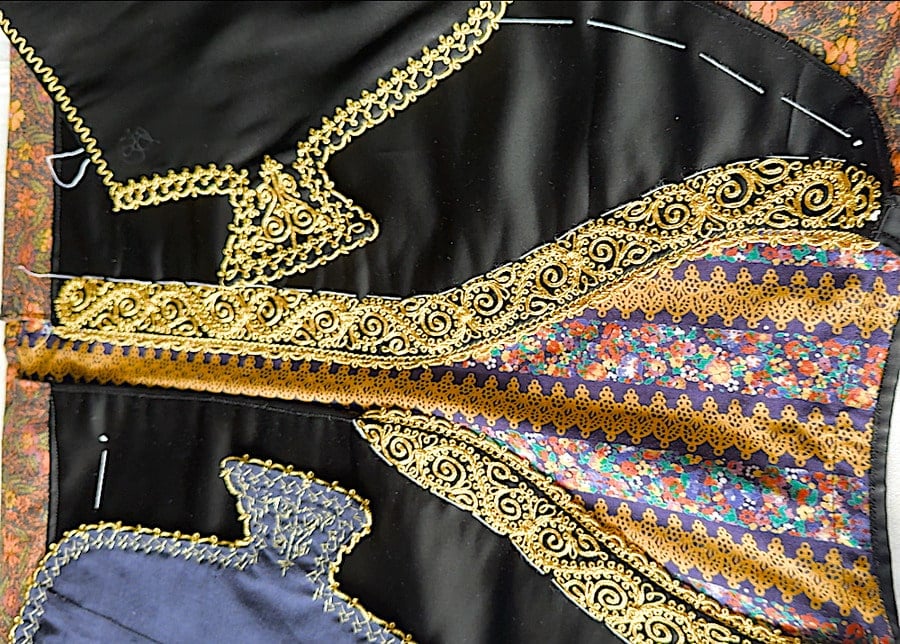
Describing the process to Greek Reporter, Bissa explained that the metallic gold thread is rigid and resistant, making it “difficult to embroider and to pierce.” True craftsmanship is judged from the reverse side of the embroidery, where thousands of tight stitches reveal the labor behind the visible design. Given the time and skill involved, a full formal costume today costs around €4,000 ($4,740).
The severe elegance of men’s black foustanella
The traditional male Metsovo outfit embodies the clean, structured lines characteristic of men’s clothing in many Greek mountain regions. Its most distinctive feature is the black fustanella.
The ensemble typically consists of three to four pieces and is less elaborate than women’s formal attire, with a current value averaging around €1,000 ($1,185). Despite its simplicity, each outfit still demands meticulous construction and careful finishing to meet traditional standards.
A fading craft in Greece and one successor
As one of the last master tailors of Greece’s Metsovo, Malambekos remains deeply committed to the trade, steadfastly preserving every traditional production method. He also noted in speaking with Greek Reporter that state support in Greece for handcrafts such as tailoring and woodworking has historically been limited.
Today, the continuity of this craft depends on knowledge being passed down. His apprentice, Evdokia Bissa, has trained alongside him for three years and demonstrates the same dedication. She told Greek Reporter that “without passion, it cannot be done.” Her skill in producing work on par with older masters suggests that the tradition will endure.
Although modern variations featuring colorful floral motifs exist, Bissa emphasizes that the authentic Metsovo identity is defined by gold thread embroidery and strict adherence to technique. This is not a fast process; each stitch requires patience, precision, and intent.