
A review of the Oklahoma State Department of Education during Fiscal Year 2021 recommended improvements to the agency’s financial reporting system, but it found no misspending under former State Superintendent of Public Instruction Joy Hofmeister, according to State Auditor and Inspector Cindy Byrd.
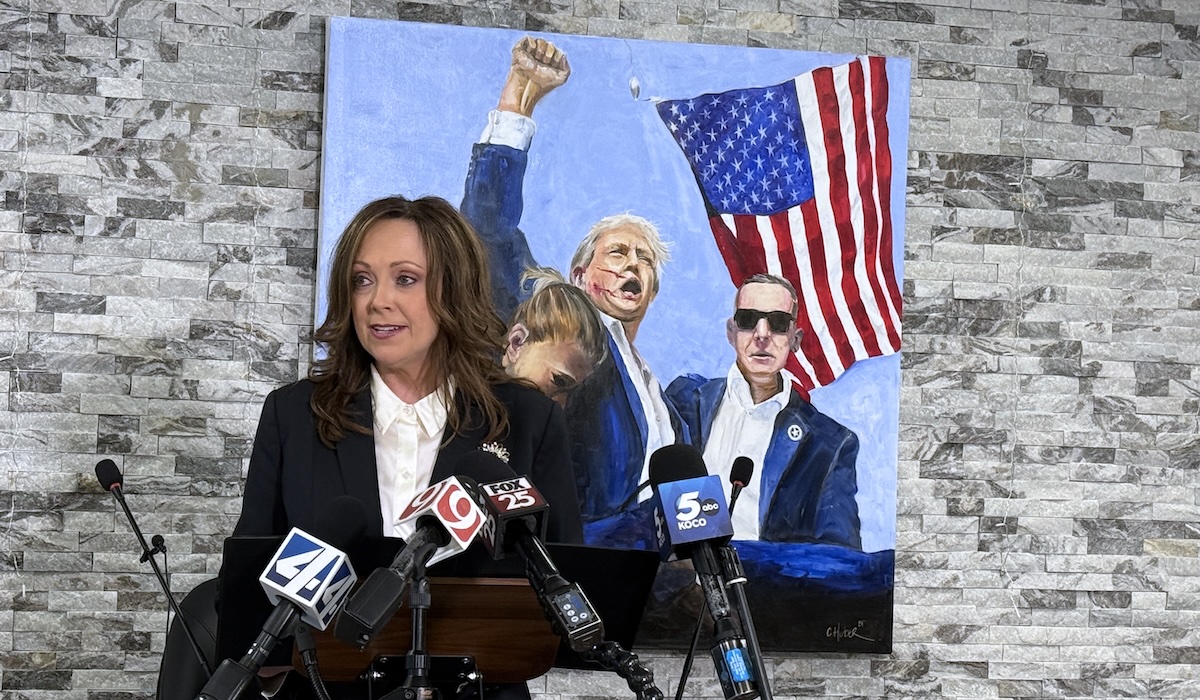
During a Wednesday press conference in an office building owned by current Senate District 24 candidate Robert Keyes, Byrd said she found no indications of financial fraud, but she did identify issues that would require a legislative fix, particularly involving the Oklahoma Cost Accounting System.
“OCAS is not providing taxpayers with the transparency that many people assume it is,” Byrd said. “Oklahoma does not have any effective mechanism to catch financial wrongdoing or excessive administrative spending at the local level.”
Originally requested in September 2021 by Gov. Kevin Stitt, Byrd’s 61-page special audit (embedded below) reviewed only the prior fiscal year, from July 1, 2020, and June 30, 2021.
Byrd said her review covered only 0.21 percent of funds that passed through OSDE during FY 2021, when the unprecedented circumstances of COVID-19 spurred new funding and accounting problems. She said her review also was influenced by findings from her office’s audit of Epic Charter Schools.
Under current financial tracking practices, Byrd emphasized that local misspending is hard to catch. Established three decades ago, OCAS is used by every public school district in Oklahoma to report revenue and expenditures to OSDE.
But Byrd bemoaned the fact OCAS is not able to flag malfeasance, something she said should be a wake-up call in terms of school district oversight.
“Legislators may need to consider establishing strategic training for school boards, so that they can provide the financial oversight that Oklahoma taxpayers deserve,” Byrd said.
Stitt echoed Byrd in a statement.
“OCAS is not giving parents and taxpayers the transparency they deserve,” Stitt said. “It is time to modernize OCAS and put every public school’s checkbook online in one central location so Oklahomans can truly follow the money.”
Hofmeister said the results reflect her team’s integrity, diligence and transparency, as reported by Nuria Martinez-Keel of Oklahoma Voice.
“That result reflects the integrity, diligence, and transparency our team brought to its work every day,” Hofmeister said in a statement. “I appreciate the thorough review by Auditor Byrd, and we’re glad the final report confirms our commitment to responsible stewardship and open government.”
Byrd highlighted three findings from her special audit:
- The role OSDE plays in school finance and a need for “transparency and accountability” at district levels;
- Common misunderstandings about the Oklahoma Cost Accounting System; and
- The need for more guardrails on state appropriations spent by OSDE on line items.
Byrd said there is no way for the state to safeguard against bad actors at the district level, where more than 98 percent of all education dollars are spent.
With approximately $7.6 billion spent on K-12 education annually, she said Oklahoma needs greater transparency and accountability over its appropriations. She added that “almost all of that money is spent” by the 553 school districts across Oklahoma. About $16 million is retained by OSDE for “central operations,” she said.
“Our focus needs to shift to local school boards,” Byrd said.
Despite ongoing concerns, OSDE was in compliance with laws and regulations, Byrd said her team determined.
“Any waste, fraud and abuse in education would likely occur at the local level,” Byrd said.
She identified OCAS’s limitations as a problem worth addressing.
Byrd said many people believe OCAS will catch waste, fraud and abuse, but “it does not.” The system’s primary purpose is to help OSDE comply with federal reporting requirements. The system was never designed to catch fraud, waste or abuse, according to Byrd. She also noted a misconception that OCAS is able to distinguish between administrative and classroom-level spending.
“Here is the problem. OCAS is a self-reporting platform. School district employees are on the honor system,” Byrd said. “That frequently results in errors and incorrect coding of expenditures. It is very easy for someone to make an honest mistake and miscode an administrative expenditure as a classroom expenditure. It is also possible to intentionally claim the administrative expenditures as classroom expenditures. This is a major problem for our state.”
While OSDE’s mandated responsibilities for district finances are “narrow” — in that their main requirements involve storing and publishing district financial data and imposing financial penalties on districts failing to comply with reporting regulations — the agency engages in several un-mandated tasks, Byrd said.
For example, OSDE maintains a risk assessment tool and works with districts to “help them navigate OCAS more effectively.” She said OSDE has improved the risk assessment tool since 2020 and has “taken steps to help districts report expenditures more accurately.”
Local school board members are responsible for overseeing OCAS submissions and ensuring proper reporting, not OSDE, according to Byrd. The secretary of education and the Office of Educational Quality and Accountability are also supposed to analyze education expenditures, “especially administrative spending.”
While Ryan Walters served as Oklahoma’s secretary of education for half of the audit period, Byrd did not directly mention Walters during her press conference.
“The OEQA in 2021 failed to meet regularly and failed to fully comply with those requirements,” Byrd said. “The OEQA had the authority to review expenditures in districts that exceeded administrative costs. But none of the 23 schools that exceeded the limit was selected for review in 2021.”
Ultimately, Byrd said, her report offers a financial analysis, not an evaluation of educational quality.
“But good financial management is a prerequisite for quality outcomes,” she said.
Byrd said the good news is that “most school districts are working hard to report expenditures honestly,” but she said bad actors exist. As a result, she said the state should create a system that can identify and stop them at the local level.
Byrd said she has been warning of such issues since the Tulsa Public Schools audit her office released in February 2025.
Epic findings precipitate OSDE audit
As Hofmeister changed her registration from Republican to Democrat and announced her challenge to Stitt’s gubernatorial reelection campaign, he requested the OSDE special audit after Byrd’s Epic Charter Schools audit found “evidence of misuse of funds.”
“I promised Oklahomans that as governor I would clean up state government to make it more transparent and accountable and I am keeping that promise,” Stitt said at the time. “As we make record investments in our public education system, students and parents deserve to know that their schools are spending our tax dollars appropriately and in accordance with the law.”
Stitt’s letter to Byrd requesting the audit sought to define the scope of the request:
- Identify all revenue sources flowing into OSDE, including but not limited to, federal funds, state appropriations, taxes and fees;
- Determine if revenues were properly allocated and expenditures from selected funds were made in accordance with applicable law; and
- Determine if OSDE and school districts are complying with the OCAS financial transaction reporting requirements and that OSDE is effectively requiring consistent application and timely accountability.
Byrd’s Epic audit, released in October 2020, questioned why OSDE failed to identify and rectify the charter school’s alleged financial malfeasance and found that OSDE fell short in providing “true accountability” for spending practices.
“The actual underlying support of revenues and expenditures is typically not verified by OSDE, nor is actual compliance with documented policies and procedures confirmed,” auditors wrote.
Stitt’s request came months after lawmakers appropriated a “record investment” of over $3.2 billion for education in Fiscal Year 2022. At the time, the agency was also handling more than $2 billion in federal pandemic aid. In 2020, following the audit of Epic Charter Schools, 22 Republican lawmakers signed onto a statement pushing for a closer look at education finances. In the letter, legislators predicted “the discovery of hundreds of millions of dollars of misused funds.” Wednesday’s findings did not affirm that prediction.
At the time, Hofmeister dismissed Stitt’s request as “another attack on Oklahoma’s public education system,” and she referenced other “serious audits” looking into possible criminal activity in public schools. Ongoing audits at the time included those of Seeworth Academy — for which former Superintendent Janet Grigg was given a deferred sentence in September — and Western Heights School District, the audit for which was released in December.
In October, shortly after leadership changes at OSDE, gubernatorial candidate and Attorney General Gentner Drummond requested an audit of the agency’s finances under former State Superintendent of Public Instruction Ryan Walters. Drummond has opted to put his request on hold, according to State Auditor and Inspector spokesperson Andrew Speno.
Read the full OSDE audit