
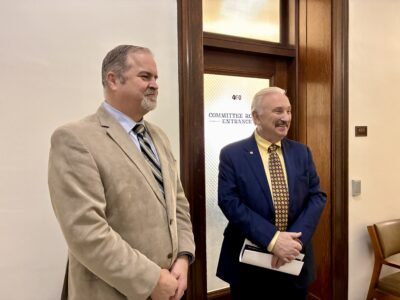
House Finance Committee Vice Chairman Clay Riley (left) and House Finance Committee Chairman Vernon Criss (right) take questions following Thursday’s committee meeting where members recommended House Bill 4027, the budget bill, for passage in the full House of Delegates. (Photo by Steven Allen Adams)
CHARLESTON – The House Finance Committee submitted its answer to Gov. Patrick Morrisey’s fiscal year 2027 general revenue budget, making substantial changes to the proposal and including possible changes to the Hope Scholarship.
The committee recommended House Bill 4027, the budget bill, to the full House for passage Thursday morning after suspending rules to allow the bill to be considered by the committee the same day.
The bill sets the general revenue budget for the state for fiscal year 2027 beginning July 1. Morrisey presented his budget to the House of Delegates and state Senate on the first day of the legislative session on Jan. 14, setting the revenue estimate at $5.493 billion.
The House Finance version sets the general revenue budget at $5.463 billion, a 0.5% decrease from the governor’s bill and a 1.5% increase from Senate Bill 250, which is up for passage there on Friday.
The House version includes more than $141 million in improvements over the governor’s recommended budget and more than $172 million in cuts, leaving a cushion of $30.5 million unappropriated in the next fiscal year.
“For the last two years, (Morrisey) spent every dollar, every dime, that he had available in his revenue estimates. We are not doing that,” said House Finance Committee Chairman Vernon Criss, R-Wood, following the conclusion of Thursday’s meeting. “We have traditionally put in a cushion so that we can take care of some contingency problems down the road.
“We know that halfway through the year, the fiscal year, that we’ll be back in January to address some of those items as we normally do,” he continued. “We want to make sure that we’ve put that cushion in there to take care of that.”
HB 4027 retains many of Morrisey’s priorities, including the 3% average public employee pay raise for executive branch workers paid through the general revenue budget. Later Thursday, the House passed House Bill 4765, which is the separate 3% pay raise bill for teachers, school service personnel and State Police employees. The bill passed in a 95-0 vote with five absent or not voting.
House Finance Committee Vice Chairman Clay Riley, speaking on the House floor Thursday afternoon, said the 3% raise would amount to an extra $1,800 for state employees, an extra $1,500 for teachers, and an extra $900 for school service personnel, offsetting the 3% premium increase for the Public Employees Insurance Agency.
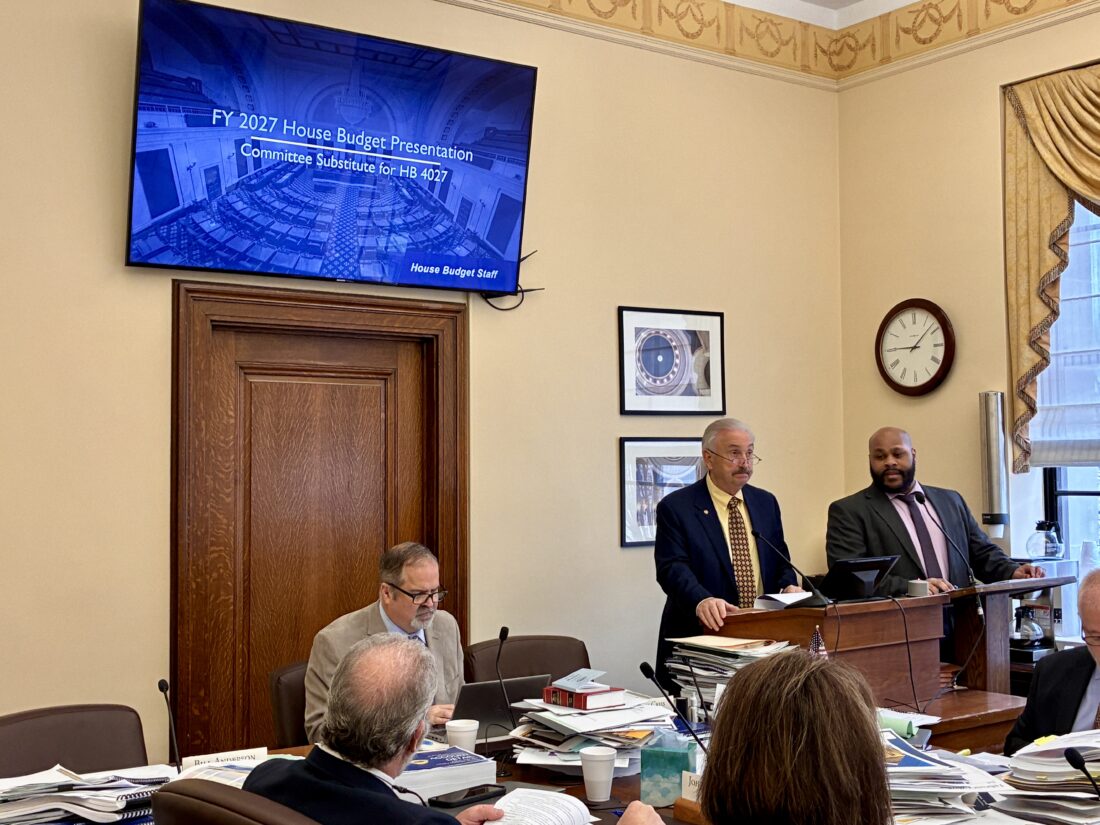
The House Finance Committee took up House Bill 4027 Thursday, its version of Gov. Patrick Morrisey’s bill setting the general revenue budget for the next fiscal year. (Photo by Steven Allen Adams)
“There’s only three people, three groups that are in code: State Police, teachers and service personnel,” said Riley, R-Harrison. “This is a significant increase. We are rewarding our people. We do want to continue to pay more, but do not confuse 3% with 3%.”
The House version of the budget fully funds the state higher education funding formula with an inflation adjustment, restoring money for higher education cut from Morrisey’s recommendation. While coming in below the governor’s recommended budget, the House version allocates more to higher education than what was appropriated for the current fiscal year.
The surplus section in the back of the budget, which includes items to be paid for out of available surplus general revenue dollars at the end of fiscal year 2026 ending on June 30, includes a total of $191.19 million directed toward infrastructure, including $150 million for the State Road Fund and $30 million for water and sewer projects.
“We have funded the items that we feel necessary, that we can take care of,” Criss said. “We feel that as the year goes along, we’ll understand the numbers and the revenue estimates as we add the revenues that actually come in.”
The House budget does not include the 10% personal income tax cut Morrisey has asked for or the 5% personal income tax cut accounted for in his budget. The full 10% cut would return $250 million to taxpayers when fully implemented.
Part of the 5% personal income tax cut in Morrisey’s budget was paid for with state departments and agencies cutting their budget requests for the next fiscal year by 2% below current fiscal year appropriations. The House budget leaves in place most of those targeted cuts, though the proposed 2% cut for higher education was restored.
“Over the years … higher education, they have suffered a lot of cuts and not consistent increases,” Criss said. “We’ve decided that we’re going to restore those cuts and make sure that we take care of higher education.”
The House budget also contemplates an originating bill up for consideration in the House Finance Committee changing the Hope Scholarship educational voucher program from a reimbursement tied to the equivalent of a participant’s per-pupil state school aid formula expenditure to a flat $5,250 award tied to tuition, curriculum, technology and transportation costs.
Both bills change how Hope recipients receive their funding, from twice during the fiscal year to four times. As a result, the House budget includes three-fourths of the Hope Scholarship funding in the budget bill, with the remainder coming from available unappropriated dollars in the current fiscal year.
“It’s a pretty mundane thing to switch from a biennial to quarterly payment,” Riley said. “You don’t have to prefund as much because revenues start coming in. While that’s a very basic idea and concept, it really does help the budgeting and the cash flow issues.”
In the House budget, the Hope Scholarship is funded at $158.4 million, with money coming from the general revenue budget as well as lottery and excess lottery surplus dollars for fiscal year 27. That’s down from $230.1 million included in the governor’s budget.
House Finance Committee Minority Chairman John Williams, D-Monongalia, said it’s is too early to tell what form the budget will take between now and the end of the legislative session at midnight on March 14. But he said there were some things in HB 4027 with which the House Democratic caucus was happy.
“I still think we’re a long way away,” Williams said. “There are obviously some similarities between what the Senate gave us. In a lot of ways, more similarities with what the governor originally gave us. I think the tax cut is still going to be a big looming factor of disagreement between all three parties. And so, we’ll have to see how that plays out.
“I think the biggest things that I’m happy about, and that members of the Democratic caucus are happy about, is that Medicaid is still in the front of the budget,” Williams said. “Medicaid staying in the front of the budget is extremely important. We want to keep our eye on that.”
During the discussion of HB 4765, House Minority Leader Sean Hornbuckle, D-Cabell, expressed support for the pay raises included in the bill and the House budget, but wished members could have done more.
“It is imperative that we do something, and we do something today. However, I also fear that it is not near enough,” Hornbuckle said.
Steven Allen Adams can be reached at sadams@newsandsentinel.com