
On a March evening in 1898, gunfire exploded through Mumbai’s Crawford Market. That night, angry city residents raised their rifles at an unusual target: the public clock tower atop the market building.
The timepiece had been erected years prior, just before the British government’s demanded Indians bend to the West’s standardization of time. The division of eternity by the device felt like yet another fist of colonial oppression, a tool of centralized control. That night, bullets pierced the clock face, partly destroying one of its dials.
Time-telling with clocks—and mechanical clocks in particular—has played a significant role in the development and shaping of human societies and the growth of industry. And, for good reason, people have fought them every step of the way. Mechanizing timekeeping separate from nature changed how we think and behave, spawning new psychology and sparking rebellion.
“The clock is both the oppressor and the symbol of the oppressor,” historian of technology David Rooney tells Popular Science.
The first mechanical clocks appear in 13th century Italy
Mechanical clocks first appeared in northern Italy in the 13th century, following earlier methods of timekeeping like sundials and hourglasses. Timekeeping devices dated back to water clocks in ancient Babylon and Egypt, and European monks were known to use candles of specific lengths to time their prayers.
It was a piece of technology called the verge escapement that laid the groundwork for mechanical clocks. The verge escapement is a weight-driven gear wheel whose teeth are repeatedly stopped and released by a pair of metal pallets mounted on a central bar called a foliot. A clock’s “tick is literally the teeth of the wheels hitting the escapement and then being allowed to escape as the foliot goes around,” says Rooney.
A descendant of the verge escapement is still the beating heart of modern mechanical clocks. If you pull the face off your watch, you can see it at work. The difference is, in your watch, the escapement’s pulling power is a battery. In early clocks, it was gravity.
The rapid rise of clocks in bell towers
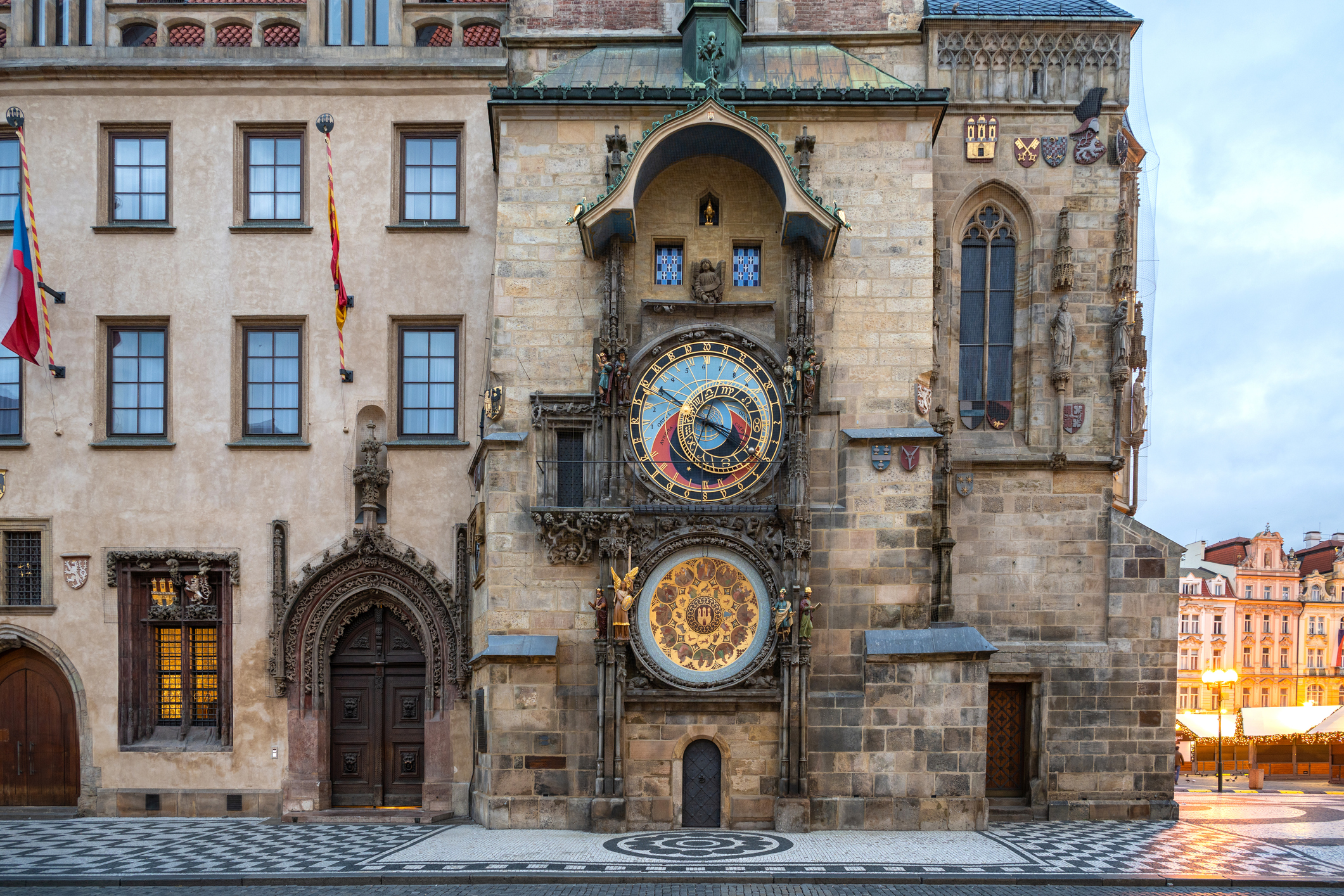
Mechanical clocks were invented for a specific purpose: to work in tandem with bell towers. Bell towers had been erected in city centers and were rung by sun-watching timekeepers to let everyone know when it was time to wake up, eat, work, go to church, and attend public meetings.
“There was a demand for a device to mechanize the practice of ringing bells,” says Rooney. Prior to the clock, bells were sounded manually. Furnishing a bell tower with a mechanical clock “could liberate somebody from that labor.”
The mechanical clock spread from Italy through Europe, from one urban center to another, adorning bell towers throughout England, Germany, France, the Netherlands, Belgium, and Luxembourg.
In the book, The WEIRDest People in the World: How the West Became Psychologically Peculiar and Particularly Prosperous, Harvard anthropologist Dr. Joseph Henrich writes that 20 percent of cities with 5,000 or more people had at least one public clock by 1450. Most churches had one by 1600. Their proliferation likely contributed to the rise of Western time psychology as we experience it today.
“The arrival of clocks in urban spaces provided a new kind of time discipline to the masses,” Rooney says.
How standardized time changed our brains
People’s own subjective judgements and estimations about the passage of time are what experts call psychological time. If we know the duration of things that occupy our time—like how long it takes us to make a cup of coffee or walk to work—we will use these memories as internal measurements for clock time. This is one of the many reasons the 2020 quarantine felt like such a temporal anomaly. Separated from our routines, time began to feel like an accordion, expanding and contracting depending on our mood.
Similarly, people’s internal experience of time changed with the new technology. Before mechanical clocks, days—the expanse between the seasonally changeable sunrise and sunset—were broken up only by tasks. With clock time, days became a series of fixed increments.
Business owners began paying their workers by the hour. And in societies where hourly pay became commonplace, conceptualization of time evolved to include a sense of scarcity, as if time not spent “properly” was wasted. This mentality is known as time thrift. “Time is money” became the refrain.
Related ‘History of Every Thing’ Stories
How clocks and time became systems of control and oppression
As clocks became more common and railroads gave birth to Standard Time in the 1800s, the clock became a symbol of order. “Clocks were used by people with power to keep other people under control,” Rooney says.
In his book, About Time: A History of Civilization in Twelve Clocks, Rooney points to the textile industry as one of the most oppressive industries in its use of clocks to regulate the lives of workers. Textile managers would forbid their workforce from wearing watches, changing the wall clock throughout the day to get more time and work out of workers for the same pay.
In his book Capital: A Critique of Political Economy, Karl Marx captures the tyranny of these workplaces by quoting a British government factory inspector who said, “moments are the elements of profit.”
Following the Crawford Market protest, mass public demonstrations continued in Mumbai through the turn of the century. In 1905, Mumbai’s largest textile mill changed its clocks to the new Standard Time, prompting a full-on strike. The frustrated people of India were in good company. Many around the world railed against the idea of a single, universal authority.
A few years later, suffragettes planted a bomb in the Royal Observatory in Scotland, a floor away from the telescope chronograph, a clockwork device scientists used for timing observation, Rooney writes. Like the anti-colonialists in Mumbai, the women were targeting the power and control of Standard Time.
Among the suffragettes’ other targets had been men’s clubs, railway stations, and telephone lines. The night of the observatory break-in, their homemade bomb blew out windows and doors. The driving-clock that kept the telescope pointed at a specific star was badly damaged.
Resistance to clocks and clock time endures to this day. Movements like the Great Resignation, quiet quitting, the four-day workweek, and efforts to abolish Daylight Saving Time are all echoes of the time-control rebellions of history. Centuries into clocks ruling our days, we haven’t forgotten that clock time is merely a guest in our collective way of thinking.
In The History of Every Thing, Popular Science uncovers the hidden stories and surprising origins behind everyday things.

2025 PopSci Best of What’s New