
A new investigation of ancient horned animal skulls found in Spain’s Des-Cubierta Cave deepens the mystery of when and why Neanderthals put them there.
According to multiple lines of evidence, the skulls weren’t all placed there at the same time but were likely carried into a narrow gallery repeatedly over a prolonged period during the late Middle Paleolithic, between around 70,000 and 50,000 years ago.
Excavation of the cave began in 2009, and one of the rock layers caught archaeologists’ attention for a large assemblage of Mousterian stone tools, a culture primarily associated with Neanderthals in Europe.
But it wasn’t just tools; there was also an unusual assemblage of animal remains, overwhelmingly composed of skulls.
Researchers cataloged the top parts of the skulls of at least 35 individual animals, including 28 bovines, five deer, and two rhinoceroses. Most of the rest of the skeletons, such as jawbones, limbs, and even cheekbones, are absent.
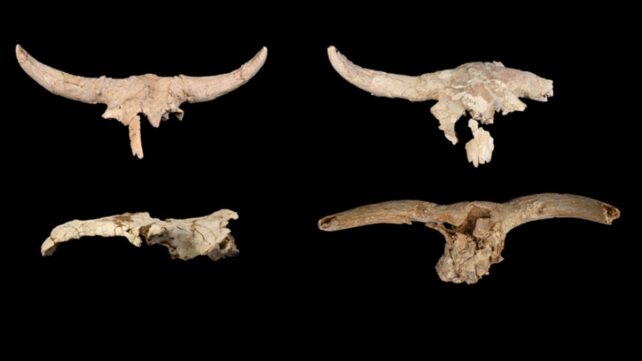
The deliberate accumulation of animal crania is pretty rare in the archaeological record. A team led by archaeologist Lucía Villaescusa of the University of Alcalá in Spain wanted to know if the site itself could yield any clues about the way these skulls were placed.
They studied multiple lines of evidence, including the spatial distribution of geological debris and archaeological artifacts in the deposit; reassembly of the fragmented bones; and the level of preservation of the bones.

Their results showed that rockfall first introduced a cone of debris into the gallery. It was after this rockfall that Neanderthals began to bring in animal skulls, placing them in the cave during separate phases of activity.
The timeframe of this activity is unclear, but the separation between deposits makes it clear that it was not a one-and-done instance of skull collection.
Related: Child’s Bones Buried 40,000 Years Ago Solve a Longstanding Neanderthal Mystery
As with so many ancient human and Neanderthal activities, it’s likely we’ll never know why the Neanderthals of Des-Cubierta had a repeated tradition of putting crania in a cave, but the repeated pattern suggests a structured practice that offers a rare glimpse into the possible symbolic lives of our ancient relatives.
“The integration of geological, spatial, and taphonomic data demonstrates that the accumulation of large herbivore crania was not a single depositional event, but rather the result of repeated episodes embedded within a long-term process of gallery use,” the researchers write.
“This sustained and reiterated behaviour highlights the structured and transmitted nature of this practice, adding a significant piece to the broader discussion on the complexity and symbolic potential of Neanderthal cultural expressions.”
The findings have been published in Archaeological and Anthropological Sciences.