
Cyberpunk conjures images of pink-and-blue cityscapes, but its philosophical ethos boils down to “high tech, low life.” A subgenre of sci-fi, it often depicts dystopian near-futures in which technologies like artificial intelligence and virtual reality are accompanied by social decay and corporate rule. The roots of cyberpunk can be traced back to New Wave authors like William Gibson and Philip K. Dick in the ‘70s and ’80s, but the gritty rebels on the fringes of society quickly wormed thier way into movies and TV.
As AI becomes integrated into our daily lives and corporations wield increasingly unchecked power, it’s no surprise that cyberpunk is experiencing a resurgence in popularity. Both nostalgic and cautionary, the best cyberpunk films speculate on the realities of accelerationism. They’re also usually action-driven, stylish, and fully immersive. Here are 10 unassailable cyberpunk cinematic masterpieces.
10) Strange Days

Kathryn Bigelow’s 1995 neo-noir thriller Strange Days is an underrated yet essential cyberpunk flick that captures both the themes and aesthetics of the genre. Set during the last 48 hours of 1999, we’re quickly introduced to SQUID technology, which allows users to record and experience other people’s memories and sensations. Ralph Fiennes plays Lenny Nero, a black-market dealer selling experiences to the “wiretrip” or VR-addicted population (similar to Cyberpunk 2077’s braindances).
The film is grimy and intoxicating, not unlike the experiences on the illicit SQUID discs. The POV sequences were groundbreaking at the time, requiring specialized camera rigs to be built. The setting is a crumbling Los Angeles facing police brutality and riots, in which Angela Bassett’s Mace Mason is both the moral compass and the physical protector. Today, Stange Days is an eerie watch, having come close to predicting several of our modern woes, including the influencer industry and commodification of lived experience.
9) A Scanner Darkly

In Richard Linklater’s 2006 adaptation of Philip K. Dick’s novel, we find ourselves outside the city and in a sub-subgenre called “suburban cyberpunk.” Animated over live actors, the film uses a distinct technique called interpolated rotoscoping to create a bizarre, constantly shifting reality that works extremely well alongside all the paranoia. Keanu Reeves stars as an undercover narcotics agent, Bob Arctor, who is tasked with infiltrating a circle of Substance D users (a dangerous drug that damages the brain’s ability to connect perception and reality). To protect his identity, Arctor wears a “scramble suit,” or surveillance disguise that constantly shifts his appearance into a composite of thousands of different faces and body types.
Veering away from traditional cyberpunk aesthetics and action sequences, the film zooms in, taking a more intimate look at Arctor’s crumbling psyche. Still set in a near-future dystopia, Linklater probes the idea of mass government surveillance and the resulting paranoia, as well as the impacts of drug addiction and the fragile nature of our realities and identities.
8) RoboCop

RoboCop is a 1987 satirical sci-fi action movie from director Paul Verhoeven. Set in a near-future Detroit where the Omni Consumer Products or OCP megacorporation has privatized law enforcement, the plot follows police officer Alex Murphy after he’s murdered and resurrected as a cyborg law enforcement unit with no individual identity. His body becomes company property, and his human memories are suppressed.
The grotesque corporate optimism of Veerhoven’s world contrasts beautifully with RoboCop’s journey, as fragmented memories of his former home, his wife, and his son are treated as system malfunctions, and programmed directives prevent him from acting against OCP’s objectives. Easily one of the most iconic cyberpunk movies ever released, RoboCop has brawn and brains, combining action and stylized violence with a genuinely compelling story about identity.
7) Tetsuo: The Iron Man

Shinya Tsukamoto’s 1989 body-horror classic Tetsuo: The Iron Man was shot in black-and-white 16mm and follows a salaryman whose body begins mutating into scrap metal after encountering a mysterious “metal fetishist.” The plot specifics are largely secondary, however, to the visceral experience, with its grinding metal and violently erupting mechanical growths. Using stop-motion animation and experimental editing, Tsukamoto turns the film into a sensory, tactile transformation for the audience. Aschewing cold corporate sleekness, it explores the melding of humans and technology with the grotesque and personal.
A defining work of Japanese cyberpunk (also known as Extreme Japanese Cyberpunk), Tetsuo diverges radically from Western cyberpunk’s noir influences. The Japanese subgenre emerged from punk, industrial noise, and underground art scenes, and its films are largely low-budget productions that reject structure. Tetsuo doesn’t bother to explain the salaryman’s transformation through science or grounded tech; rather, through imagery and body horror, you feel industrial society consume him. For cyberpunk fans who have yet to dip a toe into this realm, Tetsuo captures the inner experience better than almost anything else.
6) Akira
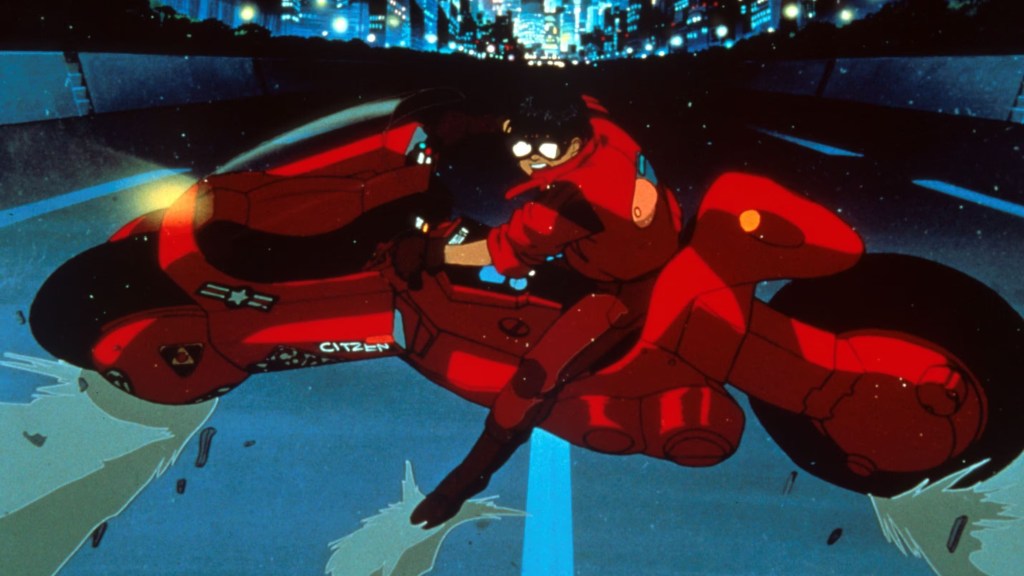
Katsuhiro Otomo’s Akira is a defining staple of both anime and cyberpunk. Released in 1988, the movie takes place in Neo-Tokyo after a mysterious explosion destroys the original city. From there, we follow biker gang member Kaneda and his friend Tetsuo, but as Tetsuo develops psychic abilities, his transformation cuts straight to the heart of a classic cyberpunk theme: whether tech will outpace humanity’s ability to control it.
Capturing astonishing scale and specificity, Akira uses over 160,000 animation cels (an unprecedented number at the time) and includes subtle environmental details, like flickering holographic advertisements and decaying infrastructure, to depict its incredible Neo-Tokyo. Tetsuo’s evolution destabilizes both his body and the city, and parallels the government’s loss of control over its own ambitions. An influence on nearly all the cyberpunk anime which came after, Akira’s presence can also be felt in everything from The Matrix to modern video games.
5) Videodrome
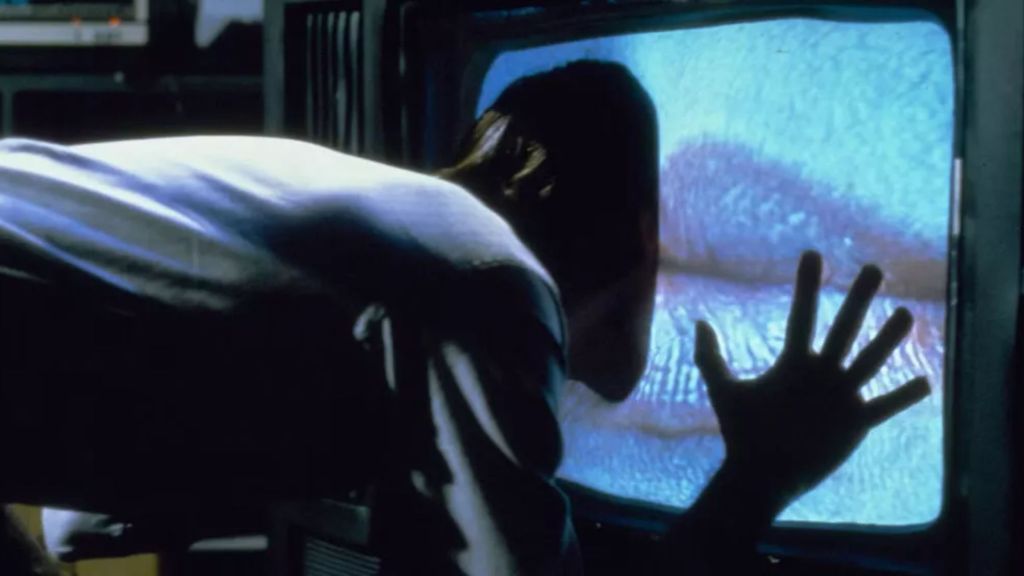
Videodrome is a 1983 body horror classic from iconic director David Cronenberg. While it’s not the first thing that comes to mind when most people think of cyberpunk, it captures the genre’s themes perfectly and was heavily influential on cyberpunk as a whole. In it, James Woods plays a TV executive named Max who discovers a pirate broadcast known as Videodrome, which depicts graphic torture and violence. He becomes obsessed with finding its source, only to realize it’s signal alters the brain, causing hallucinations and eventually mutating the body itself.
Alongside Blade Runner, Videodrome was hugely influential on Japanese cyberpunk filmmakers like Tsukamoto. Its fusion of science fiction and body horror became foundational in the Extreme Japanese Cyberpunk wave. Cronenberg uses practical effects to capture unforgettable imagery, such as Max’s head merging with the TV or his abdomen developing a living, breathing slit capable of accepting videotapes. The merging of technology with human anatomy is an idea that would later be used in films like Tetsuo: The Iron Man. Perhaps one of the earliest examples of cyberpunk cinema, Videodrome is an often-overlooked staple of the genre.
4) World on a Wire

Often considered proto-cyberpunk, Rainer Werner Fassbinder’s World on a Wire was released in ‘73 and is one of the earliest films to articulate cyberpunk’s ideas and aesthetics. Made for German TV, the film introduces us to a scientist named Dr. Fred Stiller as he oversees the Simulacron project, which has created an entire artificial world populated by digital consciousnesses who believe they’re real. When the project’s director mysteriously dies, and records of his existence begin disappearing, Stiller becomes increasingly paranoid that his own reality may not be what it seems.
An “allegory of the cave” story that predates The Matrix by 26 years, Fassbinder’s concept and its visual design both feel decades ahead of thier time. Reflective glass surfaces, mirrors, and transparent barriers create a sleek atmosphere that often fragments or duplicates characters within the frame. Everything from cyberpunk’s mid-century retro-futurism aesthetic to the corporate and existential cybernoir subgenres was heavily influenced, if not birthed, by World on a Wire. Beyond influencing the genre as a whole, the idea also touches on real modern fears and ideas, like the simulation hypothesis or dead internet theory. Its influence can be felt in nearly every cyberpunk film that followed, but on its own, it’s an incredible movie and a must-watch for fans of the genre.
3) Ghost in the Shell
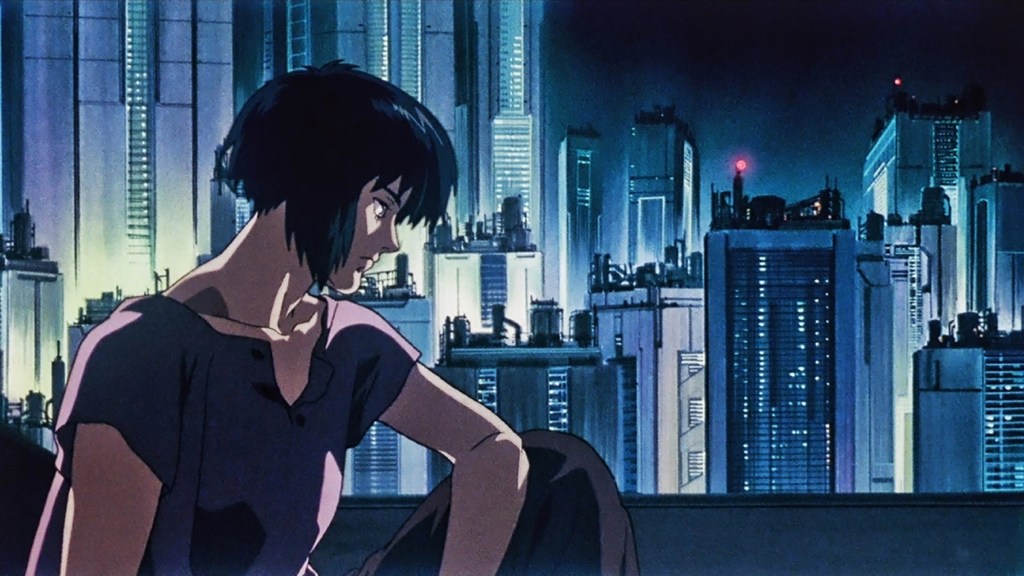
Directed by Mamoru Oshii, Ghost in the Shell is an iconic Japanese animated film from 1995 set in a near-future where human consciousness can be digitized, and bodies can be replaced with cybernetic parts. Kusanagi is a full-body cyborg working for Section 9, an elite counter-cyberterrorism unit, but her hunt for a rogue intelligence called the Puppet Master (capable of hacking human consciousness directly) takes a turn when the entity reveals it wasn’t programmed by anyone.
Another masterwork of the genre, Ghost in the Shell circles the eternal question of what makes consciousness real, and turns its noir into a full-blown existential sci-fi epic. Kusanagi has memories and doubts and watches strangers from a boat, wondering what separates her from them. Yet rather than simplify, reduce, or attempt to answer its central question, it makes Kusanagi’s uncertainty the entire point. With perhaps one of the best endings of any cyberpunk film, the quintessential anime ultimately transcends its various genres and becomes something singular and spectacular.
2) The Matrix

Directed by the Wachowskis and starring Keanu Reeves, Laurence Fishburne, and Carrie-Anne Moss, The Matrix was released in 1999, but it likely needs no introduction as the most popular film to ever emerge from the genre. The story is set in a future where humanity unknowingly lives in a simulation run by machines, their bodies harvested for energy in the real world. Reeves plays Neo, a programmer who is eventually pulled out of the simulation by Morpheus and company.
What The Matrix did that nothing else had managed to do was bring cyberpunk to the masses without dumbing it down. The genre had been largely relegated to “niche “ or “cult” status for twenty years, with only a few exceptions. The Wachowskis’ simulated reality probed ideas of systemic control, and the unreliability of what we’re told is real in the most fun, stylish, and memorable way possible. It’s spectacle (i.e., bullet time), sold the tickets, but the philosophy is what has kept it relevant all this time. With patience, The Matrix earns all its payoffs, including the legendary red pill scene. Everyone remembers where they were when they first witnessed Neo wake up in the real world. And everyone has, at least once, wondered whether they themselves live inside a matrix.
1) Blade Runner & Blade Runner 2049

It may feel like cheating to include both Blade Runner films in the top spot, but they are equally excellent and quintessential to the genre, with the 1982 film being the standout of the ‘80s and the 2017 adaptation being the harbinger of the most recent cyberpunk wave.
Based on Philip K. Dick’s novel Do Androids Dream of Electric Sheep?, the original Blade Runner stars Harrison Ford as a detective in a dystopian Los Angeles, tasked with hunting down a group of rogue replicants. The film essentially cemented the visual language that we now associate with cyberpunk. Dick’s book was already asking the hard questions about what separates a human from a convincing imitation of one. Yet, Scott took the premise and built an entire world around it: a corporate ad-infested, overcrowded, rain-drenched neon cityscape that is both futuristic and derelict, and which nobody has stopped borrowing from since.
Villeneuve’s Blade Runner 2049, on the other hand, is considered both one of the best cyberpunk films of all time and one of the best sci-fi sequels of all time. Ryan Gosling’s K is a replicant blade runner who uncovers a secret that sends him across a devastated future California full of radioactive wastelands, buried cities, and even a future Las Vegas that’s been abandoned and left to decay. Rather than a rehash, Villeneuve expands the story and world with these new landscapes, stunning modern effects, and digs deeper into the original’s theme, moving from whether replicants are human to whether they can act with humanity.
Which cyberpunk movie do you think deserves the number one spot? Leave a comment below and join the conversation now in the ComicBook Forum!