
Germany still has “over 100” companies operating in Russia, and the taxes and profits generated help to finance Moscow’s ongoing war, Ukraine’s ambassador to Germany Oleksii Makeiev warned on Sunday.
He delivered the criticism as Ukraine approaches the fourth anniversary of Russia’s full-scale invasion and faces what he described as a sustained campaign of strikes on energy infrastructure that has left parts of the country without stable heat, water and electricity.
JOIN US ON TELEGRAM
Follow our coverage of the war on the @Kyivpost_official.
In an interview with Deutschlandfunk, Makeiev argued that parts of Europe’s business community still view economic engagement with Russia as viable despite the ongoing war.
He added that such activity has tangible consequences. Taxes paid and profits generated in Russia ultimately feed into the country’s state budget, which finances military production and operations.
More than 100 German companies still active in Russia
“There are enough people and companies in Germany who, after 12 years of war – or four years of full-scale invasion – continue to operate in Russia and generate revenue that, through taxation, helps finance missiles, bombs and Russia’s armed forces,” he said.
He named companies including Metro, Ritter Sport, and Claas, adding that more than 100 German firms are still doing business in Russia.
Makeiev also used a historical comparison to criticize companies that remain in Russia, questioning whether such firms might one day be viewed “as a new IG Farben” for enabling a criminal regime, as he put it.IG Farben was a major German chemical conglomerate that supplied materials to Nazi Germany during World War II and was later dismantled after the war due to its role in supporting the regime’s military apparatus and involvement in war crimes. Several of its executives were prosecuted in post-war trials.
Other Topics of Interest
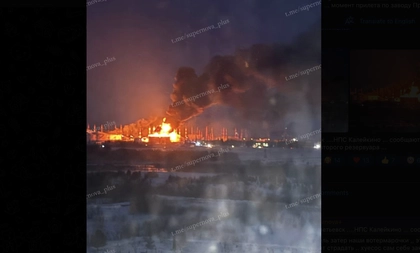
Explosions Hit Russia’s Belgorod, Almetyevsk
Residents across Russia reported multiple explosions, some of which were confirmed at oil and energy facilities in Belgorod and the Tatarstan Republic.
The ambassador’s remarks come as European governments continue debating how far economic pressure on Moscow should extend and whether existing sanctions are sufficient to curtail Russia’s war effort.
Peace talks and pressure on Russia
Makeiev reiterated Kyiv’s position that Russia will only agree to a meaningful settlement under pressure – which he believes could be projected primarily by the US alongside strong European partners, including Germany.
“All these negotiations are based on the assumption that Russia can only be forced into peace from a position of strength,” he underscored.
He further accused Moscow of using talks to buy time and avoid additional sanctions, saying Russia “plays for time” and does not genuinely seek peace.
Makeiev also criticized the idea of linking peace efforts to major economic projects with Russia, calling such engagement “a huge mistake” from a European perspective and pointing to Germany’s earlier policy of economic interdependence with Russia as a failure that deepened energy dependence.
Before Russia’s full-scale invasion of Ukraine in 2022, Germany relied heavily on Russian natural gas, much of it delivered via the Nord Stream 1 pipeline running under the Baltic Sea directly to Germany. At times, more than half of Germany’s gas imports came from Russia. The Nord Stream 2 project, completed but never certified, further underscored Berlin’s strategy of economic interdependence with Moscow – a policy critics say increased Germany’s vulnerability to geopolitical pressure.
Migration and European integration
Makeiev also addressed debates in Europe and the US over migration and refugee policy, where the intake of displaced people has become increasingly contested in political discourse.
“Working-age people leave the country, women with children leave, families break apart,” he said.
At the same time, he argued that Ukrainians in Germany have integrated into the labor market more quickly than many expected.
“The latest figures show that Ukrainians are already quite well integrated after three years in Germany. They work,” he said, adding that migration should be seen as part of a broader European integration process.
“One day, when Ukraine becomes a full member of the European Union, Ukrainians will work in Germany, Poland, the Czech Republic and France – and Germans will work in Ukraine,” he said, pointing to the country’s reconstruction needs.
Makeiev added that Ukrainians are prepared to contribute economically, saying many are accustomed to working extended hours and in multiple shifts.
Calls to sever economic ties
Makeiev argued that reducing Russia’s ability to wage war requires cutting remaining economic links, including corporate activity and revenue streams from oil and gas.
He called for stricter enforcement of sanctions, action against Russia’s so-called shadow fleet transporting oil, and stronger measures targeting energy revenues.
“Half measures will only be at our expense – at the expense of human lives, soldiers and civilians in Ukraine,” he said.