

In this feature, we talk to a variety of firms and organisations about the Berne Financial Services Agreement which is now in force, and what it means for banks, insurers, wealth managers and others.
When so much attention is drawn by noisy geopolitics, a
development that may have escaped the radar is a
“ground-breaking” mutual recognition trade deal on financial
services between Switzerland and the UK.
The Berne Financial Services Agreement uses “outcomes-based”
mutual recognition of domestic laws and regulations to enable
cross-border trade in financial services to wholesale and
sophisticated clients, as the UK’s regulator, the Financial
Conduct Authority, puts it. The agreement was signed in
December 2023 and took force on 1 January.
Although a global market access framework for the UK held sway
prior to the BFSA, it was more complex. (The previous set-up was
called the “Overseas Persons Exchange Exclusion Framework.”)
“The BFSA makes this simpler and it is easier to manage,” Vanessa
Dubra (pictured below), head of international at the Swiss
Bankers Association, told WealthBriefing in a
recent interview.

Vanessa Dubra
Swiss banks that meet Swiss regulatory requirements don’t need to
be separately regulated in the UK, and vice versa. “For Swiss
institutions not yet in the UK, it offers easier access to the UK
– particularly for smaller banks,” she said. “This agreement is
not just about the relationship between Switzerland and the UK…it
could serve as a model for other financial markets.”
At PIMFA, the UK-based
wealth management industry association, the message about the
BFSA is positive.
“The Berne Agreement is groundbreaking – it uses outcomes-based
mutual recognition of the UK and Swiss regulatory and supervisory
frameworks, rather than harmonisation of rules and, by doing so,
opens a new chapter in cross-border trade in financial services,”
Maja Erceg, senior policy advisor for EU and government affairs
at PIMFA, told this publication.
“For our member firms – UK wealth business – we see this as an
opportunity to expand market access and secure new business
without the additional challenge and cost that come from meeting
specific Swiss regulatory requirements or from securing presence
in Switzerland. “Most obviously, UK client advisors will now
be able to serve high net worth individuals in Switzerland
without registering in Switzerland,” she continued.
“We see this agreement as giving UK firms an advantage over many
international firms who may have to obtain authorisation and deal
with various other restrictions to operate in Switzerland. We
hope that the framework that is now in place will serve as an
incentive for firms and encourage them to be proactive and use
this opportunity to expand the client base into another
jurisdiction,” Erceg added.

The City of London
The Swiss government told WealthBriefing that the
agreement is significant.
“This agreement between two important European financial centres
is a clear commitment to open financial markets and opens up new
opportunities for cross-border cooperation. Now we look to the
private sector to profit from the potential of the agreement,”
Daniela Stoffel, State Secretary for International Finance at the
Federal Department of Finance, Switzerland, said in an
emailed statement to this news service.

Federal government building, Berne
Familiar faces
Swiss banks and other financial institutions are familiar faces
that operate in London as well as the UK regions, such
as UBS, Julius Baer, Pictet, Lombard Odier and Mirabaud, for
example. UK-headquartered banks with operations in Switzerland
include Barclays Bank (Switzerland) SA; Barclays plc; HSBC
Private Bank; HSBC Bank; IG Bank SA; Investec Bank (Switzerland)
AG; Rothschild & Co Bank AG; Schroder & Co Bank AG; Morgan
Stanley plc London, Zürich branch; JP Morgan Securities plc
London, Zürich branch; Goldman Sachs International London, Zurich
branch; and Citigroup Global Markets plc London, Zurich
branch.
The pact opens the prospect of expanded financial services trade
and capital flows between two European countries that aren’t in
the European Union (although Switzerland does have membership of
the Single Market and Schengen area). The deal is
taking force almost 10 years since the UK public voted to
leave the EU.
WealthBriefing asked Duncan MacIntyre (pictured below),
partner at Lombard Odier, UK,
what a bank that operates in both countries thinks of the accord.
MacIntyre is UK region head at Lombard Odier and leads teams
across London, Geneva, Zurich and the Bahamas.

Duncan MacIntyre
“While the largest UK and Swiss firms doing business in each
other’s countries are already regulated and registered in these
places – which means the Berne accord may have limited impact on
what they do – it could potentially be more significant for
independent wealth managers and others looking to get into these
markets,” he said.
The deal tightens trade relations between the UK, home to the
world’s largest onshore financial hub (London) and offshore one
(Switzerland). The UK is also home to plenty of offshore wealth
as well, if one assumes the cross-border nature of a chunk of it.
According to Boston
Consulting Group last year, the UK mainland is home to $1
trillion of cross-border wealth; if jurisdictions that are linked
to the UK, albeit with a level of autonomy are included, that
takes the figure to about $2.6 trillion (The Bahamas, Channel
Islands and Isle of Man, Cayman Islands). Switzerland had a total
of $2.7 trillion. And that is just the cross-border part
– it does not include the domestic wealth in both countries.
Cross-border centres, ranked
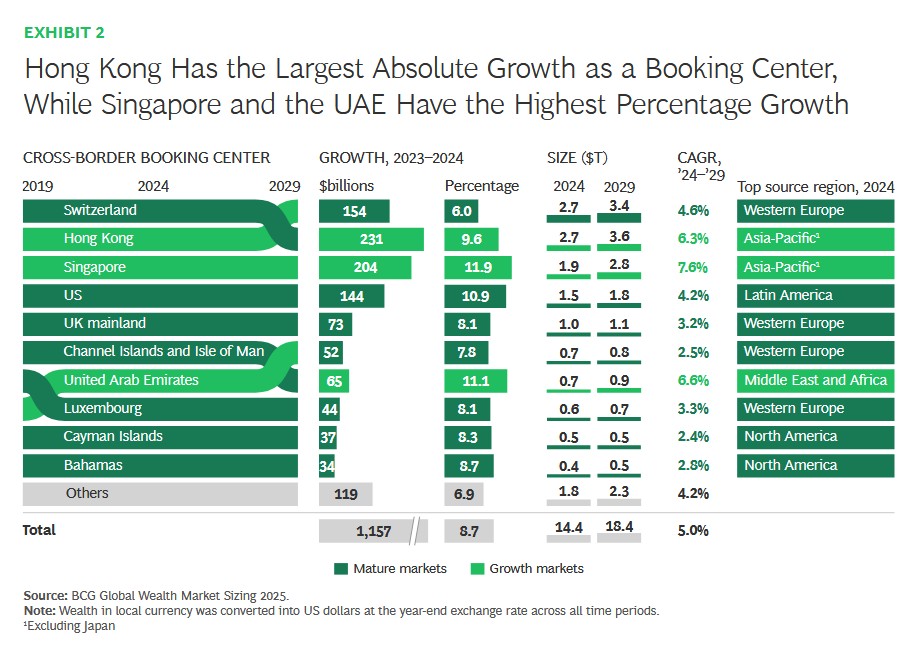
Source: BCG
“You have got the largest onshore financial centre – the UK – and
the largest offshore financial centre – Switzerland – coming
together,” MacIntyre said.
From the Swiss perspective, the Berne accord is more about the
opportunities for private banking and wealth management; on the
UK side, this has more potential for its insurance industry, he
continued. “It creates a new paradigm. It says `you respect our
laws and we will respect yours’. At the broad level, this [mutual
recognition of standards approach] is a brilliant idea,” he
said.
Streamlining
“The BFSA streamlines regulatory requirements by reducing
duplicative licensing and compliance obligations, enabling
financial institutions to operate in the counterpart jurisdiction
largely on the basis of their home-state regulatory regimes,” Dr
Ariel Sergio Davidoff (pictured below), LLM, TEP, told
WealthBriefing.

Ariel Sergio Davidoff
“Swiss financial institutions are therefore well positioned to
strengthen their competitive standing in the United Kingdom. The
agreement enhances access to one of Switzerland’s most
significant wealth management export markets and allows Swiss
banks to service UK high net worth clients with greater legal
certainty, without the need for local authorisation,” he
said.
High net worth – now an official
concept
The agreement allows Swiss financial services suppliers in
particular to provide cross-border investment services for
professional and “high net worth” clients in the UK in
selected areas.
Interestingly, the concept of “high net worth” is now given a
kind of official status for regulatory purposes. According to the
FCA’s own account of this point, it says “To provide registered
services under the BFSA to a natural person who wishes to be
treated as a high net worth client, the agreement requires a
Swiss firm to satisfy that such a client has net assets of £2
million ($2.71 million) or more.”
British insurance companies can provide cross-border services in
Switzerland in selected areas of non-life insurance. In the area
of financial market infrastructures, the BFSA facilitates the
recognition of central counterparties, strengthens cooperation
between parties about trading venues, and simplifies certain
requirements for over-the-counter derivatives. In the area of
asset management, the agreement sets out the regimes already in
force in Switzerland and the UK.
Conversations with bankers and others suggests that industry
players will take time to work out exactly how the system works
in practice, and how much, for example, will a Swiss-regulated
bank or independent asset manager need to do in compliance and
reporting terms with the UK’s FCA, and vice versa for UK-based
firms seeking to enter the Swiss market.
Preparations
Swiss banks are getting ready.
“Swiss banks have already begun implementing the agreement.
However, as some guidelines were only published in autumn 2025
and the Memorandum of Understanding between the UK and Swiss
supervisory authorities was signed only last September, the
process remains at an early stage,” the Swiss Bankers
Association’s Dubra said.
“Some [firms] have been preparing the business cases and some
will do so in the next few months,” she said.
Kerstin Mathias, director of international affairs at UK Finance, a London-based
trade body representing UK banks, is optimistic.
“We are very positive about it. We see it as setting a gold
standard of an agreement between two well-regulated and
sophisticated financial centres,” she said. There is a
“side-letter” in the agreement – originally signed by the
previous UK government – giving scope for new areas to be covered
in time.
Corridors
The agreement also highlights how jurisdictions, in pushing to
gain a market edge and adjust to new circumstances, carve out
trade “corridors” – a theme this news service has
explored before.
For Switzerland, the pact has taken place when relations with the
EU haven’t always been easy. Switzerland has a mass of bilateral
treaties with the EU on topics as varied as transport, free
movement and agricultural trade. The EU wanted to sweep all these
into a framework pact. Switzerland is not likely to ratify new
agreements before 2027 and will have to hold a referendum
first.
At the margins, the BFSA may give a bit of export revenue hope
for firms in the UK seeking new markets. Even allowing for the
loss of some UK resident non-domiciled wealth from the UK since
the system was closed off by the current government, some of
those persons might have moved to Switzerland – so they
remain in the mix as potential clients.
Switzerland, for its part, has had to adjust over the past decade
after its bank secrecy laws – at least when used by
non-Swiss people – ended. (Bank secrecy remains very much in
force for Swiss citizens, however.)
Davidoff said the Berne deal will influence the kind of treatment
clients receive.
“These regulatory simplifications are anticipated to influence
client-servicing models, enabling cross-border private bankers
and advisors to engage with clients remotely or via periodic
on-site visits, rather than maintaining a permanent local
presence,” he said. “In the asset management sector, the BFSA
affirms existing cross-border fund distribution and delegation
arrangements, creating opportunities for innovative product
offerings and closer collaboration between UK and Swiss firms
under a more permissive delegation framework.
“We are observing keen interest from a range of market
participants, particularly from a technical perspective, with
many seeking clarity on the practical implementation steps
required prior to entering the UK or Swiss market. As reflected
in the practical guidance, the initial steps will invariably
involve legal analysis and clarification to ensure compliance.
There is no expectation of rushed action; rather, a measured,
step-by-step implementation approach is envisaged,” Davidoff
said.
Predictions
PIMFA’s Erceg said the removal of regulatory barriers to UK firms
who wish to operate in Switzerland is “clearly the most important
aspect of this agreement.”
“Costs associated with administration are a hugely important
factor in any cross-border business, and the removal of these
barriers should create unhindered market access and new
opportunities for wealth managers.
“However, it’s important to note that the agreement is not set up
to ensure trade flows in one direction. To this end, it may be
that the most important aspect of the agreement for UK wealth
firms is the £2 million threshold HNW individuals need to meet to
be classified as professional by a Swiss firm.
“In this context, it’s important to note that the FCA is
currently consulting on client categorisation rules in the UK,
and whilst we are supportive of the regulator’s intention to
refresh the requirements to opt clients up to professional
status, their proposed threshold of £10 million is significantly
higher. The risk remains that agreements such as the Berne
agreement may place the UK at a competitive disadvantage going
forward,” she said.
Trade still humming
Almost a decade on from Brexit, the Swiss pact with the UK, along
with other trade deals that countries have signed up to, perhaps
pushes back against the idea that globalisation of financial
services is in retreat.
“The UK’s position as the world’s leading financial centre is
underpinned by its adherence to global standards and its openness
to cross-border trade. In the post-Brexit world, the agreement
shows that the UK can build coalitions with other nations in
Europe in the pursuit of closer economic ties and growth,” Erceg
said. The agreement moves from the traditional EU-style
equivalence to deference – a more flexible model allowing firms
to do business in other markets following their home country”s
regulations. This provides businesses with much needed legal
certainty.
“The dynamic character of the agreement is important, and we
welcome the intention to expand its sectoral coverage to include
sustainable finance in the future too. The two sides have
committed to develop internationally comparable standards for
climate-related corporate disclosures and to align financial
flows with the goals of the Paris Agreement. This is encouraging
as working across borders is nowhere more important than in
sustainable finance,” Erceg concluded.
If you value this content and want to add comments or
contribute ideas, email the editor at tom.burroughes@wealthbriefing.com.