
From the conquest of Greek treasures to their integration into Roman mansions and temples, the exhibition “Greece in Rome” tells how Hellenic culture shaped the art, aesthetics and identity of the Eternal City. What the exhibition is like: a review by Silvia Mazza.
“Infesta mihi credite signa ab Syracusis illata sunt hunc urbi” (Livy, XXXIV 4, 4). With these words, in 195 B.C., Cato, a spokesman for the most ardent conservatism, railed against the vast amount of cultural artifacts the Romans moved from Syracuse to the Urbe, which he claimed undermined the sobriety of the Romans. In fact, Greek culture at that time was already deeply permeating the life of the city. A few years earlier Livy (XXXIX, 22, 9) records how the consul Fulvius Nobilius to celebrate his triumph over the Aetolians brought with him artifices from Greece. That attitude of disapproval was propagated, then, alongside the irreconcilable awareness of the cultural superiority of the Greek world. An awareness that should be identified, on closer inspection, already in the creation of the myth of Rome as a “polis ellenis,” founded by the descendants of Trojan refugees in Italy. Even in figurative and architectural language, forms and solutions from the Greek aesthetic baggage had to be imported to Rome from very ancient times. Pliny reports that as early as the fifth century BC. C. the decoration of the temple of Ceres, Libero and Libera on the slopes of the Aventine had been called upon two Sicilian artists, Damophilos and Gorgasos (Naturalis Historia, XXXV, 154).
The grand parabola of the increasingly widespread penetration of Greek culture in the Urbe, from its founding to the imperial age, through early imports, conquests and private collecting, is celebrated in the exhibition Greece in Rome, curated by Eugenio La Rocca and Claudio Parisi Presicce, through April 12 at Villa Caffarelli, at the Capitoline Museums, in Rome. The exhibition, promoted by Roma Capitale, Assessorato alla Cultura – Sovrintendenza Capitolina ai Beni Culturali (organization Zètema Progetto Cultura; catalog Gangemi Editore) presents 150 Greek originals, some never exhibited before, others returned to Rome after centuries of dispersion, to tell the story of the encounter between two extraordinary civilizations that founded the taste and aesthetics of the West, contributing to the definition of its identity.
The layout
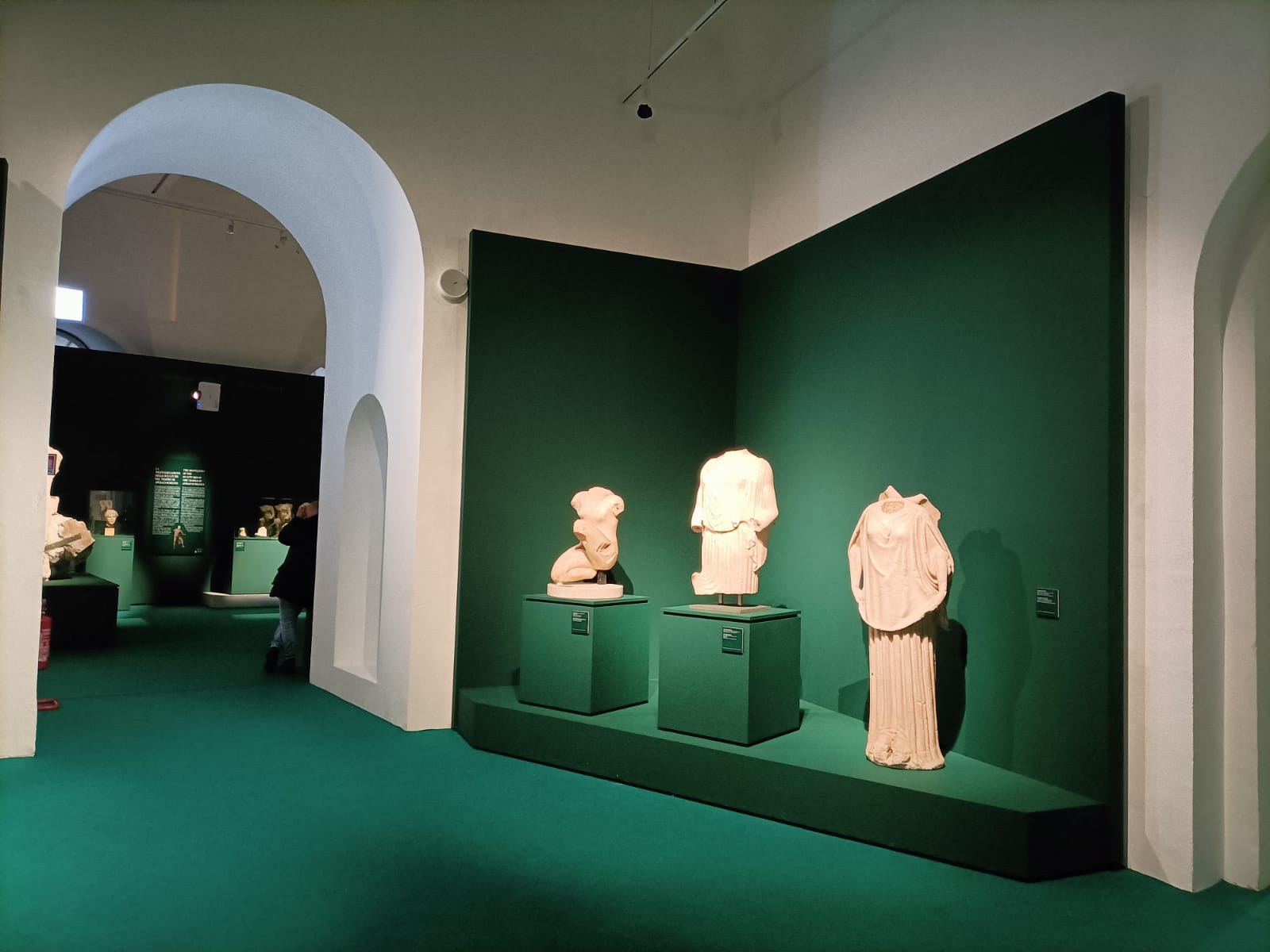
The visual impact and communicative effectiveness of an exhibition is conveyed by its layout. Not infrequently disconnected from the scientific project, other times sacrificed by overpowering didactic apparatus, or even insignificant, like that, to stay in Rome, of last year’s exhibition-event on Caravaggio at Palazzo Barberini. At Villa Caffarelli, on the other hand, one of the best staging of an archaeological exhibition in recent times has been achieved. Even before the critical analysis of the itinerary with the works, the review starts from that.
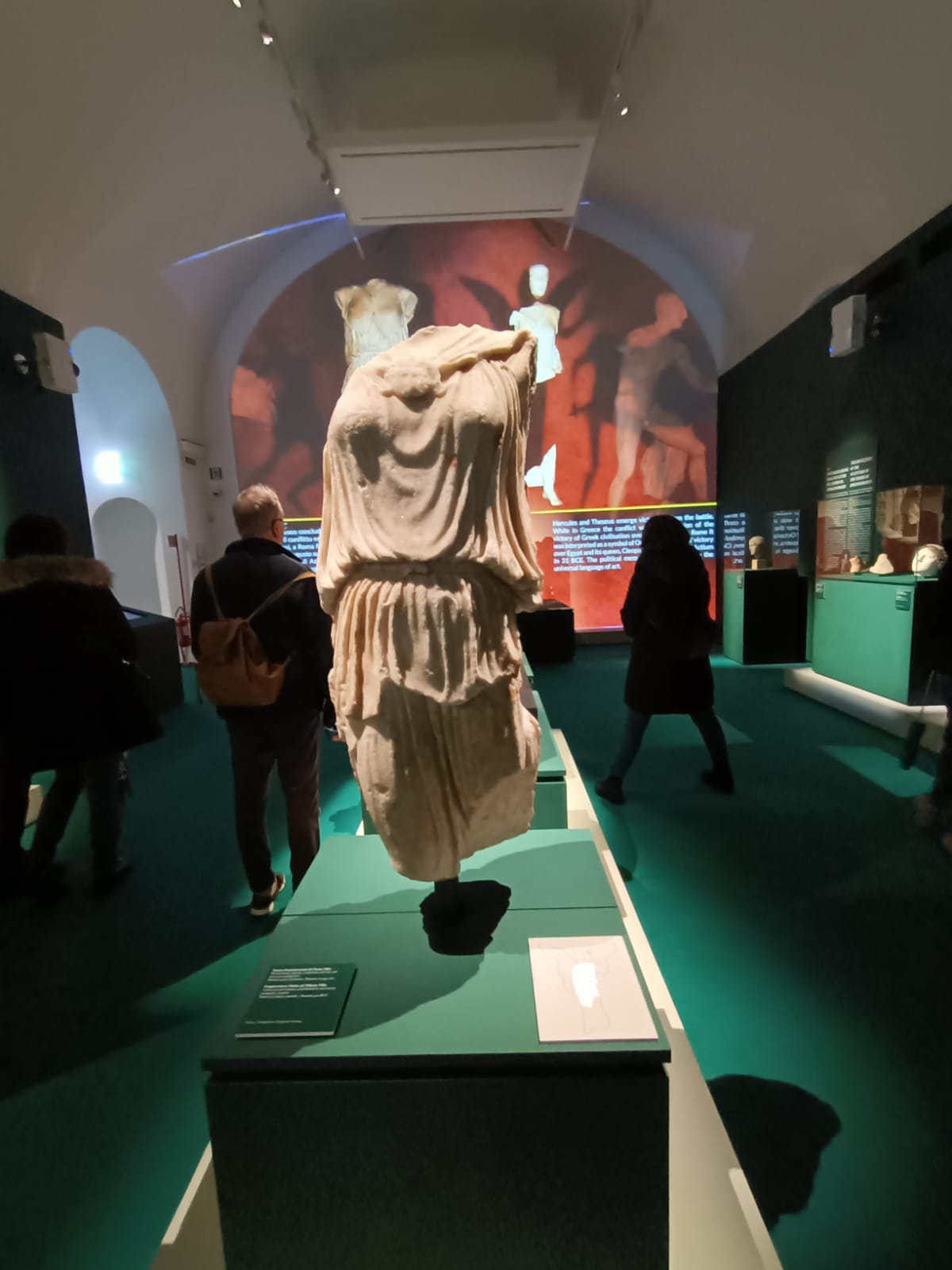
The effectiveness of the narrative is achieved through a balanced integration between the realism of the direct exhibition of the object and the complex discourse of multimedia and virtual simulation. The staging strategies, even of the single piece isolated and abstracted from its context with dedicated illuminating elements, are, in fact, supported by the multimedia content that guides the visitor on an immersive journey through architectural reconstructions, ceremonial contexts, and decorative apparatus. This integrated approach, combining archaeology and digital technologies, offers on the one hand an immersive visitor experience and, on the other hand, the possibility of constestualizing the works, aimed at suggesting how they were seen by the first “spectators,” fostering real understanding.
Not the only approach. In fact, the solutions to achieve this goal make use of a communication system that is never taken for granted and constantly varied. The museotechnical solutions manage to catch the eye even without the technological “devilry.” In fact, a silhouette printed on the back of the display case is enough to help the visitor reconstruct from a few fragments the terracotta sculpture depicting a wounded Amazon: a masterpiece by the same Sicilian artists who were the authors of the decoration of the temple on the Aventine mentioned above. The exhibited works rediscover a new semiotic capacity, that is, able to offer keys to the interpretation of their meaning. The exhibition, in fact, also has as a connotative figure that of reconstructing the history of the meanings they have assumed over time: objects born as votives or funerary become political symbols, enter the aristocratic domus to represent culture, prestige and power. It is highlighted how each work has had multiple lives, multiple uses and multiple readings. Not just aesthetic evidence, then, but objects that, in their passage from Greece to Rome, changed function and helped shape the Roman artistic language. The world of things is connected to the world of concepts, going so far as to make us perceive even that of feelings. If the archetype of the museum as a tomb (a musealized object is removed from its original use and context) was alluded to by Umberto Eco in sharply critical tones, among these rooms, on the other hand, the feeling is that the exhibits are meant to arouse, as Stephen Greenblatt put it, “resonance” and “wonder.” The narrative is constructed so that the decadence of peoples and the disappearance of myths is overwhelmed by the illusion of survival. In this the exhibition we may well say stages a hierophany, a sacred manifestation of the cultural superiority of ancient Greece. Spectacularization is not, in short, an end in itself. There are set-ups that should be fixed in exhibition catalogs. This is one of them.
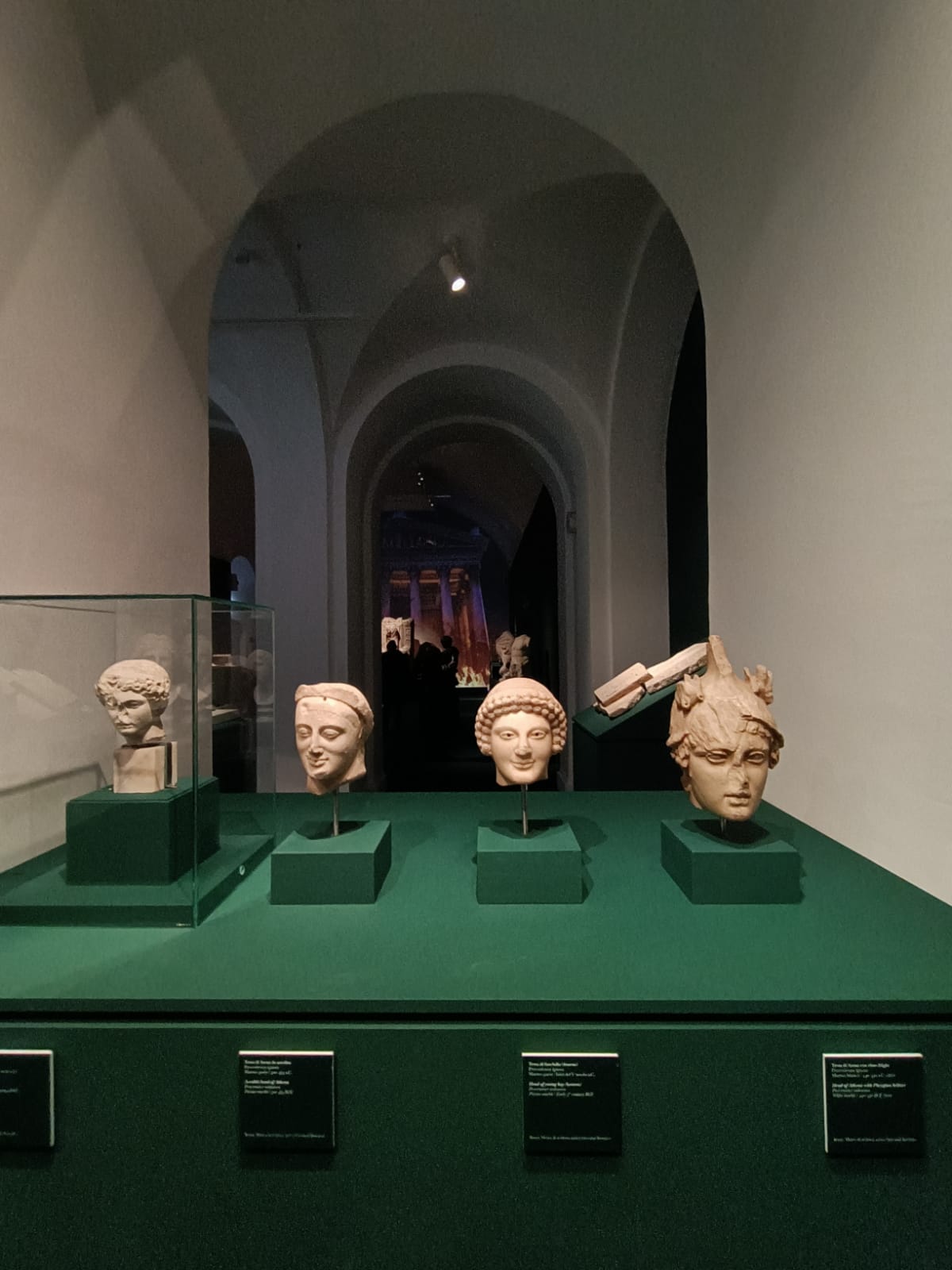
Going into some concrete solutions, the landing at the central hall of the exhibition is all about the concept of limit and threshold, of the rite of passage from one interior to another interior, as a moment of “initiation” to the next “station.” An effective solution of visual integration between one exhibition environment and the other is had with the small wall in which exquisitely crafted heads, belonging to cult or votive statues, are aligned, framing the large room with the video projection: here the study of the projection planes in succession manages to avoid the risk of visual interference. A solution that recalls another museum archetype, that of the temple. One thinks of the so-called “temple of the Athenians” in Delos, where the opening of windows on either side of the entrance door to the náos suggests the desire to show from the outside the works of art inside (the statues for which the temple was built).
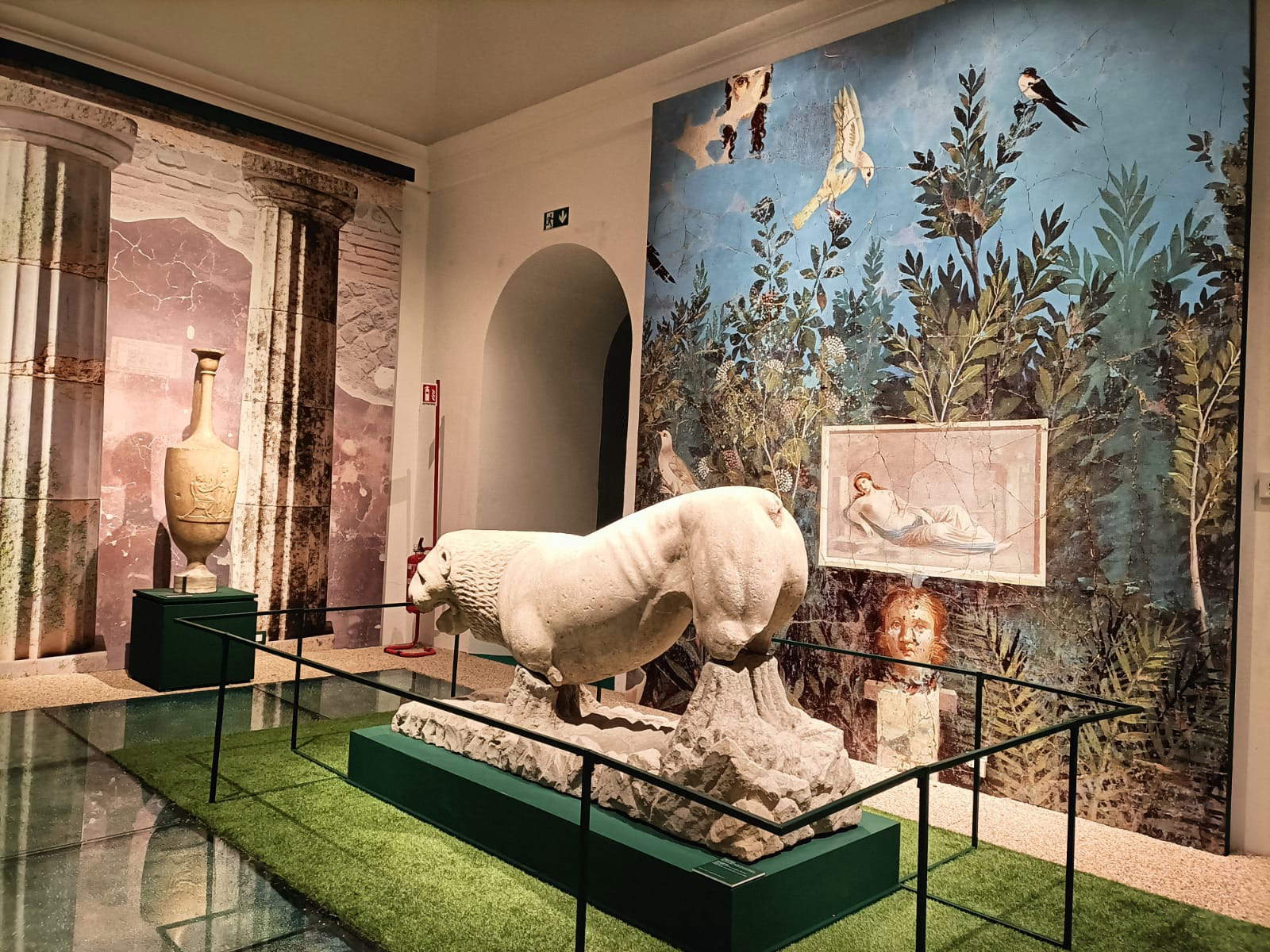
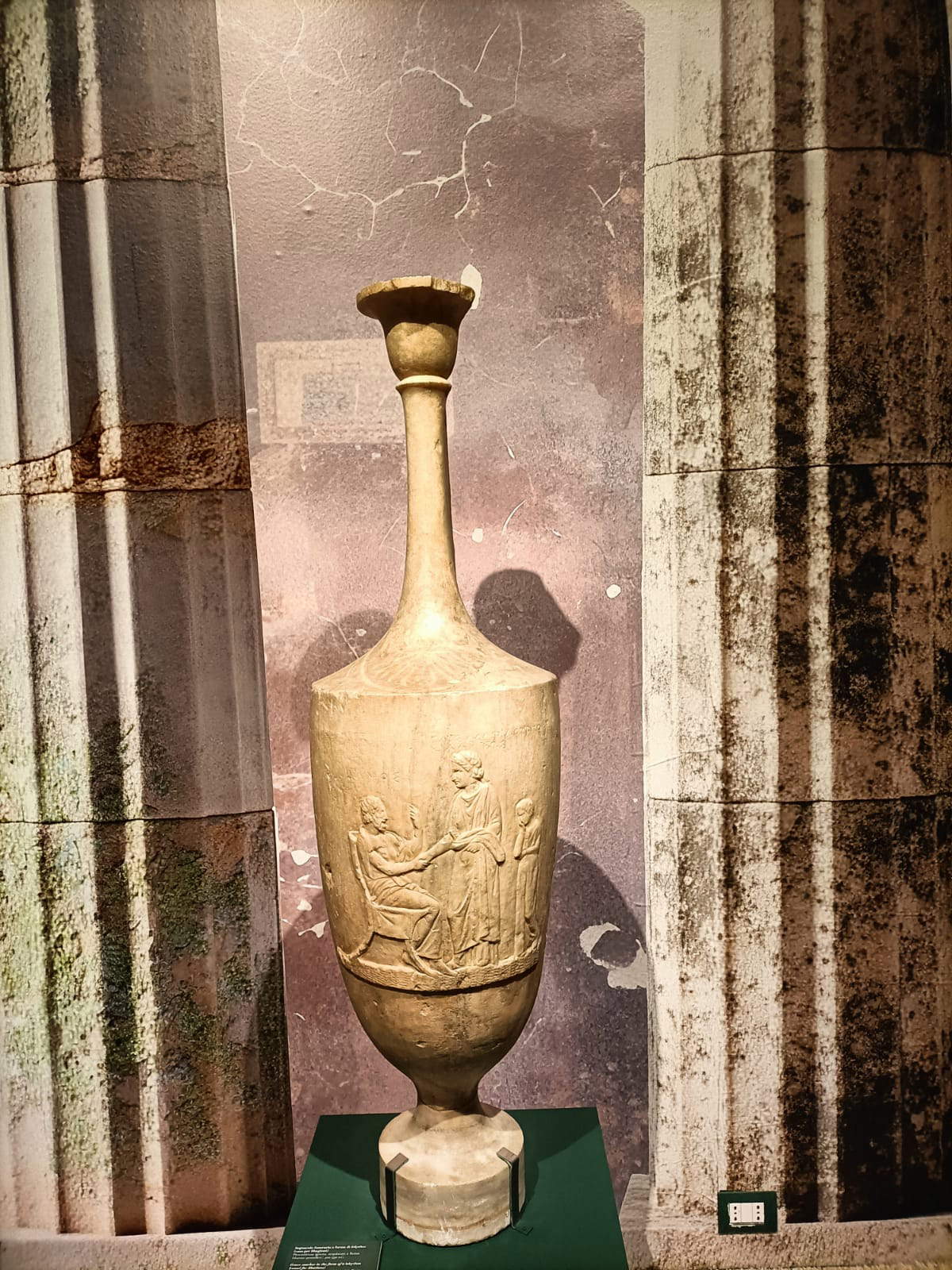
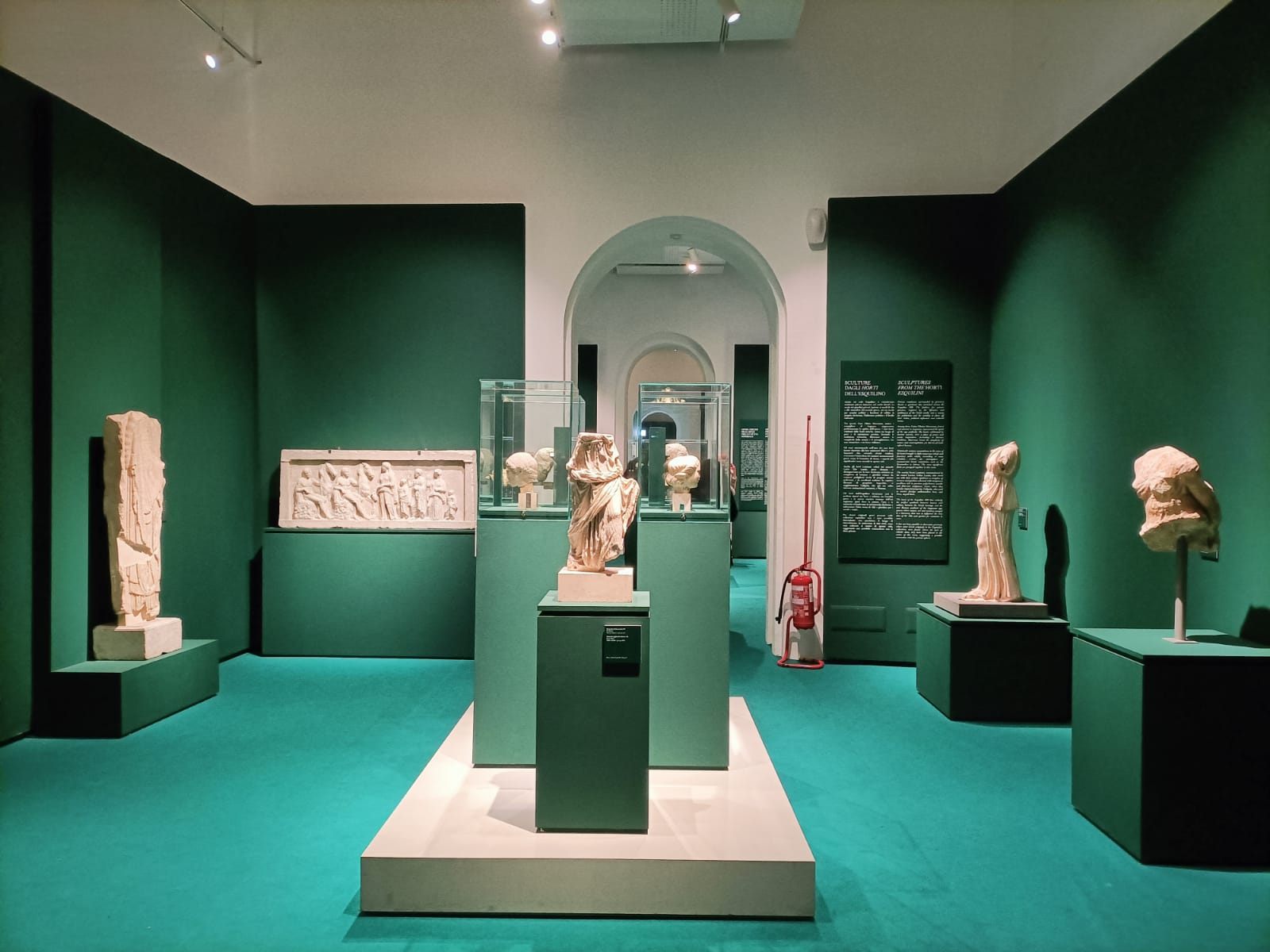
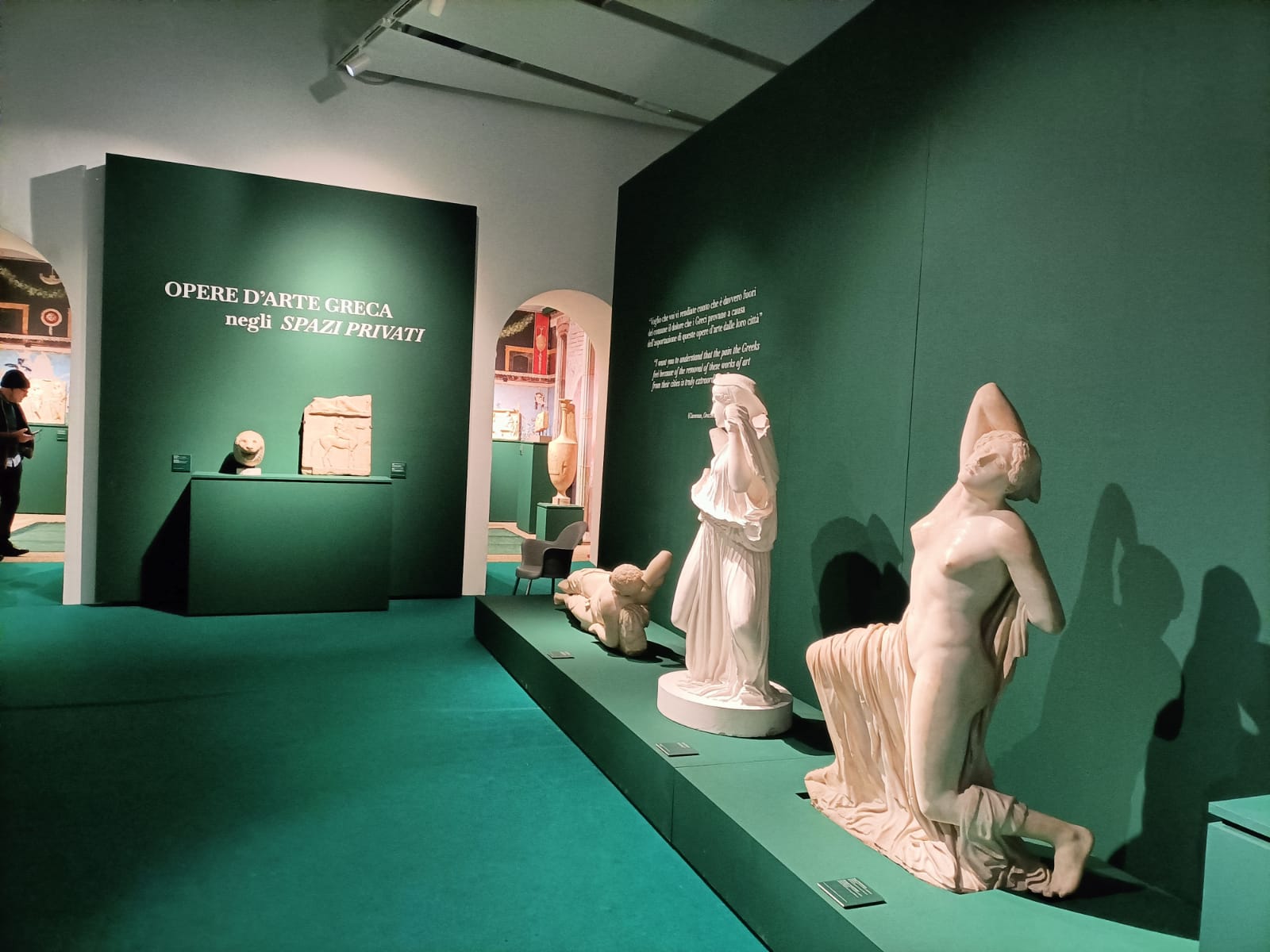
And then how can we fail to mention the precise kinaesthetic attentions that oversee the placement and display of materials; the lighting attentions, functional to preserve the objects, as Brandi put it, in the “thickening of the penumbra”, and again to the dynamics of vision by angulos, that is, not neatly frontal, thought out, for example, for the frontonal sculptures on the long podium of the room with which Section IV opens and which depict the myth of the massacre of Niobe’s children. And, again, for the marble lekythos (large, narrow, elongated vase) displayed in the “garden room,” about which we will say more later, the typical display in the intercolumn is recovered, which served in ancient times as a mnemonic frame.
The works
In addition to works from the Museums System of Roma Capitale (Musei Capitolini, Antiquarium, Centrale Montemartini, Giovanni Barracco Museum of Ancient Sculpture, Museum of Roman Civilization, Ara Pacis Museum, Teatro di Marcello, Sacred Area of Largo Argentina, Museum of the Imperial Forums) and important Italian institutions, such as the National Roman Museum, the Uffizi Galleries in Florence and the Archaeological Museum in Naples, the exhibition boasts loans from the most famous museums in the world, including the Ny Carlsberg Glyptotek in Copenhagen, the Museum of Fine Arts in Boston, the Vatican Museums, the Metropolitan Museum of Art in New York, the British Museum in London, and the Museum of Fine Arts in Budapest. Works from private collections, notably the Sorgente Group Foundation in Rome and the Al Thani Collection in Paris, also complete the exhibition.
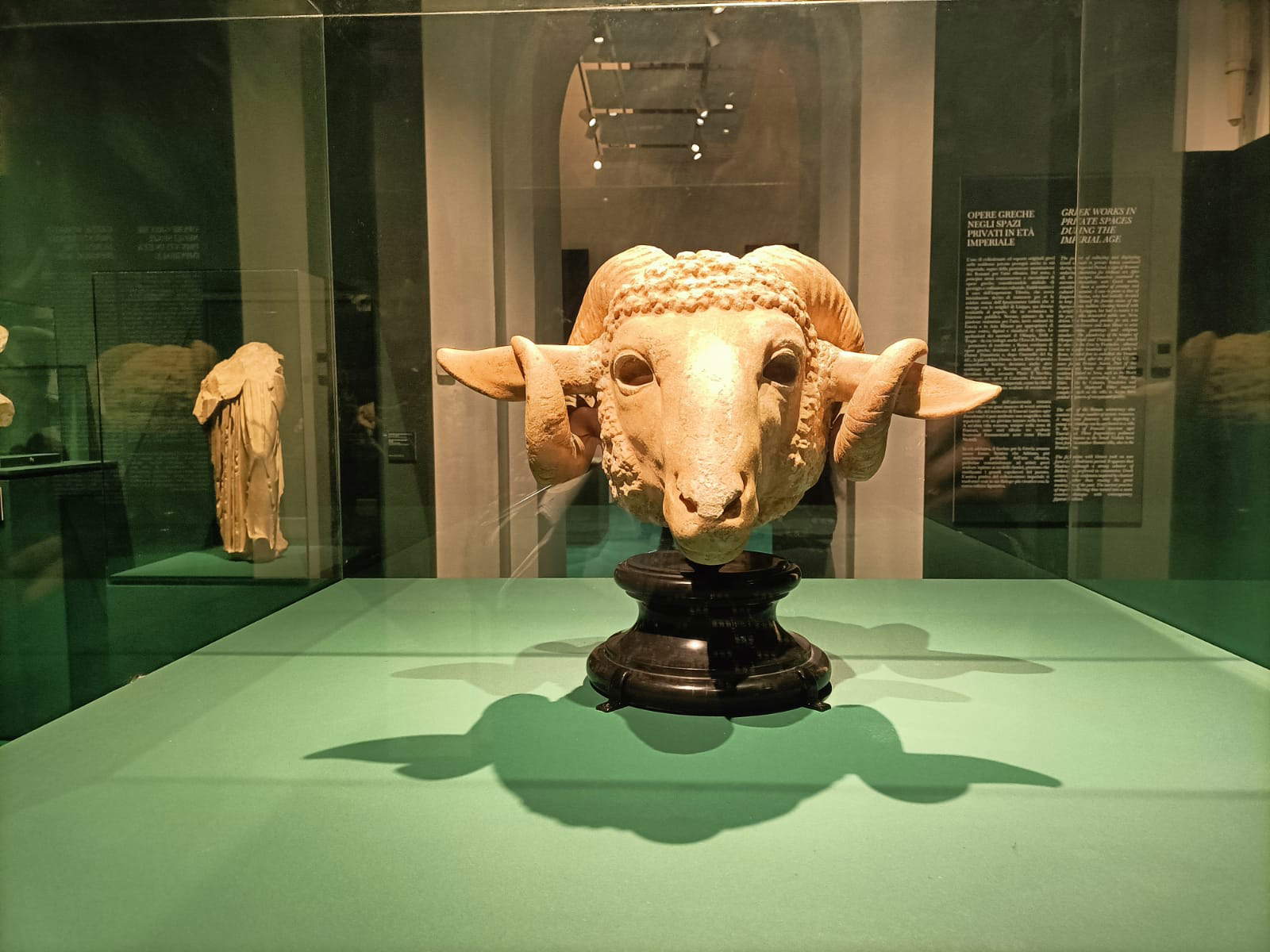
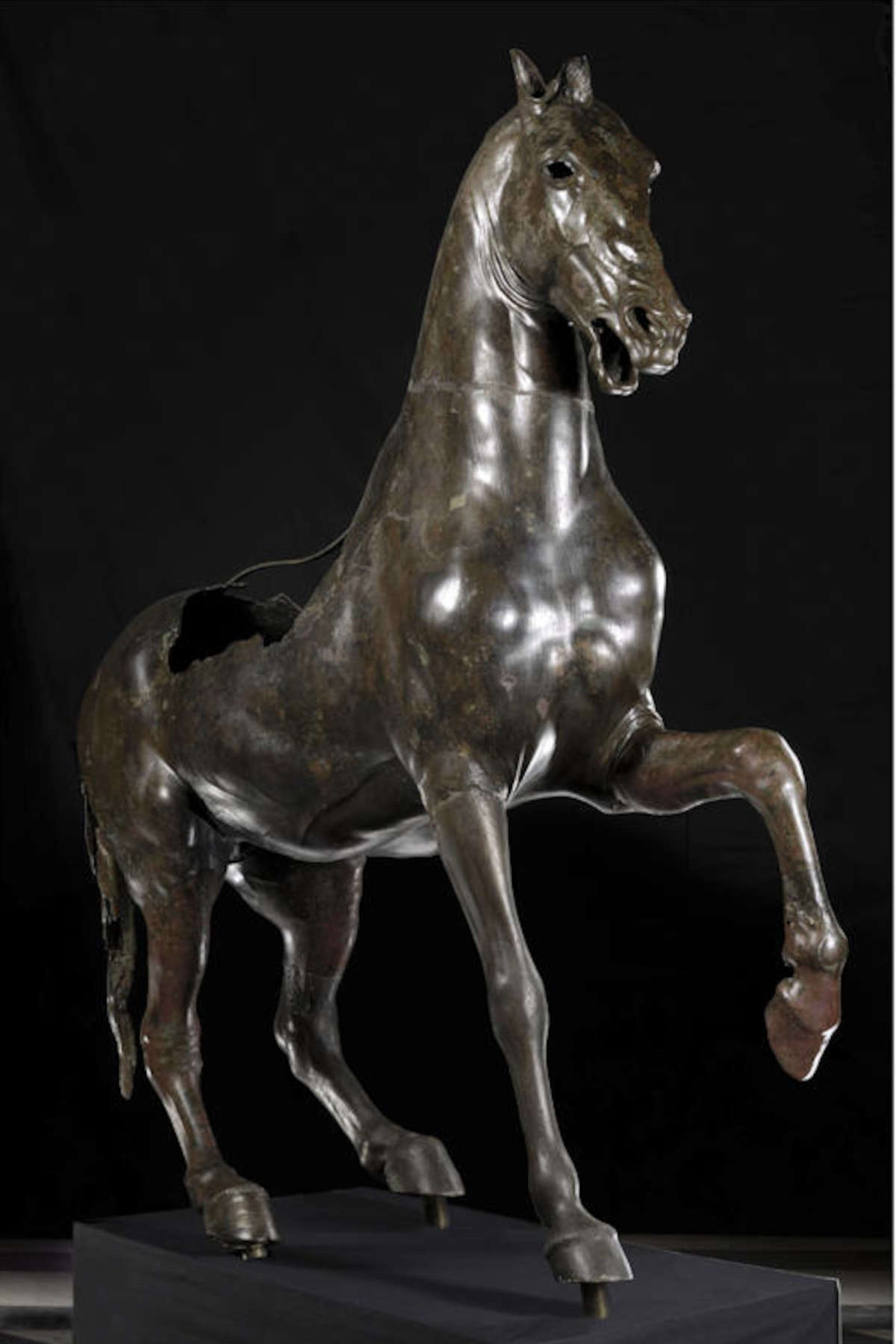
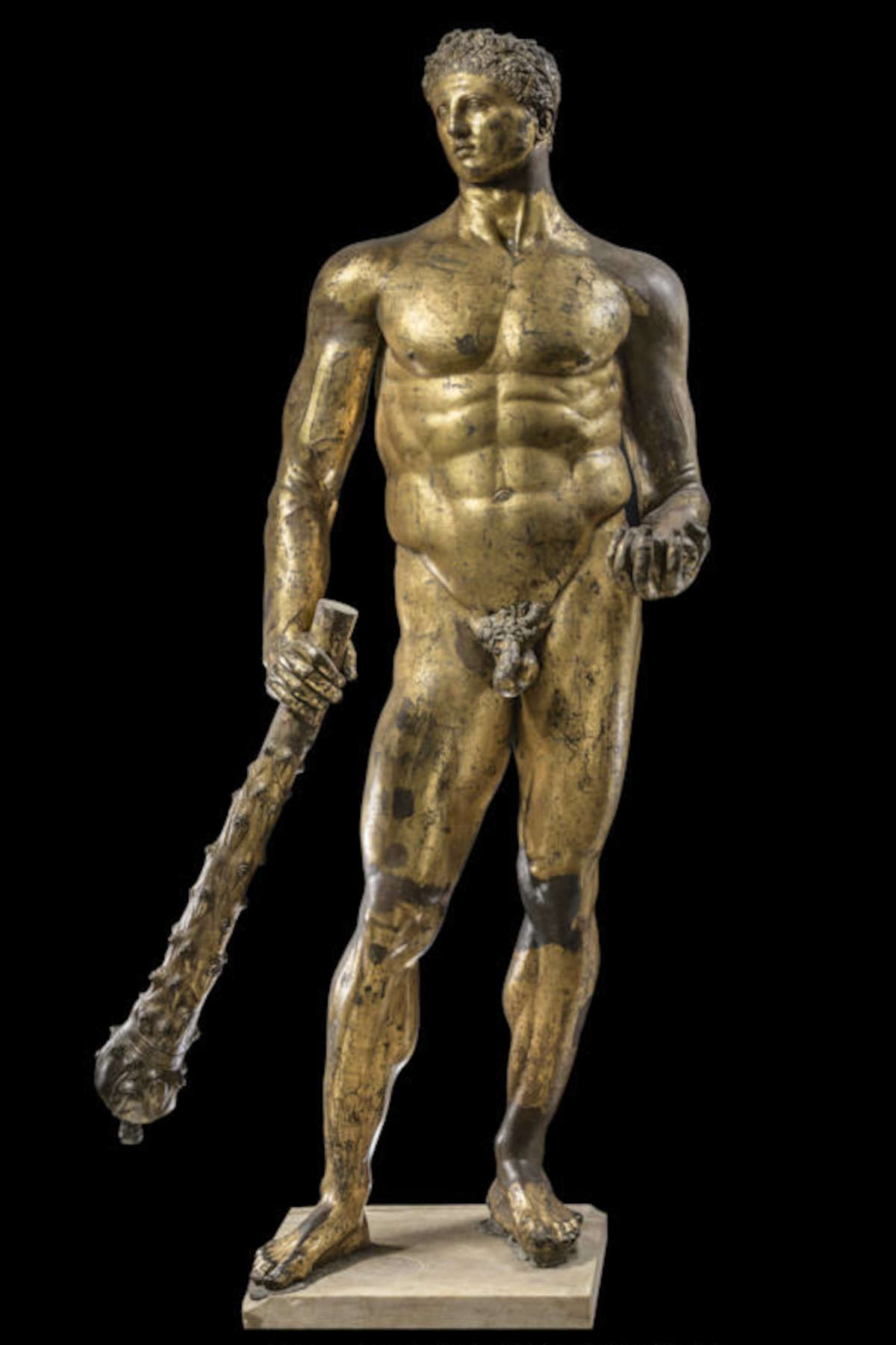
Along with a vast repertoire of heterogeneous materials, among the many masterpieces on display are the monumental horse, a 5th-century original attributed to the bronze artist Hegias, the master of Phidias; the colossal statue of Hercules in gilded bronze; and the large votive relief with the Dioscuri, one of the most impressive to have come to Rome, which is surprisingly well preserved; the Group of theEphedrismos, with the two pairs of maidens engaged in the ancient game of “straddling,” reunited for the first time on the occasion of the exhibition; the superb life-size Ram’s Head, in which extraordinary realism is matched by refined detail.
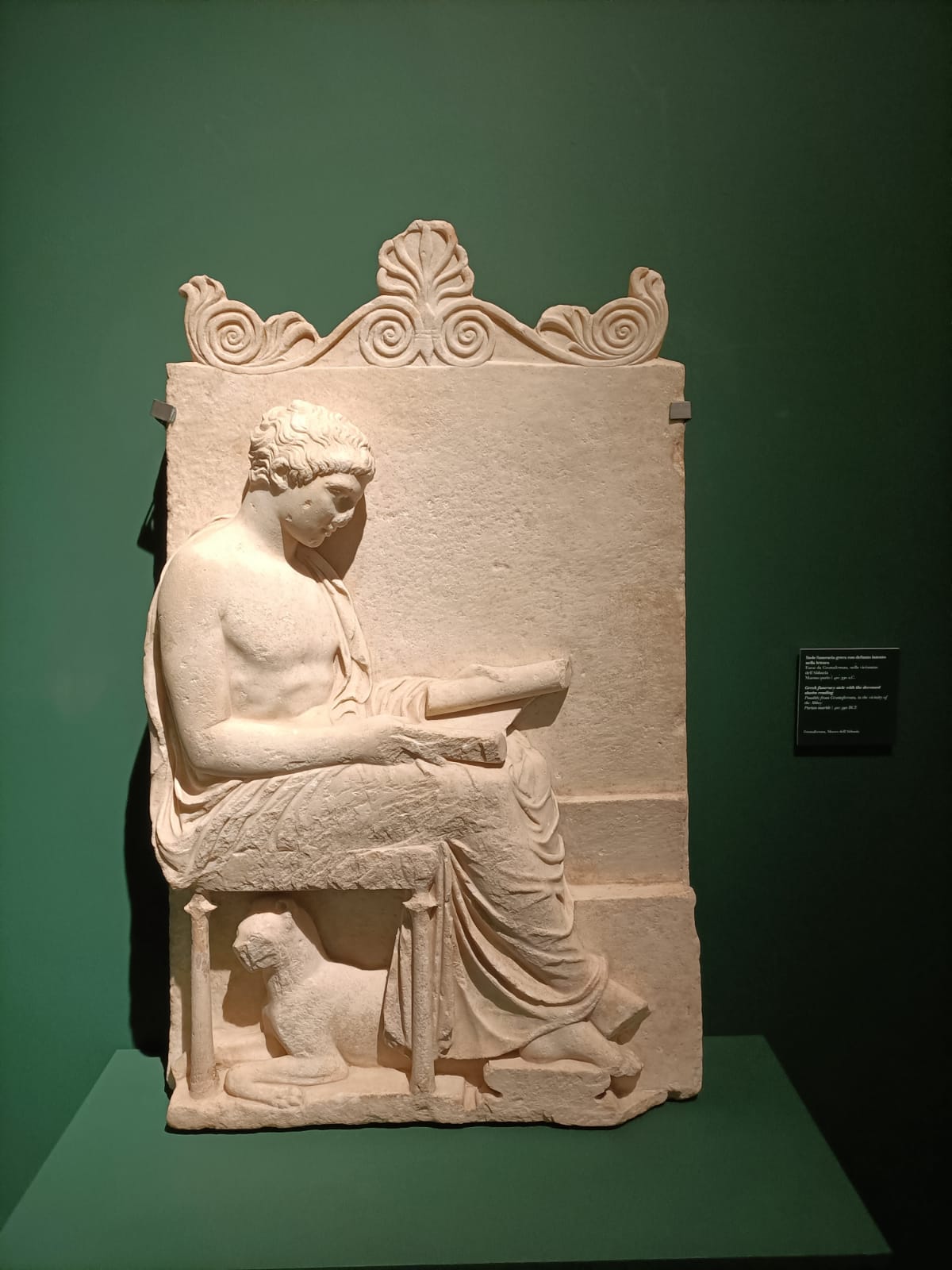
Among the works one moves by its measured intensity the Stele of Grottaferrata, a funerary stele depicting a young man absorbed in reading a volume he holds on his lap. It is a bas-relief constructed by the Greek sculptor by parallel planes, which in a short compressed space suggest a sense of depth. The figure perfectly contained within an ideal parallelepiped with its simple gesture shows itself to us men of the 21st century as familiar, everyday and at the same time removed into a dimension of otherworldly intangibility. It is a manifest image to the importance of education: the culture and training that can overcome death and qualify our lives even when it has left us.

The exhibition itinerary
It is divided into five sections, introduced by a graphic map of the Roman empire between the 2nd and 1st centuries BC. The first section, entitled “Rome Meets Greece,” examines the earliest contacts between Rome and Greek communities, already between the 8th and 7th centuries BC. Through the vast network of relations and exchanges in the Mediterranean, often through the mediation of southern Italy and Sicily, refined artifacts, mainly ceramic, arrive in the city, destined for prestigious contexts such as sanctuaries and tombs. Significant examples of this are some fragments of ceramics with which the section kicks off, from the region of Euboea in Greece, found in the Sacred Area of Sant’Omobono, lined up in the table-library at the end of the first room, and, again, the so-called Group 125, discovered on the Esquiline, a rich aristocratic funerary outfit with valuable ceramics of Corinthian import. Notable among these is a jug(olpe) with an inscription in Greek “of Kleiklo,” perhaps the name of a merchant from Corinth who settled in Rome at the time of Tarquinius Priscus, a valuable clue to the social and cultural mobility of the period. This is a fundamental aspect that allows us to reconnect with what we said at the beginning: Rome, even in its earliest stages knew how to integrate foreign flows and transform them into part of its own identity. We then continue with a selection of exceptional finds, including votive bronzes depicting a kore and a goat.
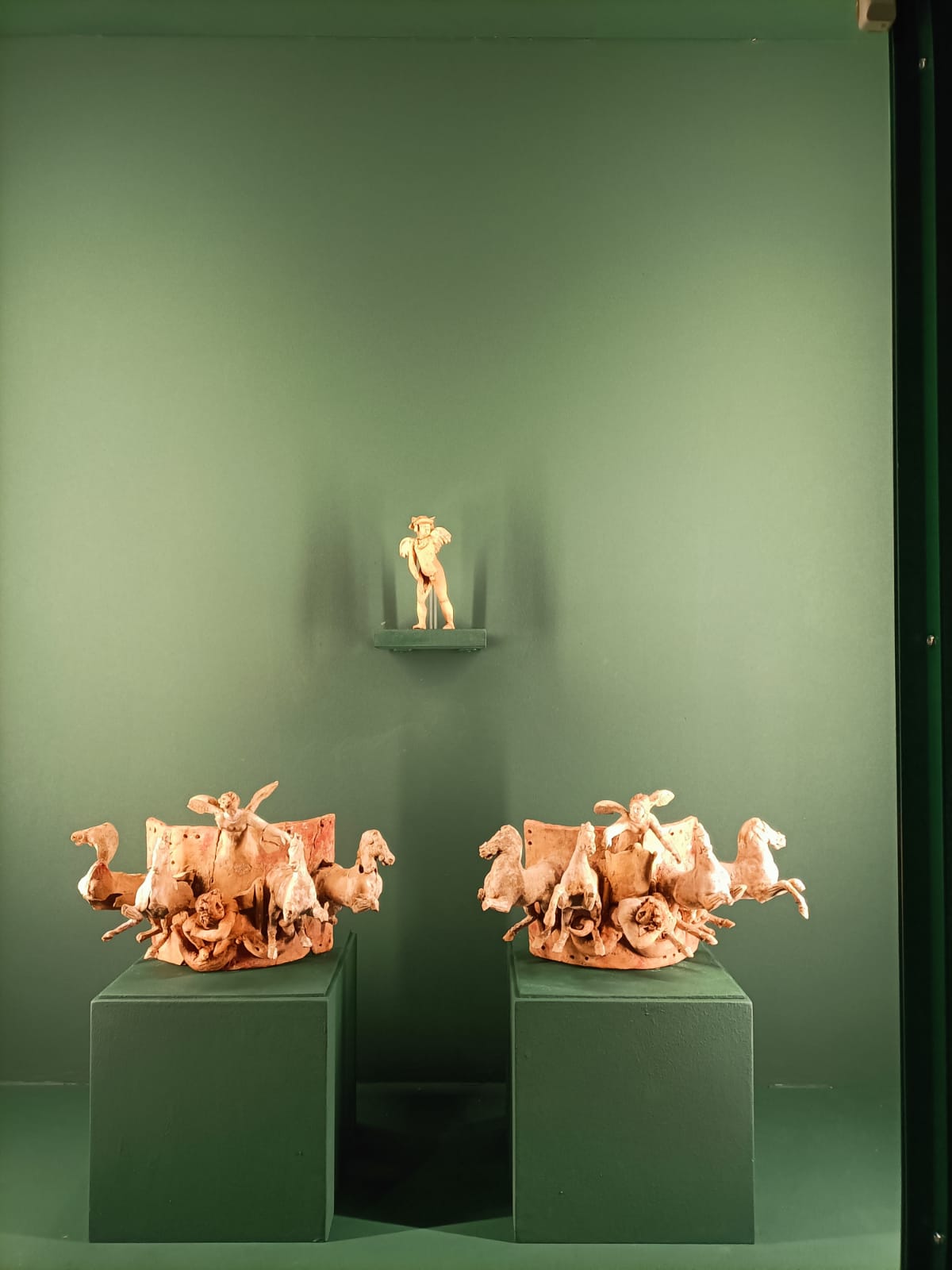
Openness to Greek products is evident not only in trade but also in early identification between Greek and Roman deities, as evidenced by the fragment of a krater with the god Hephaestus on a mule found in the Roman Forum. An increasing import of objects of all kinds (bronze votive statuettes, marble artifacts and cups used in sacred rituals), displayed in the corridor, testifies that with the establishment of the Republic in 509 B.C. the desire to assimilate Greek forms, models and rituals intensified. But painted depured clay artifacts are also noted, such as the two fine sconces depicting a quadriga led by a winged Nike (early decades of the third century BCE).
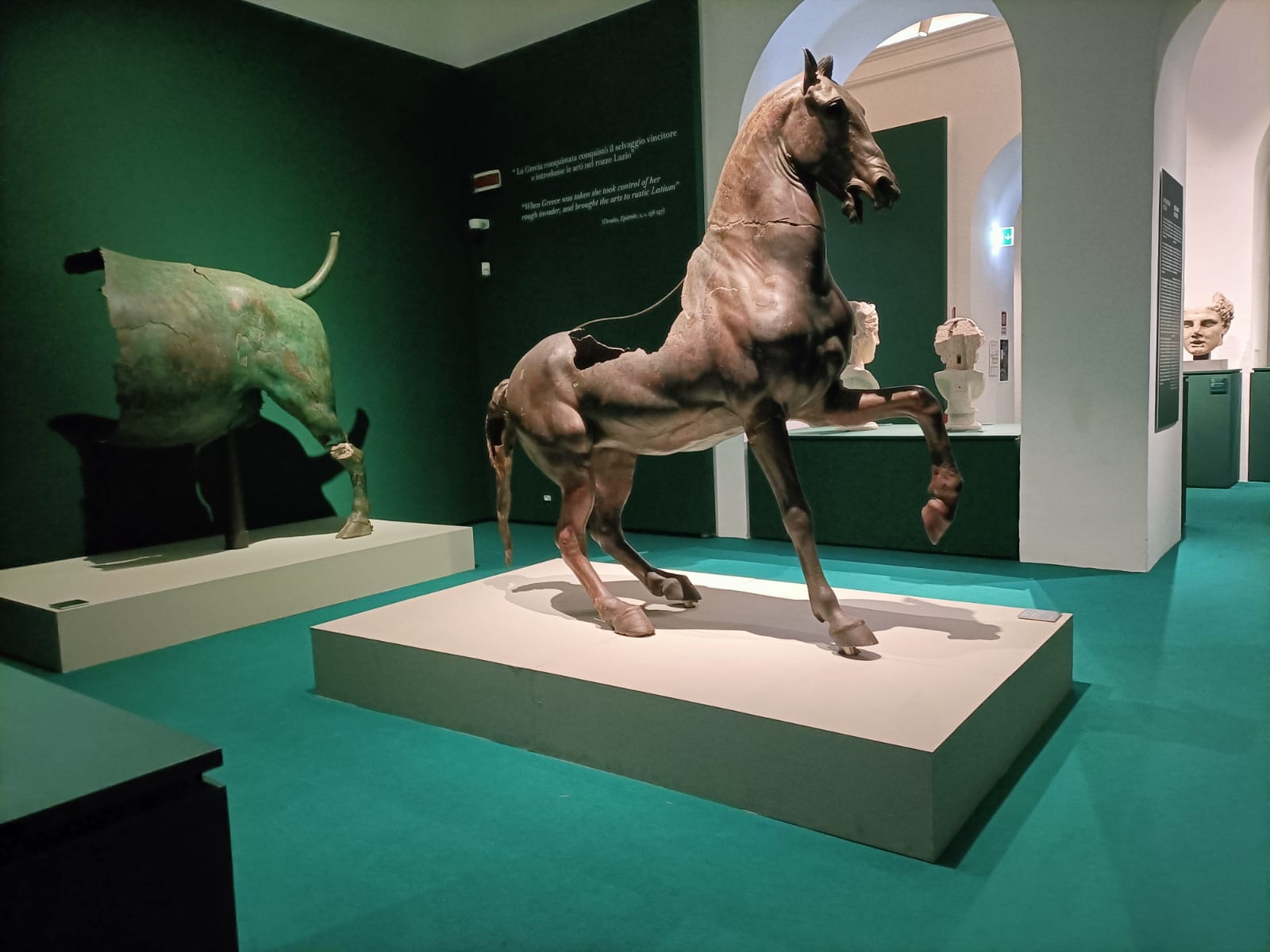
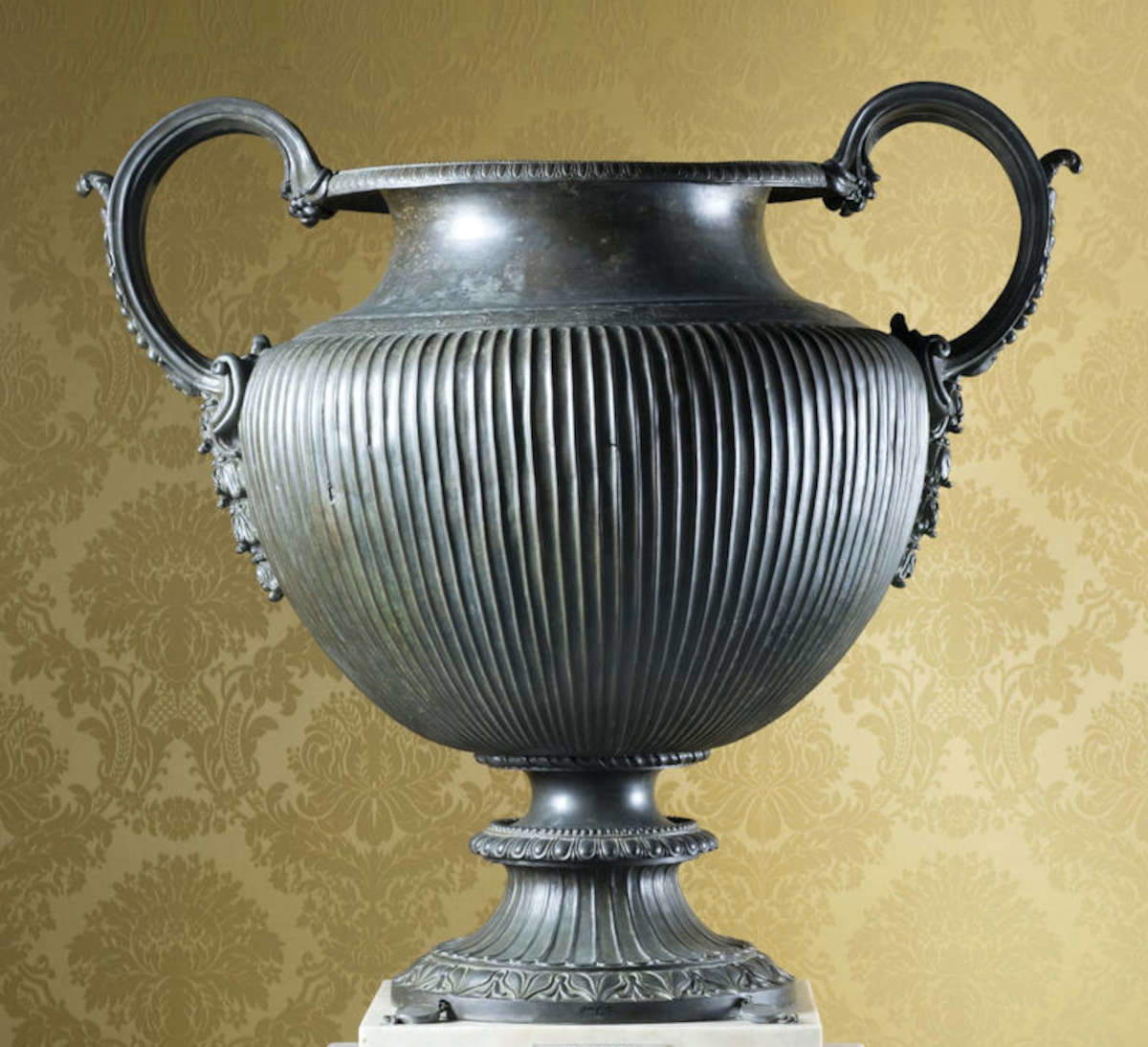
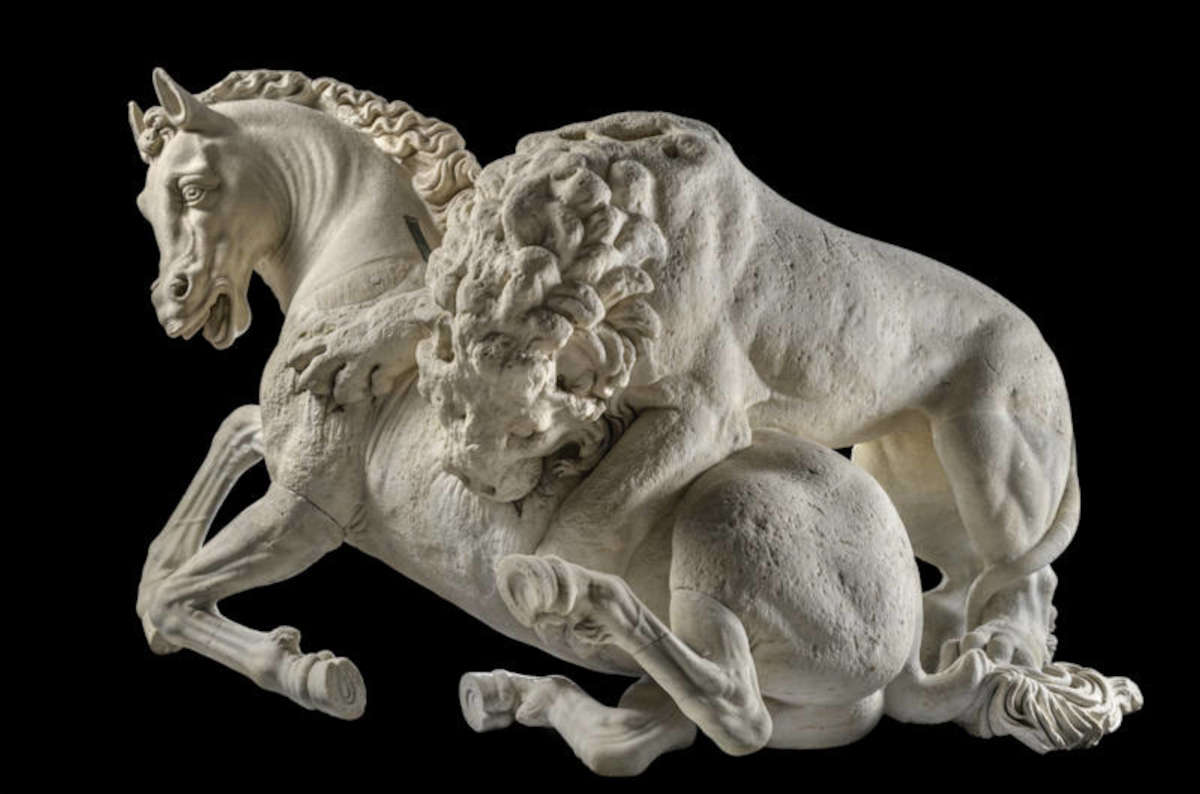
From importation to appropriation. On this change in Rome’s attitude toward Greece (by then subjugated during the 2nd century BCE) is based the second section of the exhibition, “Rome Conquers Greece.” It opens with an extraordinary gimmick, almost, a visual “oxymoron”: the conquest is introduced by a seemingly modest piece: a block of travertine with a two-line Greek inscription, the original of which was transferred by Sulla, after the sacking of Athens in 86 BC. The section restores an idea of the artistic booty transferred to Roman territory with the domination of the eastern Mediterranean, mostly consisting of bronze artifacts such as the famous Crater of Mithridates V, recovered from the seabed off Nero’s villa at Anzio. To have brought together so many bronze artifacts, a rarity given the recasting of these works in the Middle Ages, in one room alone is worth the visit: in addition to the colossal Statue of Hercules already mentioned or the Hindquarters Bull, in the center of the room it is given to turn 360 degrees around the majestic Horse (5th century B.C.) to fully appreciate the soaring proportions and naturalism of the pose.
Through looted art Rome appropriates not only the material goods of Greece but, through them, its memory, becoming unwitting custodian of the artistic heritage of the Hellenic world. Next step after appropriation is integration. “Conquered Greece conquered the conquering savage and introduced the arts into uncouth Latium,” wrote Horace (Epistles, II, 1, 156). With this sentence the narrative of the third section opens, “Greece conquers Rome.” In the central hall is an extraordinary concentration of masterpieces, from the Amazon on horseback (late 5th century B.C.) to theAcroterio Montalto (400 – 300 B.C.), which makes its return to Rome after an absence of two centuries. Similar to a neoclassical culture in terms of the smoothing of the surface, it is juxtaposed, because of the detail of the slipped peplos that leaves the figure’s entire right side uncovered, with another acroterial figure (placed on the apex or corners of a pediment): a Leda with a swan (410-370 BC). Among the sculptures on the central spine, an Athena Nike (430 B.C.E.) literally stands out because of its slight sparkle: this is due to the quality of the marble, lychinites, the finest quality quarried in Paros, Cyclades, famous since antiquity for its purity and luminosity.
Many of the works of art displayed in the section had come from Greece in the retinue of the victorious generals and placed in the public spaces of the city (squares, porticoes, temples and libraries), helping to transform its appearance and nurturing the Romans’ growing passion for Hellenistic culture, now considered an indispensable part of the education of every educated man. The relocation of these objects involved their refunctionalization: artifacts that had originated as votive offerings or as celebratory monuments of Greek rulers were displayed as symbols of Roman power, taking on new functions and new values within the Urbe. A case in point is the Templum Pacis, to which an in-depth discussion is devoted in a small room next to the main one. This is the great complex commissioned by Vespasian after his victory in Judea (75 CE), which perfectly summarizes the fine line between power and art: born as a symbol of restored peace, the temple soon became a sort of museum of Greek art in the heart of the Empire. Scenically dominating this central core of the exhibition is the video projection dedicated to the Greek frontal sculptures reused in the temple of Apollo Sosianus, located in front of the Maecello Theater.
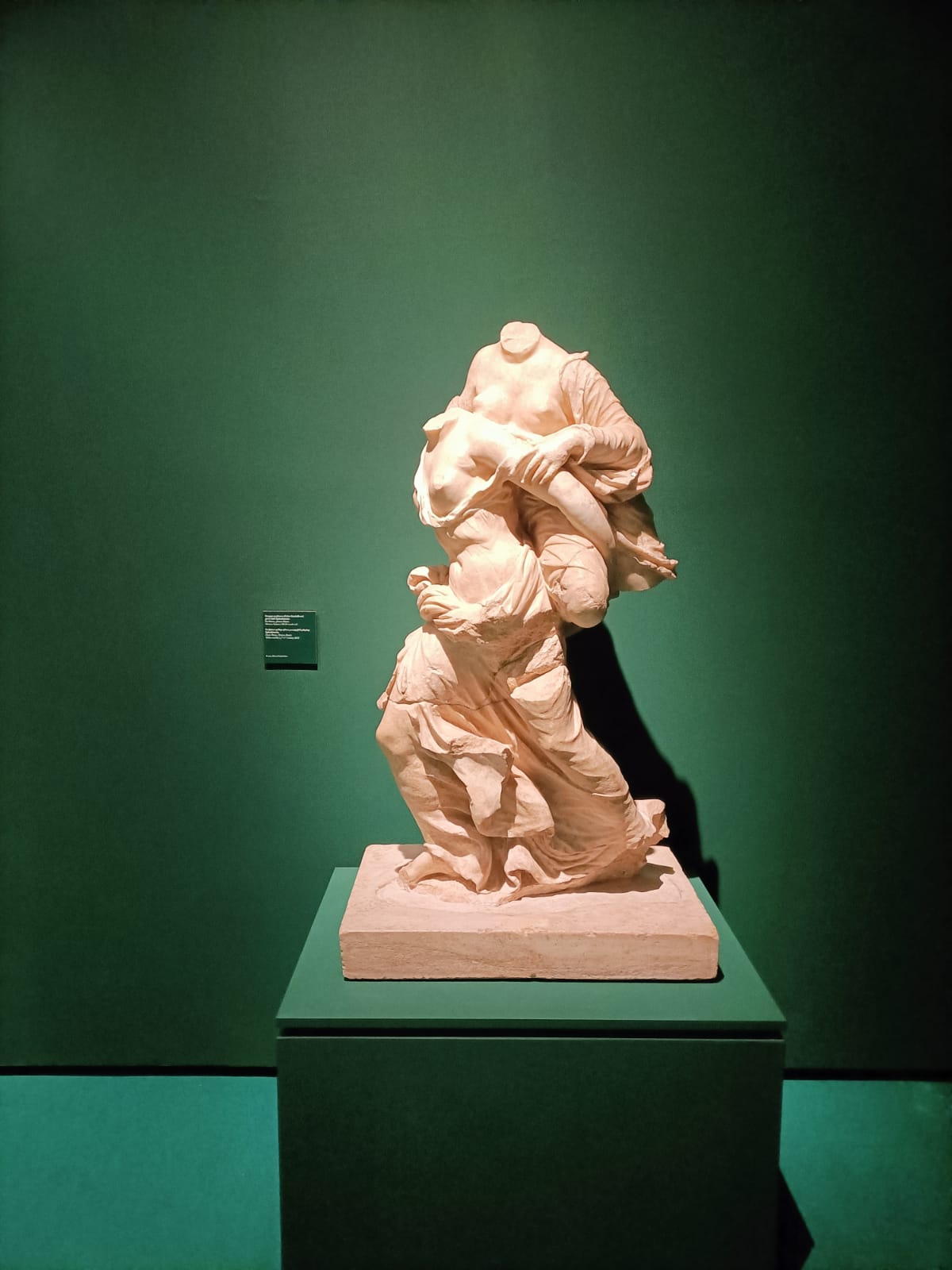
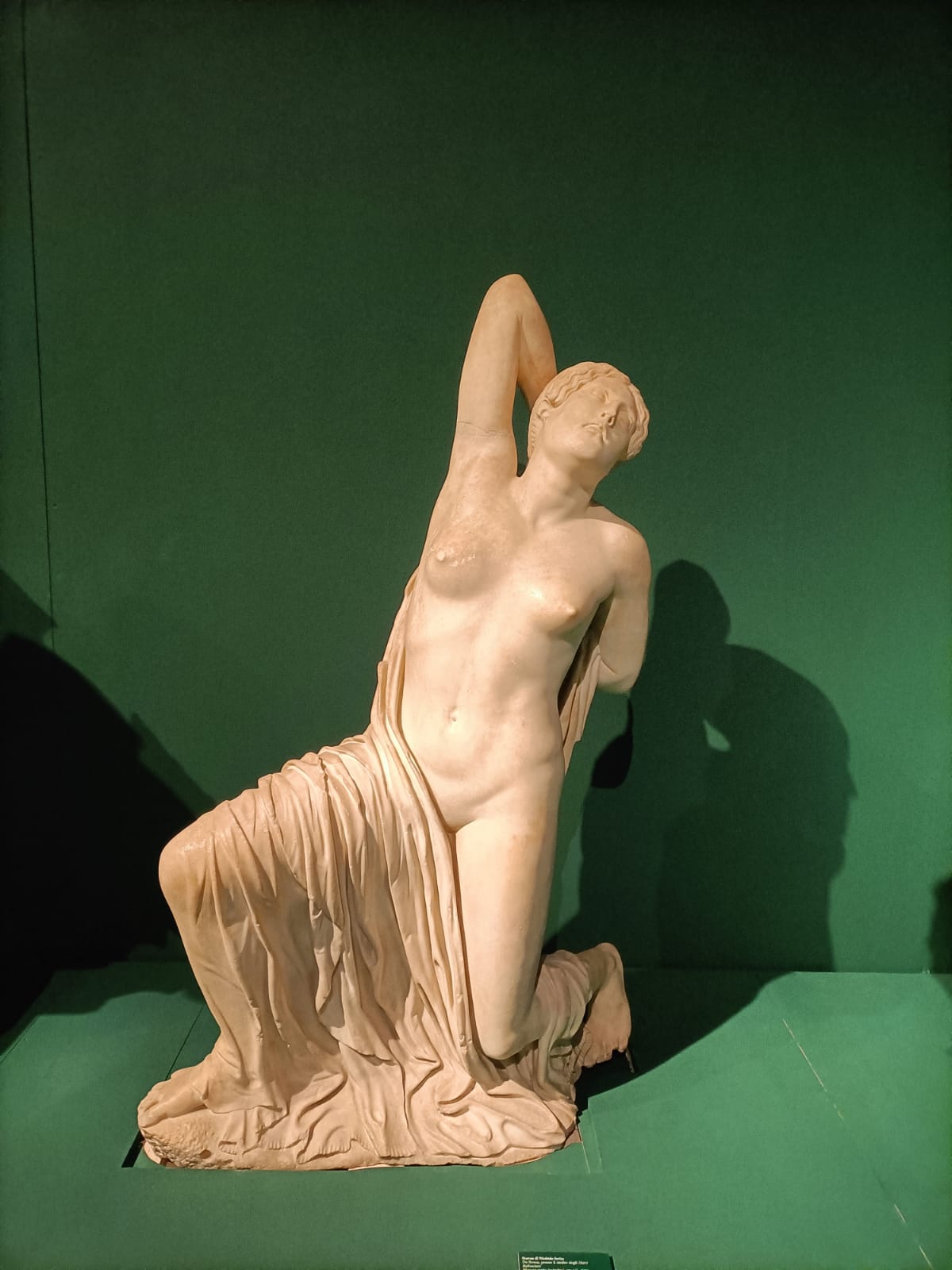
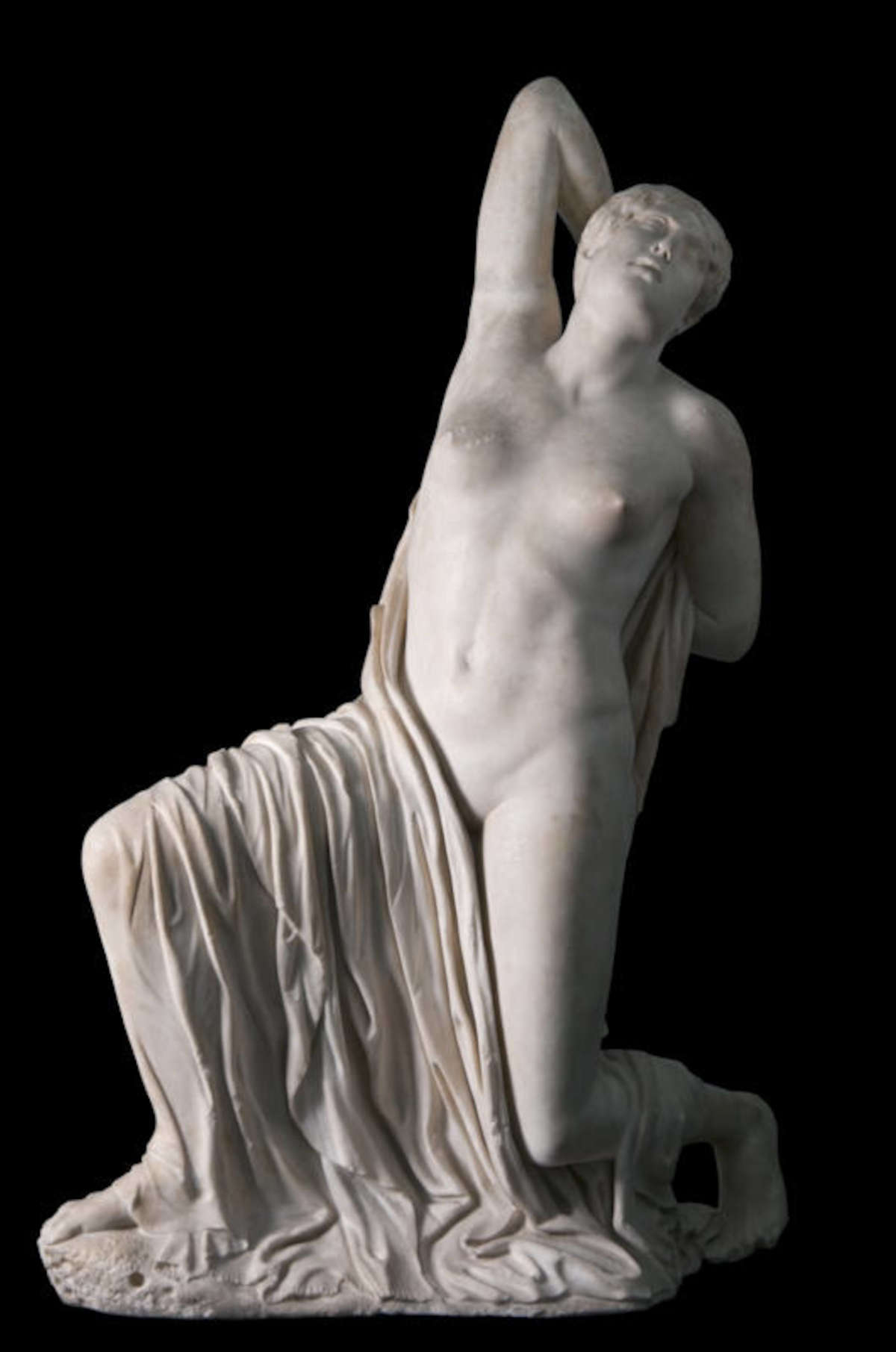
Not only public monuments, but also private residences could be enriched with artworks of Greek origin. The theme is developed in the fourth section, “Greek Works of Art in Private Spaces,” which is divided into two subsections. The first presents the Greek sculptures that decorated the horti, or sumptuous residential complexes surrounded by the greenery of nymphaea and fountains on the edge of central Rome. It is possible to admire a selection of masterpieces, exceptionally brought together here, from the Sallustian horti , between the Pincian Hill and the Quirinal Hill: prominent among them, on the long podium to the right of the room, are the pediment sculptures depicting the myth of the massacre of Niobe’s sons, killed at the hands of Apollo and Artemis. In particular, the collapsing female figure struck in the back by a dart was chosen as the exhibition icon.
Also present are significant finds from the horti of Maecenas and the Lamiani horti, which stretched across the Esquiline Hill. Next in the second grouping are works related to villas of the imperial age largely located in the suburbs, a sign of the Romans’ persistent admiration for Hellenic art, considered a symbol of prestige and cultural sophistication. One room in the exhibition recreates a garden of a wealthy Roman residence, where two monumental works stand out: the marble lekythos (large vase) and a marble lion, reused as an ornamental element for fountains. In another room in this section the absolute protagonist is a life-size ram’s head in Pentelic marble, which offers an example of the precious objects Roman emperors loved to surround themselves with. So did the aristocracy. Worthy of all is the Grottaferrata Stele already mentioned.
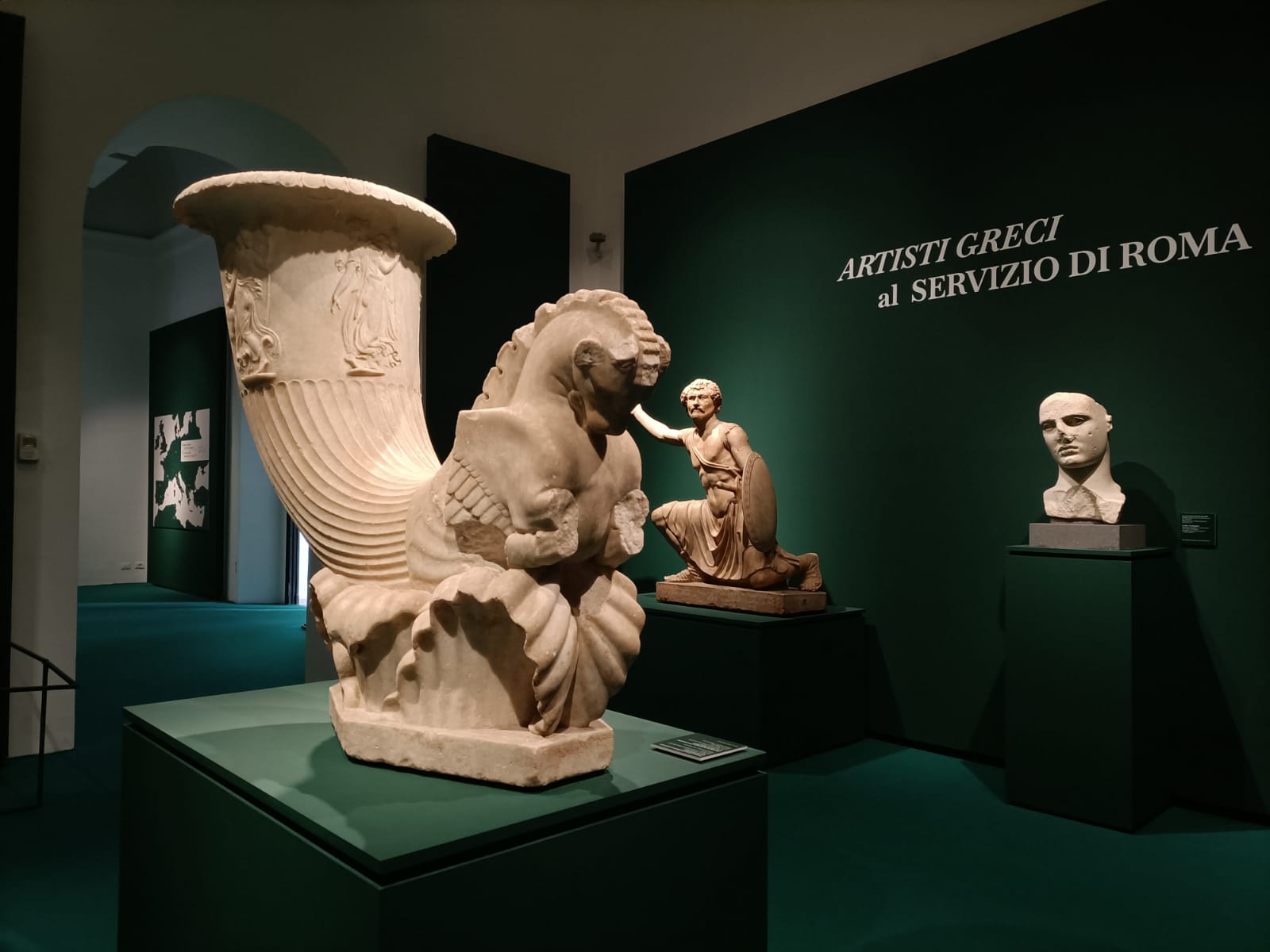
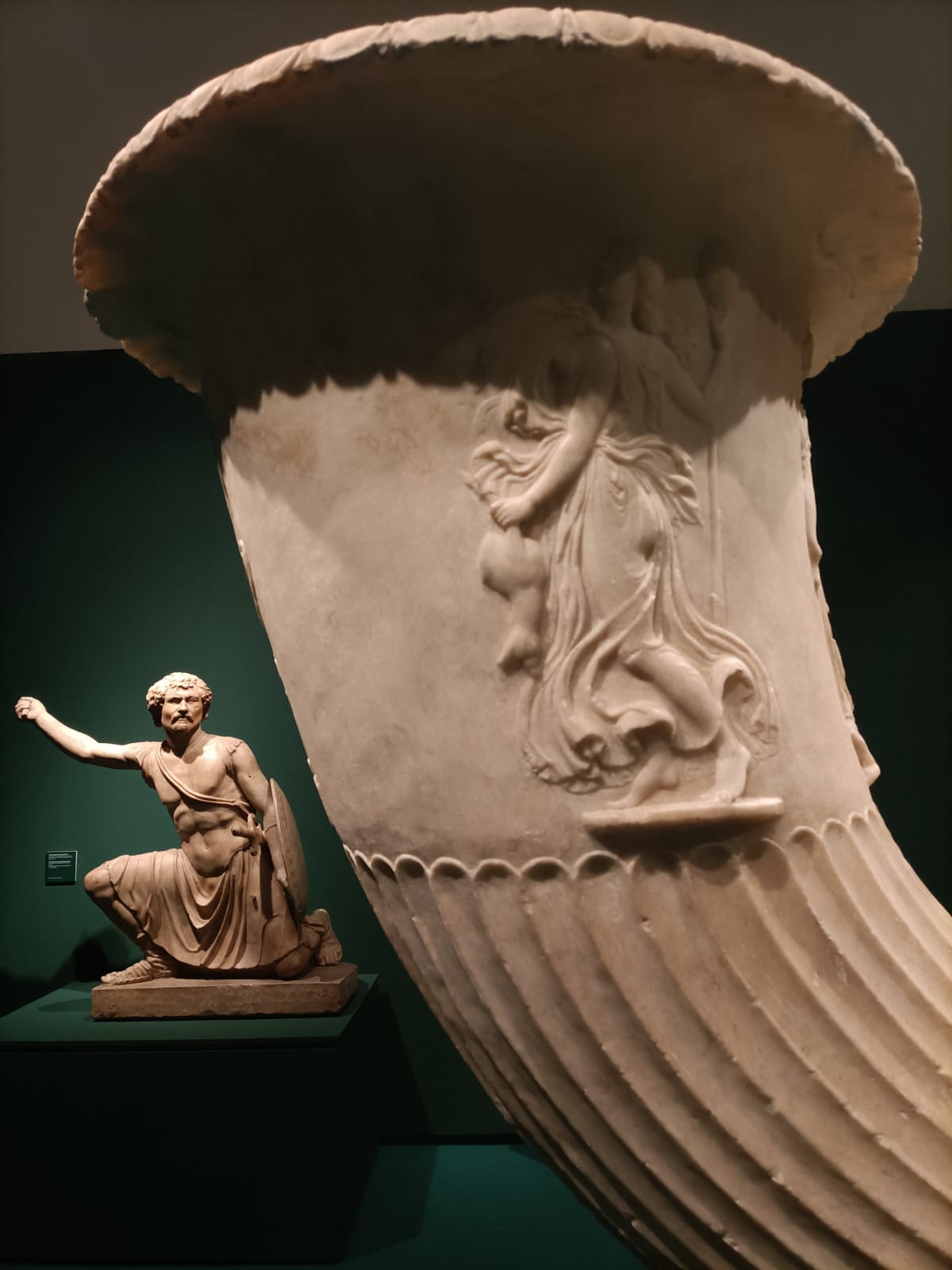
Beginning in the second century B.C.E., many Greek sculptors migrated to Rome and set up flourishing ateliers there, also specializing in the creation of cult statues in the classicist style intended for Roman temples. Later, in the first century B.C.E., the growing demand for Greek art stimulated the establishment of workshops, mostly active in Delos and Athens, specializing in refined eclectic-style creations. This production is recounted in the fifth and final section, “Greek Artists in the Service of Rome.” The works often took up mythological or Dionysian subjects from the tradition, as is represented in the Fountain in the shape of a Rhyton (potentory horn; 1st cent. BCE), decorated with Maenads and signed by the artist Pontios.
Toward the end of the tour, the exhibition takes a playful departure, inviting visitors to “find the differences” between twin statuettes of the young Pan from a villa on the outskirts of Rome (among the few works of which it is forbidden to take photographs): identical in form, they differ in the quality of the marble and the content of the inscription on the pillar. Greek art had by then become a pliant tool bent to Roman needs: the deep religious sentiment that permeated the best artistic production of the Archaic and Classical ages had been lost in favor of the aesthetic quality of the work of art.


The author of this article: Silvia Mazza
Storica dell’arte e giornalista, scrive su “Il Giornale dell’Arte”, “Il Giornale dell’Architettura” e “The Art Newspaper”. Le sue inchieste sono state citate dal “Corriere della Sera” e dal compianto Folco Quilici nel suo ultimo libro Tutt’attorno la Sicilia: Un’avventura di mare (Utet, Torino 2017). Come opinionista specializzata interviene spesso sulla stampa siciliana (“Gazzetta del Sud”, “Il Giornale di Sicilia”, “La Sicilia”, etc.). Dal 2006 al 2012 è stata corrispondente per il quotidiano “America Oggi” (New Jersey), titolare della rubrica di “Arte e Cultura” del magazine domenicale “Oggi 7”. Con un diploma di Specializzazione in Storia dell’Arte Medievale e Moderna, ha una formazione specifica nel campo della conservazione del patrimonio culturale (Carta del Rischio).
Warning: the translation into English of the original Italian article was created using automatic tools.
We undertake to review all articles, but we do not guarantee the total absence of inaccuracies in the translation due to the program. You can
find the original by clicking on the ITA button. If you find any mistake,please contact us.