
Greece is positioning itself as the central southern gateway for liquefied natural gas (LNG) imports into Europe, as it takes advantage of the European Union’s ban on Russian natural gas by 2027.
In preparation, Greece is leveraging its strategic geographical location, expanding LNG importing capacity, upgrading infrastructure, and strengthened its ties with the United States to secure a central role in the EU’s post-Russian energy market.
Before the invasion of Ukraine began in 2022, Russia supplied approximately 40% of the European Union’s natural gas, but by 2024, this market share had plummeted to 11%. Meanwhile, US LNG now represents nearly 60% of the EU’s total LNG imports.
At the center of this transition is Revithoussa, Greece’s LNG terminal built on the rocky island west of Athens, and which has become a crucial entry point for American natural gas.
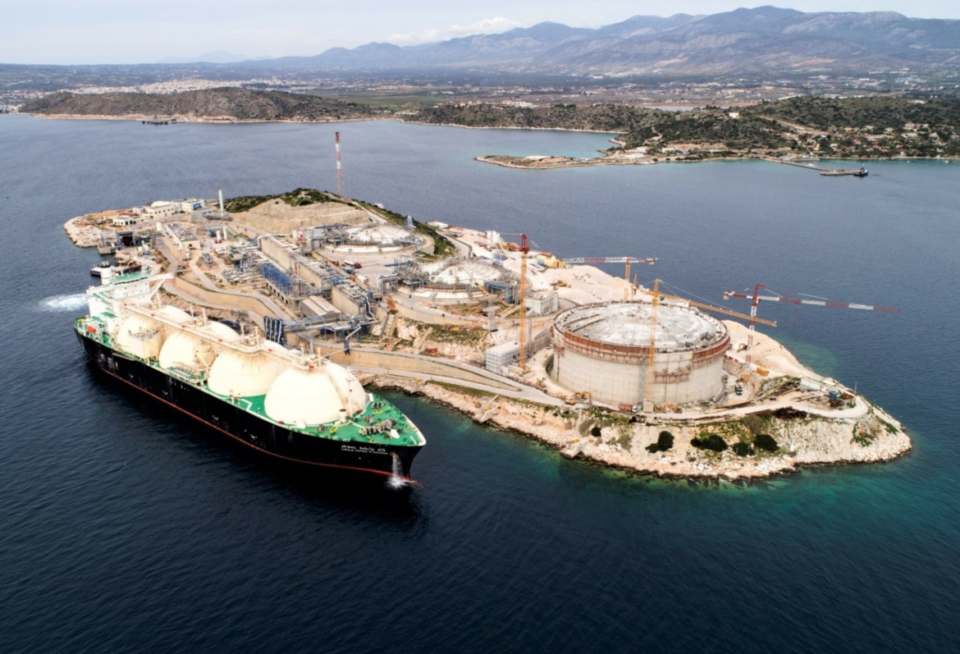
The Revythousa LNG Terminal
It is from this facility that, once re-gasified, natural gas is transported northward toward the Balkans and beyond via the Vertical Corridor, the collaborative pipeline system established by Greece, Bulgaria, Romania, Moldova, and Ukraine that completely reversed the traditional north-to-south flow of European gas.
According to the Financial Times, LNG buyers are booking slots for ships to load at the Revithoussa terminal all the way up to 2040.
Emphasizing this energy transition, Greece’s Minister of the Environment and Energy Stavros Papastavrou was also quoted by the Financial Times as saying that “we are no longer going to finance the attacker. More efforts must be made to phase out Russian fossil fuels. This decoupling will not happen by itself.”
Significant barriers remain, however, including physical bottlenecks within the Vertical Corridor’s pipeline system. Furthermore, the accumulation of natural gas transit tariffs across Greece, Bulgaria, Romania, and Hungary currently makes the corridor expensive.
Beyond these logistical and financial hurdles, the Financial Times notes critics warning Europe against exchanging one geopolitical dependency for another. However, an expert quoted in the article also points out that political intervention is much harder as US gas exports are dispersed across multiple companies.