
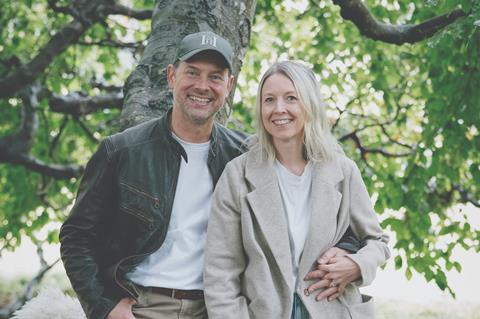
Andrew Mitchell has always been musical, but in a very private way. “I hated performing. I didn’t sing. It was piano, composition, arrangements – stuff I could do in the background.”
So, when he felt a clear and unequivocal call to worship ministry, he was not best pleased. “I didn’t have any desire to be a worship leader,” he says. “I really wanted to be a lawyer.”
Early life
The desire to earn significant amounts of money stemmed from a difficult childhood experience. He may have been an elder in their local church, but Andrew’s father was “leading a double life”; he had an adulterous affair and even bought another house. Andrew was 22 when his parents finally spilt. It was a challenging period, which also included moving from their much-loved family home.
“There’s always that sense of needing to re-establish safety and provision,” Andrew admits. “I thought: I never want to experience that again. I’m going to go into law, help families, also have a nice, fat salary – which will see all that sense of erosion that had happened with my father leaving healed and restored. Of course, you cannot look to things like that for healing and restoration – only God can do that – but that was the tussle I was having.”
During the darkest times, music was a refuge. “I remember sobbing at my piano when my father finally did go,” says Andrew. Shortly afterwards, he felt God speak to him about a different path. “God said to me: ‘I really want you to write worship and to minister.’ And I said: ‘Absolutely not. I am not an extrovert. I am not a platform person.’”
Andrew had been a Christian long enough to know he couldn’t “pick and choose” areas of life to give to God. “I had to allow Him to direct me in every area of my life.”
Within three months of his father leaving, Andew had given God his reluctant, slightly terrified ‘Yes’. The timing, he says, was fascinating. “Without all of the control, manipulation and fear that [my father] induced, there was just this clear air,” he says. “I was able to press into God without any negative influence from him.”
Nashville calling
Doors began to open. He spent time in Nashville, met a Christian music producer and toured with a well-known British worship leader.
“Music gave me that voice – to express things that I felt deeply in my heart, to the one who is unconditionally loving, as opposed to my father, who was very conditional and changeable.”
The next seven years were spent between the UK and Nashville, recording three albums and touring relentlessly. In 2010, Andrew was offered a further two album deal with the Christian label Integrity Music when he heard God speak again. “God said to me: ‘I really need to take you out of all of this for a season, because I need to work on your heart.’
“I was really burnt out,” Andrew admits. “I got pretty brittle around the edges. And so I said: ‘You’re right. I can feel it.’
Through prayer walking and spending time with God, Andrew and his wife Jill gave God space to reveal the things in their hearts that had become exhausted and dry. “Our circumstances don’t cause our heart issues. They simply reveal them,” says Andrew. “I felt like I was on a factory floor: producing, writing songs for the next album, live worship events. My well was dried out. I needed fresh revelation.”
The pair began to renovate properties together and Andrew stopped writing songs. “I’d laid down everything to do with worship,” he says. Yet there was always a sense that, one day, God might “tap him on the shoulder again”.
A thin place
In 2015, one of Scotland’s most historic estates came up for sale. Carberry Tower Mansion was once owned by Queen Elizabeth II’s aunt before being gifted to the Church of Scotland in 1961. It was a place of deep significance for Andrew, as he’d visited regularly as a child when it was a Christian retreat centre. He remembered it as “my safe space”.
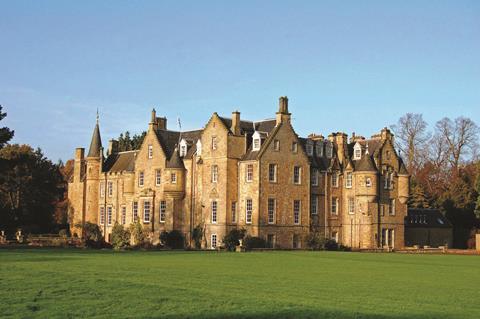
When the Mitchells were first married, they’d rented a house on the estate. “We felt God say that, at some point, we would become owners of the estate. We didn’t know how or when, but it was something we felt deeply but privately. We didn’t share it with anybody.”
But when the company that owned Carberry placed it on the open market following a multi-million pound renovation, Andrew and Jill say they “just knew” it was part of God’s plan.
There was competition from buyers from all over the world, but, after “a huge amount of prayer and intercession”, the Mitchells took ownership of Carberry on Christmas Eve 2015 – only the second private family to do so in 200 years.
“The estate was first given to the monks of Dunfermline Abbey by King David I, so people have been worshipping and praying on this land for almost a millennium. It’s a very, very significant place spiritually. It’s a thin place. It’s really easy to experience God’s presence and connect with him there.”
Making music
Ten years on, the Mitchells run Carberry as a hotel, event and conference centre – as well as it being their “ministry HQ” – a place of spiritual sanctuary.
About three years ago, Andrew felt called back to worship. In a dramatic vision, he saw the word ‘safehouse’ “in big, fiery letters” above his head. “I knew instantly God was saying, that’s what our worship banner was to be.”
In Nashville, he experienced the commercialism of the Christian music industry firsthand. “Every major record label owns a Christian subsidiary. It’s a billion-dollar industry. And, so often, the motivation is wealth and fame and recognition, as opposed to just worshipping Jesus.”
But at Carberry, Safehouse Scotland Music moves to a different beat. “Through His grace, we have no reliance on worship for a mortgage, a lifestyle, secret aspirations – we don’t have any of that. We get to minister from a place of uninfluenced neutrality. There’s an incredible liberty in that.”
As well as writing his own worship music, he is also passionate about gathering others “whose hearts are focused purely on Jesus”.
“Every single song we have in our grain stores has come out of our own walk with God,” he says. “And because they’ve impacted us so much, we felt God was saying it was time they’re released, so that they have the freedom to impact others. So that’s what we’re walking in.”
For more information visit safehousescotland.com