
A recent study found that cheering is an incredibly unique form of speech with four main patterns. Which do you prefer?
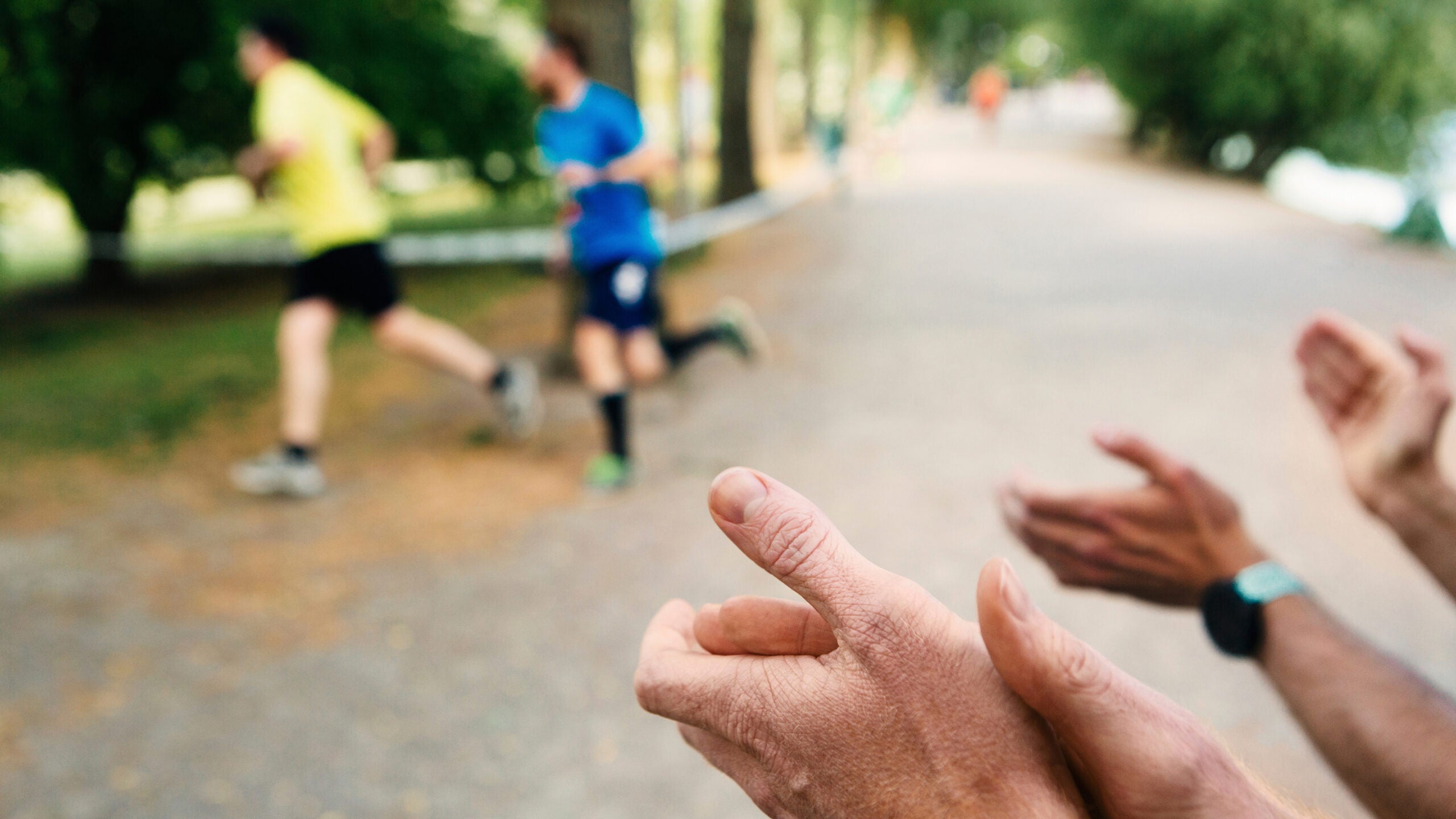
Researchers in Germany studied speech patterns in how people cheer for others during a running race. They found four main patterns. (Photo: Getty Images)
Published February 25, 2026 06:00AM
The impulse to cheer for a friend during a running race seems a near-universal experience and one that most of us probably don’t put much conscious thought into. But for Dr. Marzena Żygis, a linguist at the Leibniz-Zentrum für Allgemeine Sprachwissenschaft, a leading institution for the study of languages and linguistics in Berlin, questions about spontaneous cheering have led to a pioneering study published in December 2025 in the journal Phonetica.
Long fascinated by the “speech acts” that constitute various types of communication, Żygis’ study was part of a larger project that also looked at how German speakers alter the patterns of rhythm or sound of their speech to convey contextual information. These patterns and rhythms are known as “prosody” and describe the melody of speech in the sense of how stress, rhythm, pitch, volume, and duration can be altered to convey emotion and meaning beyond the words themselves.
During the process, Żygis discovered that there had not been any formal investigations into what makes cheering sound so different from basic speech—picture talking to a friend on the phone or at a coffee shop in the same way you’d cheer for them, and you understand why cheering is so unusual. So she set out to investigate the prosody of spontaneous cheering for marathon runners by testing how 30 native German speakers altered the acoustical characteristics of their speech to “create cheers.”
How Scientists Researched Cheering for Runners
To help quantify the study, researchers created a soundproof lab with video of runners on a screen. Participants were instructed to cheer for the runner on the screen—who should be considered the participant’s best friend—as they would if they were on the street cheering in real life.
Participants were also instructed to use only the friend’s name—one of 10 options (five for female runners and five for male runners with varying numbers of syllables) to cheer. The name of the friend was always displayed in the video so the participant knew who they were cheering for. While the focus was on just the names, some participants ad-libbed and added other phrases, such as “go, go, go” or “faster!”
The resulting 12,900 cheering “tokens,” or sounds, offered a trove of acoustical and speech act data for Żygis and her team to comb through. They analyzed the sounds and distilled the results into one of four distinct cheering patterns:
- Separately produced items of similar duration. Żygis gives the example of her own first name for this pattern, where a cheering person might shout “Mar-ZHEN-ah, Mar-ZHEN-ah!!” where all the syllables are held for the same length of time and have prolonged pauses between them of mostly equal length.
- Division of items into syllables. In this example, a cheerer might take a two-syllable name and draw it out into three syllables. For example, the researchers observed several participants turn the two-syllable name “Daniel” into a three-syllable sound “Da-NE-el” and the three-syllable name “Daniela” into a four-syllable cheer, “Da-ni-EL-ah.”
- Mixed pattern of 1 and 2. In these examples, some syllables are drawn out while others are matched in length. A longer name with multiple syllables, such as “Emanuela” or “Bartholomäus,” provides more acoustical real estate for the cheerer to get creative in how they mix and match syllables and pauses.
- A singing pattern with mixed features. This melodic approach uses some combination of types 1 and 2 and pitch changes (high to low like you’d find in a song) to create a melodic sound. For an already melodic name like “Angelina,” a cheerer might make it sound like “An-jhel-LEE-nah” in a pattern that uses higher and lower tones that also mixes drawing out some syllables while prolonging pauses between sounds.
The study also found that participants employed a number of other acoustical tricks to transmit their enthusiasm for their friend’s endeavor, including:
- A higher fundamental frequency, noted as F0, which refers to the baseline of the lowest tone the human voice produces during normal speech. Raising the baseline tone of the sound garners attention and transmits excitement.
- Longer item duration, or a drawing out of the syllables. Holding a note for longer also helps draw attention to the speaker.
- Slower speech rates. Slowing down allows the speaker to emphasize particular elements of the word, such as when placing stress on a particular syllable.
- Increased volume and speech intensity. Simply shouting louder and more forcefully can really sell the idea that you’re super excited for your friend.
How Who You’re Cheering for Changes the Way You Cheer
Żygis and her team also looked for explanations for the variability they found in these spontaneous cheering speech acts.
“We looked at different ages of our participants and gender,” and considered whether the participant was a female cheering for a male, a male cheering a female, or some other combination. They found differences between male and female participants “with the most striking one being that female speakers produced female names shorter than male ones,” she explains. Female speakers also produced female words with a higher speech rate than words of male gender, she adds. No difference was found for male speakers.
Overall the study confirmed some of Żygis’s expectations, but produced some surprising results. “We thought that people would use a faster speech rate in comparison to normal speaking because they would align with the run rate,” she says. And that makes sense—given that the aim of cheering is to support and motivate, she expected that the cheering person would try to match the runner’s movement by speeding up their speech.
“But it wasn’t like that,” Żygis says. “Because of the division [of names] into syllables and prolongations of the syllables, the speech rate was slower and this was unexpected. It was rather an alignment with the rhythms than a speeding up,” she explains.
Across the board, participants displayed astonishing inventiveness in how they uttered the names to create cheers, Żygis says, and that ingenuity allowed them to create unique cheers with a range of flourishes. The creativity of individual participants in meeting the parameters of the assignment surprised her. “I didn’t expect so many different patterns.”
The “Therapeutic” Effect of Cheering Someone On
Afterward, several participants remarked to Żygis that they found the activity surprisingly enjoyable, perhaps even cathartic. “Many of them told me, ‘this was such a cool experiment. It was almost a kind of therapy,’” she says. In part, that therapeutic effect was related to the fact that participants were free to lose their inhibitions; the soundproofed booth and the encouragement to be as loud and enthusiastic as they wanted allowed some participants to really get into the moment and enjoy the activity.
This reaction from participants hints at cheering’s larger purpose: its underlying role in reinforcing bonds between individuals.
“Cheering is so personal,” Żygis says, and while it’s not impossible for people to cheer for just anyone, knowing someone’s name helps the cheerer bridge the gap to support the runner. This is why many marathons have taken to printing the runner’s first name in large letters on their race bibs—showing the world who you are makes it easier for casual observers to support you as you work hard to achieve your goal.