
By Meg Thompson, Milla Kinunen, and Minh-Thu Vo
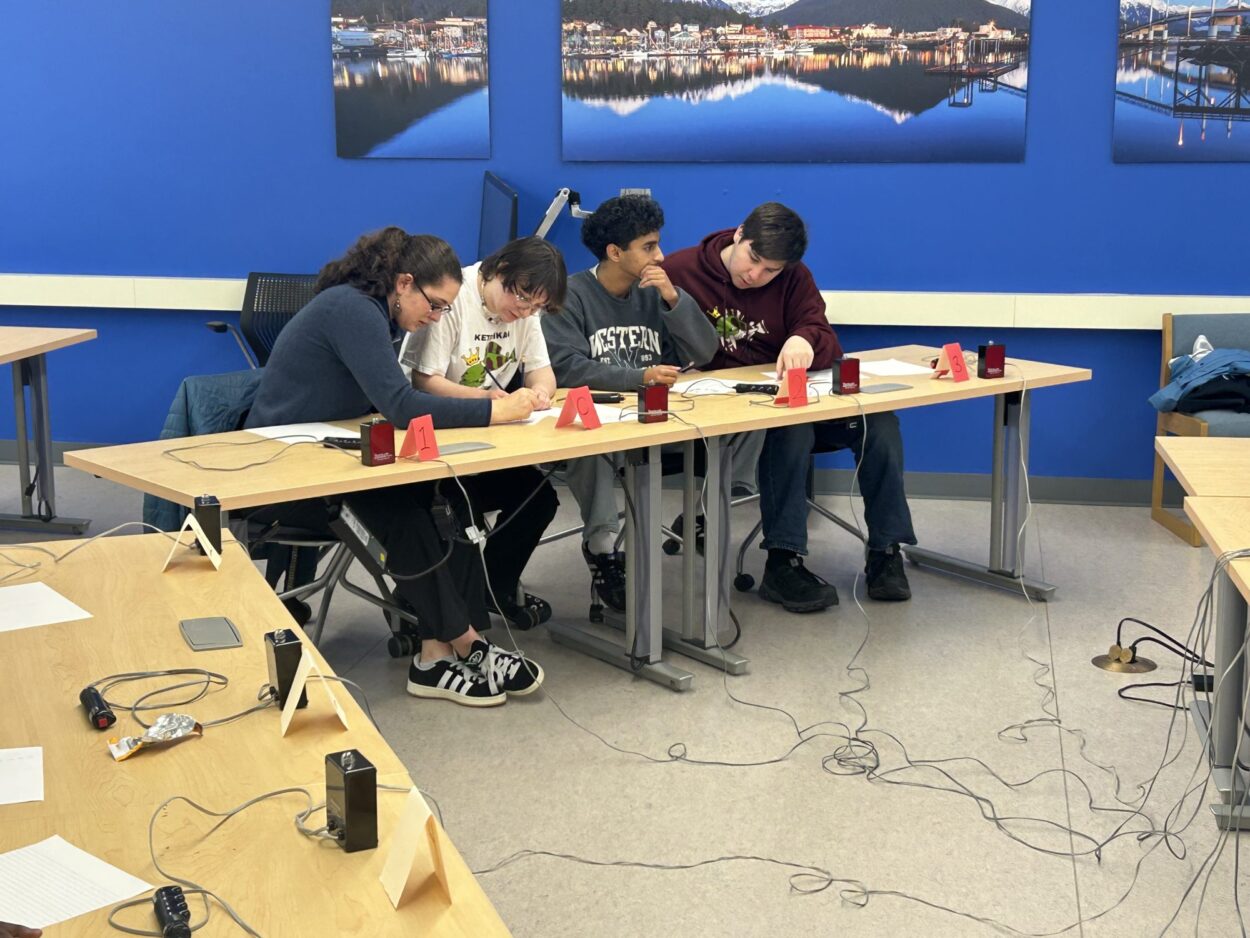
After school, in the science hall of Kayhi, around 20 students practice and test their knowledge on the ocean. Laughs echo throughout the room, and snacks are exchanged in preparation for the Jeopardy-style exercise used in a competition called the Quiz Bowl.
Kayhi Senior Bella Brown has been a part of the National Ocean Science Bowl since her sophomore year and is now a co-captain of the team.
“If kids are going into a science background, it’s such a great source just to learn and get your foot into the science community,” Brown said. “Also it’s a lot of fun, so I recommend it.”
The National Ocean Science Bowl, better known as NOSB, is a club at Kayhi that educates students on ocean sciences to prepare the next generation for STEM-related careers. Each year, this group travels to meets and conferences to expand their knowledge about the ocean.
“I enjoy learning about some parts of the ocean, which is why I enjoy NOSB because it’s just specific parts. So I really like learning about maritime history and the vessels themselves,” Brown said.
At the start of their season, they’re given a prompt for two assignments: a 15-page research paper and 15-minute presentation. They bring those projects to their regional competition, the Tsunami Bowl. This year’s prompt was “Marine Conservation: Problems, Approaches, and Solutions.” They split the team up into groups and dissect the research into its different parts.
Coach Keenan Sanderson leads the practices and quizzes the students on questions that they should expect to answer in competition, during their Jeopardy-like quiz bowl. As a former Kayhi NOSB member himself, Sanderson enjoys being able to give students the opportunity to learn about ocean sciences in a fun and engaging way.
“It’s so fun seeing all these students being excited about marine science and ocean science and fisheries,” Sanderson said.
The club has grown rapidly since Sanderson assumed leadership in 2019, going from five semi-frequent student participants to over 20 active members. Sanderson’s involvement and passion for the club, and the students’ drive to learn, has moved them forward as group.
Sanderson’s personal motivation for joining the team was his desire to spread awareness of the issues within our maritime community.
“[We’re] keeping people aware of things that are going on because these problems probably aren’t going to be going away for a while,” Sanderson said. “And we need more people to focus on them, whether they do that directly or indirectly.”
The Sabertooth Smolts, the Junior Varsity team, wrote their research paper about the ooligan, a little fish that used to be found in abundance in Ketchikan before the fishery crashed 20 years ago.
For this paper, the Smolts partnered with members of the Ketchikan Indian Community to learn more about the ooligan’s cultural significance for the Indigenous people of Alaska.
KIC president Gloria Burns says that when the ooligan returned every year, it signified the coming of spring. Their disappearance has caused a generation of people to lose that cultural practice.
“So when the fishery collapsed, you had years and years of people who had never had that experience of being sent down when you’re like 8-9 years old, to the dock to get a bucket of ooligans and try to struggle to carry it up the ramp for your grandma, or have the experience of biting their head off their first ooligan,” Burns said.
The club’s work has brought awareness to the collapsing of the fishery and the endangerment of the fish itself.
Burns says she admires how Sanderson’s work with NOSB has encouraged young people – and Indigenous students in particular – to learn more about the sciences.
“He really pushed against this stereotype of this idea that one kind of people can only be good for one sort of thing,” said Burns.
Burns says the group has helped to foster the next generation of curious learners.
And their season isn’t over quite yet – they’ll present their findings from this year’s research on March 11 at the Ketchikan Discovery Center.