
Over the last decade, WashU has significantly increased its financial aid spending as the University has implemented a number of financial aid policies. The need-blind admissions policy, a no-loan commitment, and expanded scholarships for local students have allowed WashU to improve socioeconomic diversity.
Executive Vice Chancellor for Finance and Chief Financial Officer David Gray said though the University is navigating financial challenges, WashU will not back away from its financial aid commitments. According to Gray, all University programs are subject to reexamination, but the University values its financial aid initiatives as a key part of WashU’s mission.
“At least that I am aware of, we’re not backing away from that level of commitment,” Gray told Student Life. “It does come with a hefty price tag, but we feel it’s part of the mission that we’re extremely proud of.”
Vice Provost for Undergraduate Enrollment and Student Financial Aid Ronné Turner emphasized the University’s commitment to meeting students’ needs in difficult periods.
“The University has always worked hard to meet our commitment for students and to meet students’ financial needs when there’s a downturn in the economy and folks have challenges,” Turner said. “I anticipate that the University will continue to support students and want to dedicate the resources that we need to not only enroll students but to support students throughout their time here at the University.”
Gray discussed the sustainability of financial aid and need-blind programs, as higher tuition fees are a factor that allows the University to accommodate larger amounts going towards remissions and scholarships.
“I think everything each year is always subject to examination. Nothing is sacrosanct, and that would include student aid programs,” Gray said. “We want to make sure that when we allocate dollars to specific programs that we are having the maximum impact possible.”
Over the last year, WashU has taken steps to address financial challenges, including significantly increasing tuition last year, laying off over 300 staff members, and cutting spending across the University. Gray said that declining international graduate student enrollment and the projected “demographic cliff” have played a role in recent financial struggles at WashU and peer institutions.
“[The University] has been heavily reliant on Chinese students in particular, and there have been noteworthy drop-offs in enrollment there at the graduate level. … They’re very nearly paying 100% of the cost of their education with very few subsidies though remissions or scholarships provided,” he said. “The loss of net tuition income has been radically harmful to those schools that are so reliant on that student base of enrollment.”
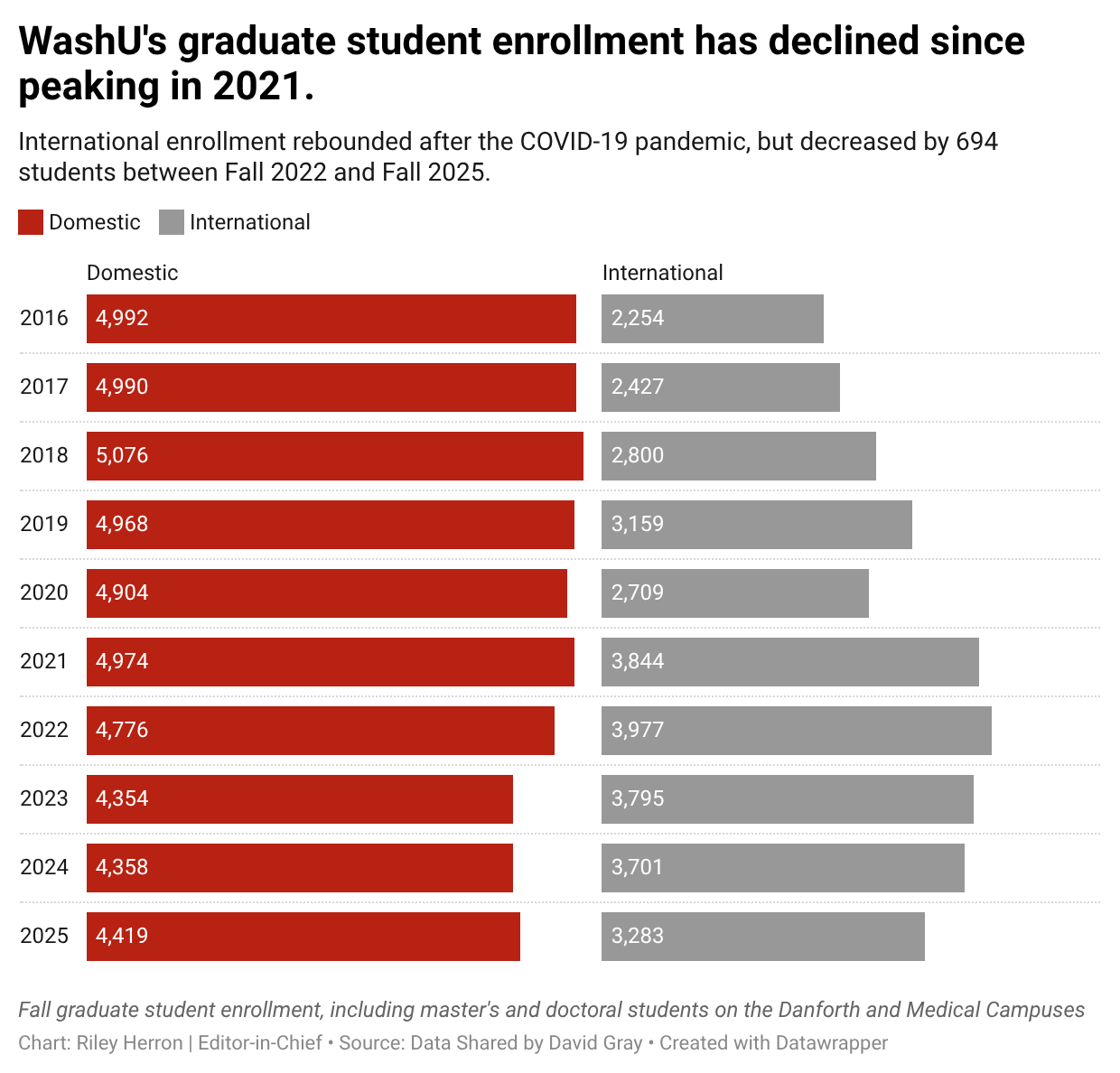
According to data shared by Gray, WashU’s graduate student population has decreased from 8,818 students in 2021 to 7,702 in 2025. There has been an especially sharp decline among international graduate students, with enrollment going down from a peak of 3,977 in 2022 to 3,283 in 2025.
Amid this situation, Gray said that the administration is looking to make further reductions to the cost of administration with a more “targeted approach” this year. He said that the University is planning a transition to a more centralized “shared services” model for human resources and financial services.
He also said that next year’s tuition should be announced in early March and to expect a more “moderate increase” compared to last year.
“I think we all recognize that, you know, there are lots of pressures on families,” Gray said. “They are dealing with a lot of inflationary costs in their household budgets, and we think it is important that we not continue to add pressure to that situation, which can be accomplished through more moderate [tuition] increases.”
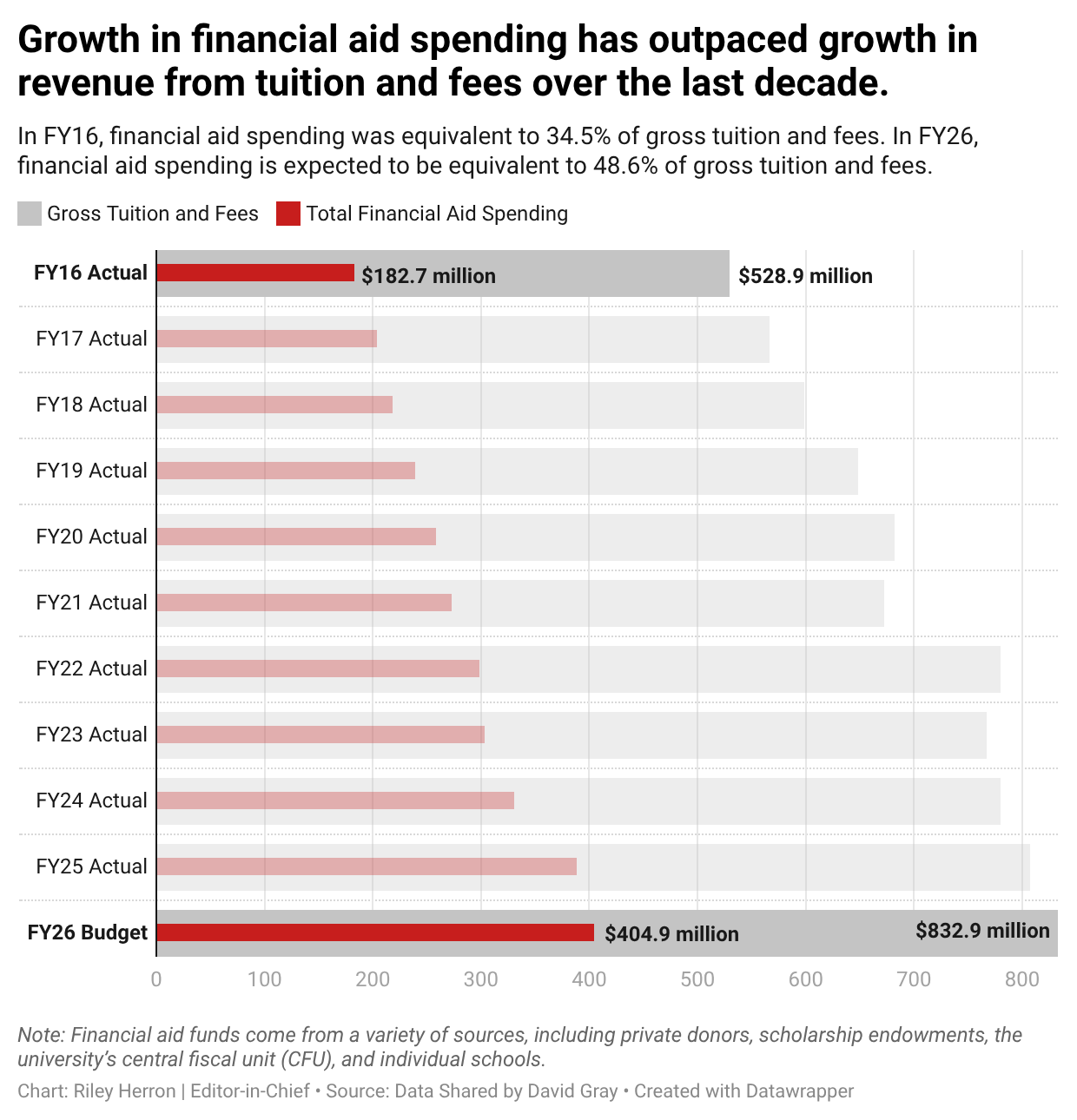
WashU’s financial aid spending has outpaced the increase in revenue from gross tuition and fees over the last 10 years, according to data shared by Gray. WashU’s gross tuition and fees increased from $528.9 million in Fiscal Year 2016 (FY16) to $832.9 million in Fiscal Year 2026 (FY26). At the same time, financial aid has more than doubled, going from $182.7 million in FY16 to over $400 million in FY26.
Gray also shared that funding for financial aid comes from private donors, scholarship endowments, the University’s Central Fiscal Unit (CFU), and individual schools. He highlighted the CFU’s increased spending, saying that the CFU funding for undergraduate scholarships increased from $2.8 million in FY16 to $76.8 million in FY26.
The increased financial aid spendings come as the University has expanded aid offerings since being named the least socioeconomically diverse university in the country in 2014 by a New York Times article. In 2021, the University announced a need-blind policy within admissions, making it the final top 20 college in the nation to do so, and in 2024, WashU implemented a no-loan program for all students.
The need-blind policy was made possible by significant return on the University’s endowment in FY21, and it transformed the way WashU reviews applications, according to Turner.
“What [need-blind] policy does is it allows the admissions team to review an application and make admissions decisions and really just admit who we feel are the most competitive applicants in the applicant pool that year, and we’re not worried about the financial aid budget,” Turner said.
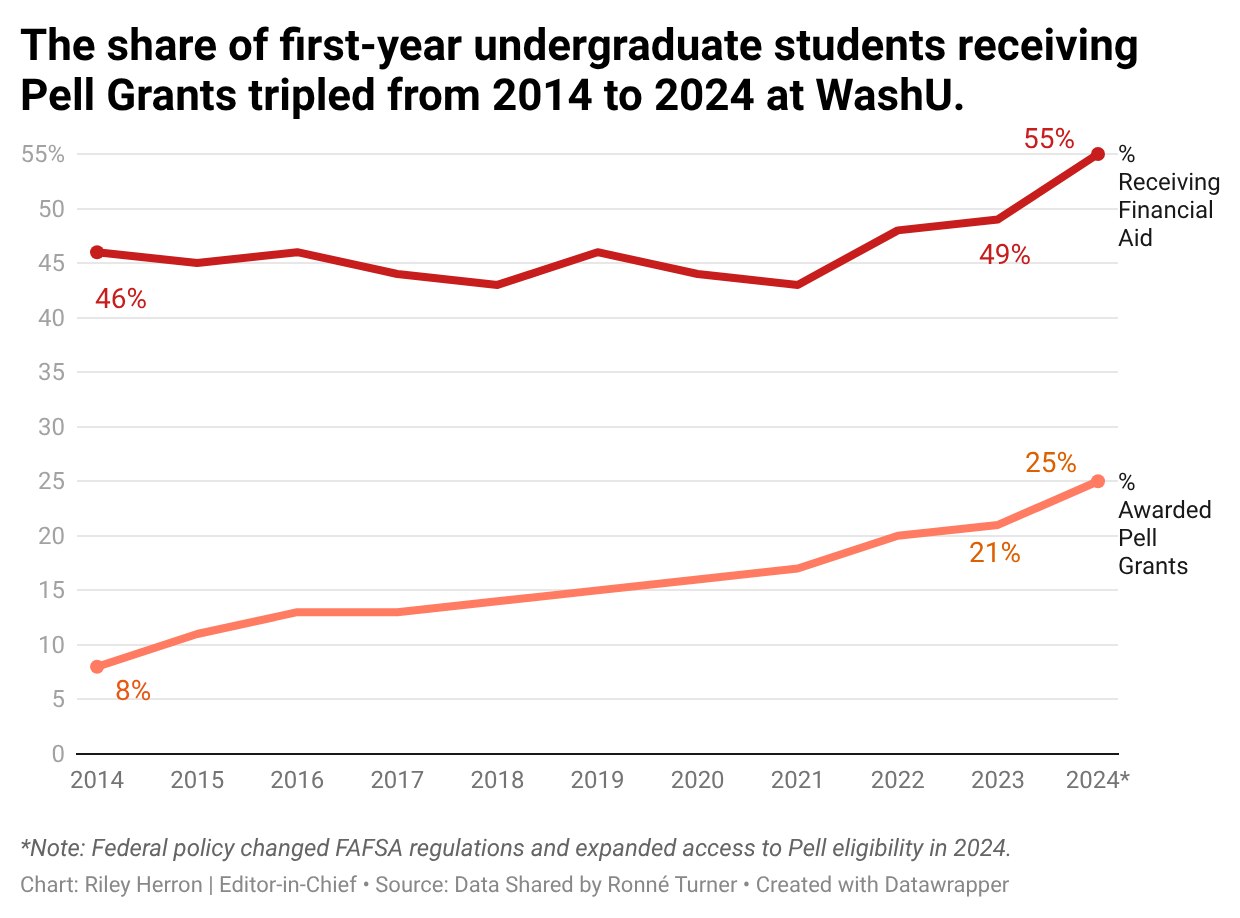
The share of WashU undergraduates receiving Pell Grants, a federal need-based financial aid program, has increased from 8% of the incoming class in 2014 to 25% of the class starting in 2024, according to data shared by Turner. Both Turner and Gray cited the increased amounts of Pell Grant recipients enrolled at WashU as representative of the school’s success in making WashU education accessible to qualified students, and emphasized the University’s commitment to continuing to promote socioeconomic diversity.
“There’s still a very high-level commitment from the top of the institution, from Chancellor Martin on down, to the need-blind program, to continuing to ensure that there is access to WashU for all qualified students who are interested in coming here,” Gray said.