
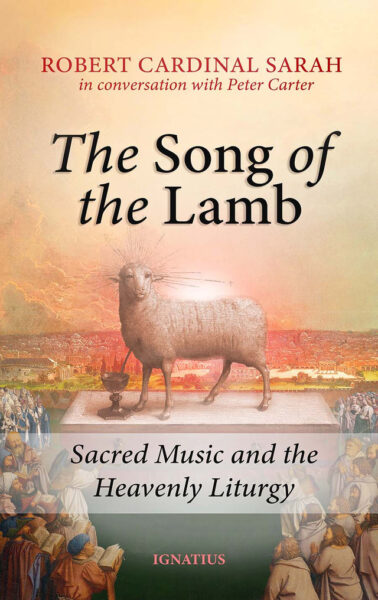
In the case of The Song of the Lamb, we receive a concise and bracing – and in these times, refreshingly clear for a high-ranking prelate – summary of the issue of sacred music in the Catholic liturgy. It is a rare book indeed whose intellectual scope is matched with the profundity of a deep spiritual reflection capable of inspiring meaningful change in this area.
But first, a background:
In contemporary Catholic sacred music, there seem to be two default popular positions: either blanket acceptance of musical populism and mediocrity, or incessant hand-wringing about the poor state of the Church’s musical life. Yet a deeper appraisal may give cause for optimism. One must begin by remembering that in the early 20th century, Gregorian chant and church polyphony were all but lost disciplines, while our earliest known recordings of this music reveal a sad state of affairs indeed. By the time Vatican II presented Sacrosanctum Concilium and later Musicam Sacram – (re)placing Gregorian Chant at the heart of the liturgy and calling for the treasuring and maintenance of the Church’s repertory of sacred music – they were not trying to transplant old musical habits into new liturgical wineskins, so much as resuscitate a nearly moribund state of affairs. The real tragedy, therefore, is that rather than heed the Church’s call to revive musical profundity in the mass, we instead transitioned into decades of populist-driven musical experimentation. The musical abuses of the late 19th and early 20th century careened headlong into the spirit of the 60’s, and the age of Aquarius had its disastrous soundtrack.
In a vital historical detail now forgotten by most, the Church saw the immediate musical devolution they had unleashed, and attempted to call the church back to at least a minimum Gregorian repertoire with the document Voluntati Obsequens in 1974. This was accompanied by a little book of basic chants called Missa Jubilate Deo. This was sent by Paul VI to every Latin Bishop worldwide with instructions to implement these Latin chants in every parish.[1] Unfortunately this was ignored almost entirely, and our age of half-baked experimentation continued unabated.
Yet from almost the beginning of these sad wandering years, many figures worked to preserve and renew the Church’s liturgical-musical patrimony in keeping with the Church’s stated wishes, situating real musical striving into the effort of liturgical enrichment and reform. America’s late William Mahrt is a legendary figure in this regard, as is the Church Music Association of America, which he shepherded during much of his lifetime. The result is that, quite ironically, sacred music in the west may be in the best shape it has been in well over a century. Not only that, but as the experiments of the previous generations die on the withering vine, serious sacred music continues to grow and make inroads in the west. There is a clear and inevitable trajectory of replacing embarrassing excess with renewed quality, and optimism for the future is high in sacred music circles.
Enter Peter Carter, who is a young driving force in sacred music’s resurgence in America. In his short career, he has engaged in a dazzling array of entrepreneurial efforts, becoming Director of the Catholic Sacred Music Project, Director of Sacred Music at the Aquinas Institute at Princeton University, helping organize the Musicam Sacram conference, spear-heading multiple performances and musical projects, supporting emerging composers, and befriending a giant of the age: Robert Cardinal Sarah. He has henceforth drawn out the good Cardinal’s deep concern for sacred music, leading to a number of conversations which have been codified in this one small but powerfully luminous text: The Song of the Lamb. And the word “luminous” is entirely justified, as there is not a single page of this powerful book which does not radiate with the Cardinal’s holiness, his love for Mother Church, and his deep knowledge of the topic at hand.
Each of the book’s fourteen chapters proceed as a conversation between Carter and Cardinal Sarah, with Sarah’s answers being the focus of the text. The book is divided into five parts, dealing with “The Nature of the Liturgy”, “Contemplation and Actual Participation”, “The Crisis of Liturgical Culture”, “The Path of Liturgical Renewal”, and finally “The Way of Beauty and the Way of the Cross.” One should also note that this book does not wander or become disjointed like many otherwise good interview-format books frequently do: it is a focused effort throughout, so much so that it could easily serve as a text for a class on this topic.
Cardinal Sarah and Carter begin by discussing the sundering between beauty and the liturgy. There is a common modern perspective that places the spoken liturgy and its physical actions on a higher plane, while art, music, and architecture are placed on a lower (and frequently optional) “ornamental” plane. Cardinal Sarah’s first offensive thrust in the text is to point out the untenability of such a position, instead naming the sacred arts as a fundamental and indivisible part of the liturgy. Writing of our tendency to divide beauty from the liturgy, he writes:
But this conception reveals a superficial understanding of artistic work and its creation, from various points of view. … Contemporary theology, particularly the theological-philosophical speculation of Joseph Ratzinger, has opened our eyes to a broader and more fascinating reality. Sacred music – when it is true art – is an epiphany: It signifies a divine manifestation through its revelation of Beauty. In sculpture, music, and poetry, He who is Beauty is incarnate in the artistic form, though in a much less full and substantive manner than in the Eucharist or in the manger at Bethlehem (Sarah, p. 25).
Sarah’s orientation is clearly Boethian/Dionysian/Ratzingerian, with God as the person of Beauty Himself, and with beauty as a path by which to approach Him. From this point on until the luminous final section on “The Way of Beauty and the Way of the Cross”, Sarah restores dignity to the work of the sacred artist and Beauty to the fundamental dignity of the liturgy.
Being a practitioner of liturgical music, Carter is aware of the questions which divide Catholics in this area. As such, he leads Cardinal Sarah into detailed and fruitful discussions on a number of these topics. For instance, in the chapter “Authentic Liturgical Inculturation”, Sarah clearly and concisely approaches a topic whose misunderstanding has done great damage to the liturgical life of his own continent. He calls us first to cultural humility, reminding us that: “Modern man readily has music at his disposal, but he is often not fully formed and matured into becoming a musical being.” What then follows is a detailed conversation of what constitutes authentic inculturation, how styles are to be judged, and the proper spiritual orientation required to effectively appraise, perform, and participate in liturgical music. Similarly incisive are his commentaries on the restoration of the divine office, Gregorian chant, and what it truly means to put “Artistry at the Service of the Liturgy.” Sarah helps the more hesitant reader move past the unfortunate ideological misunderstandings surrounding aspects of the liturgical renewal, such as when he discusses the politicization of Latin in the Roman rite. Later, in discussing the thorny issue of “inculturation” and the desirability of universality in sacred music, he sets a clear criteria by which this can be achieved:
While every nation is permitted to admit into its ecclesiastical compositions those special forms which may be said to constitute its native music, still these forms must be subordinated in such a manner to the general characteristics of sacred music that nobody of any nation may receive an impression other than good on hearing them (Sarah, p. 45).
What ultimately makes the book deeply effective is the Cardinal’s humility. Certainly, he has valid learned opinions to share on the topic of sacred music, but these are subordinated to a discussion on the topic entirely couched in the Church’s tradition, discipline, and official documents. Each of Sarah’s answers to Peter’s questions present a coherent synthesis of what the Church has taught on this subject, illuminating connections and ideas that even ardent practitioners in the discipline will find surprising and comforting. The result is a book that can be presented as a conclusive answer to the question of: “Why sacred music renewal, and why now?” It also presents a stark clarification: that to argue against the Church’s musical patrimony or to seek to supplant it carelessly is to argue against the heart of the Church itself.
As we mentioned at the outset of this review, sacred music is no longer in a moribund state. It is thriving and growing again, and at the dawn of what may end up being a true renewal. As to the potency and necessity of such a project, the last word is Cardinal Sarah’s:
Our experience of Christ in prayer should convict our hearts to reform our lives so that we might give fitting praise to God. We can echo Isaiah’s words as our own: “Woe is me! For I am lost; for I am a man of unclean lips, and I dwell in the midst of a people of unclean lips; yet my eyes have seen the King, the Lord of hosts!” (Is 6:5) We are all sinners and need purification to enter God’s presence. This purification is vital for our encounter with God in the liturgy, allowing us to sing with humble hearts and perfect praise. God places “a new song” in our mouths as a reflection of this purification. … Our objective is not just to glorify God through the sacred words and music of the liturgy, but also that His glory may be manifested through the holiness of our lives (Song of the Lamb, p. 93).
[1] Austin Flanner, ed. Vatican II: the Conciliar and Post Conciliar Documents, New Rev. ed.(Northport, NY: Costello Publishing Co., 1975), vol. I, 273-276.