
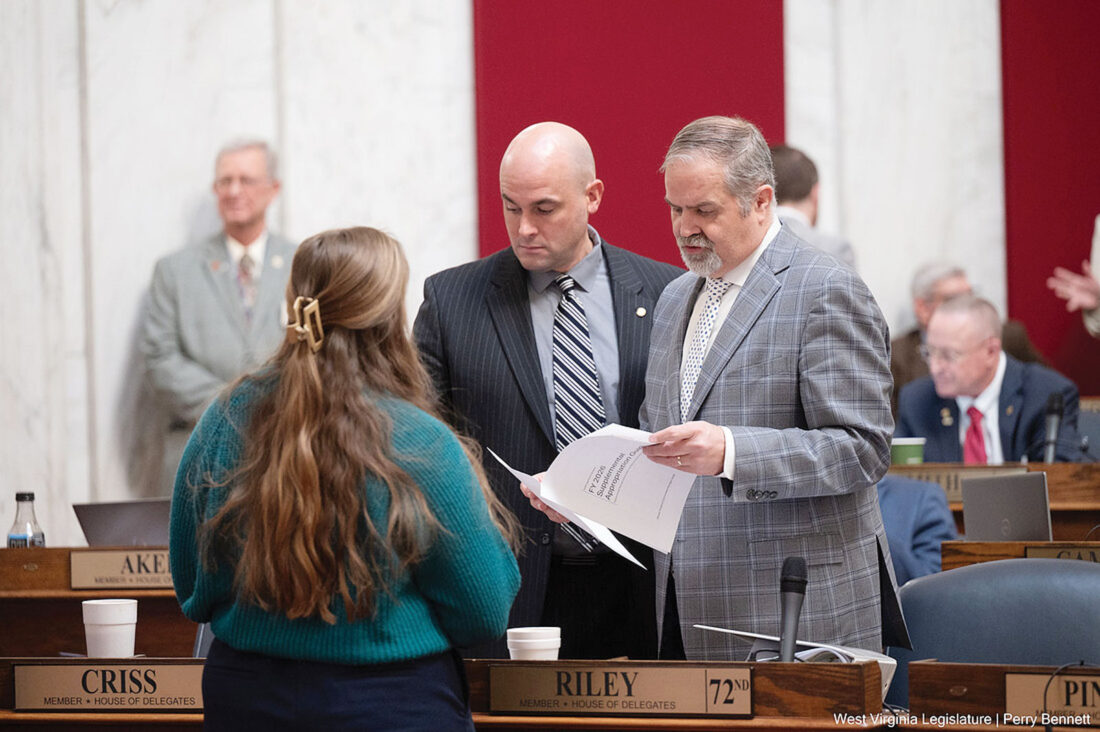
House Finance Committee Vice Chairman Clay Riley, right, told committee members Thursday that a new originating bill was meant to address concerns raised by supporters of the Hope Scholarship program. (Photo Courtesy/WV Legislative Photography)
CHARLESTON — After unveiling an originating bill last week that would have made substantive reforms to the Hope Scholarship educational voucher program, the House Finance Committee pushed out a new bill Thursday changing only the payment structure of the program.
The committee recommended for passage to the full House of Delegates a new originating bill, which will receive a number at a later date, that would require that payments be made to the accounts of Hope Scholarship recipients four times a year: Aug. 15, Oct. 15, Jan. 15, and April 15. Current law requires payments to be made Aug. 15 and Jan. 15.
The Hope Scholarship – which was passed by the Legislature in 2021 and into effect at the beginning of 2023 – gives parents the option to use an equivalent portion of the per-pupil expenditure for their children from the state School Aid Formula for educational expenses such as private or religious school tuition, home school, tutoring and learning aids.
For the 2026-27 school year, eligible families will receive $5,436 from the Hope Scholarship program if they apply after March 2, with the amount decreasing by 25% during three subsequent application windows.
The Hope Scholarship is limited to children eligible to be enrolled in a county school system’s kindergarten program the year the parents are applying, public school students who were enrolled full time during the school year prior to applying or public school students enrolled for at least 45 days during the current school year. Beginning July 1, eligibility opens to all children in the state.
The State Treasurer’s Office, which manages the Hope Scholarship, estimates the program will cost more than $230 million in fiscal year 2027, which starts July 1. That’s up from $45.2 million appropriated to the program in FY25 – a 411% increase.
The budget bill amended and passed by the House Wednesday, Senate Bill 250, provides $211 million to the Hope Scholarship, along with $20 million in Hope carryover funds available at the end of this fiscal year.
With the price tag for the scholarship continuing to grow, some lawmakers have raised concerns about the program affecting the state’s cash flow as West Virginia transitions between fiscal years when money is tighter for the state.
“This is a new program, and it has grown a tremendous amount in just a couple years. It does require some refinement,” said Del. Marty Gearheart, R-Mercer. “When you’re talking about the kind of dollars and the number of students that we have here, it does require us to look at the program and to adjust it to be certain that it will last and be functional and that the Legislature can in fact afford to pay for it and keep it going.
“When the government doesn’t have any money at the beginning of the fiscal year and the first payment is due six weeks after the beginning of the fiscal year, it’s a big nut to crack,” he continued. “By changing this payment schedule, we take that nut that’s due in August and we cut it in half. And we make it a much more manageable circumstance.”
The first originating bill presented to the Finance Committee would have capped the annual Hope Scholarship award to eligible families at $5,250 with funds limited to tuition and fees at participating in-state private schools, microschools, and home school programs; ongoing services provided by a public school district; certain educational therapy services; and certain transportation and technology costs.
That bill received pushback from Hope Scholarship families, Gov. Patrick Morrisey, Treasurer Larry Pack and other Republican lawmakers. House Finance Committee Vice Chairman Clay Riley, R-Harrison, said the new originating bill was the result of the committee taking the concerns of Hope supporters seriously.
“The reason that this bill originated out of the (committee) was for two primary reasons: cash flow and budget reconciliation. We have to pass a budget, and this is a good cash flow and cash management strategy,” Riley said. “We should embrace discussions about all aspects. It’s important to listen to the pros and the cons from all sides.”
In a statement following the committee vote, Pack thanked House Finance Committee Chairman Vernon Criss, R-Wood, for not interfering with the services the scholarship helps pay for.
“We appreciate Chairman Criss’s decision on reconsidering changes that were previously introduced,” Pack said. “We understand the need to thoroughly examine all government initiatives and look forward to having future conversations with the leadership of both houses on this program. The Hope Scholarship has had a tremendous impact on thousands of students in West Virginia. We want to ensure the longevity of the program for years to come.”
The committee’s two Democratic members, Minority Chairman John Williams and House Minority Leader Sean Hornbuckle, voted with the Republican majority on the bill after attempting unsuccessfully to amend portions of the first originating bill into the new one to restore some of the limitations.
“I do feel that it was a missed opportunity,” said Williams, D-Monongalia. “We need to do something now before it gets worse and public opinion is such that such cuts to the program are more draconian than what would have been proposed last week. … A lot of the families on this program would have still been able to exercise their school choice with the help of the Hope Scholarship, but we wouldn’t have been paying for millionaires’ kids to go to private school. And we need to think about this before it gets really out of control.”
“I’m going to vote for it because I believe going to a different payment system in regards to timing is best for our state,” said Hornbuckle, D-Cabell. “But at the same time, I would also caution the body that … not addressing a responsible guardrail system in regards to the Hope Scholarship Program is simply irresponsible.”
Steven Allen Adams can be reached at sadams@newsandsentinel.com