
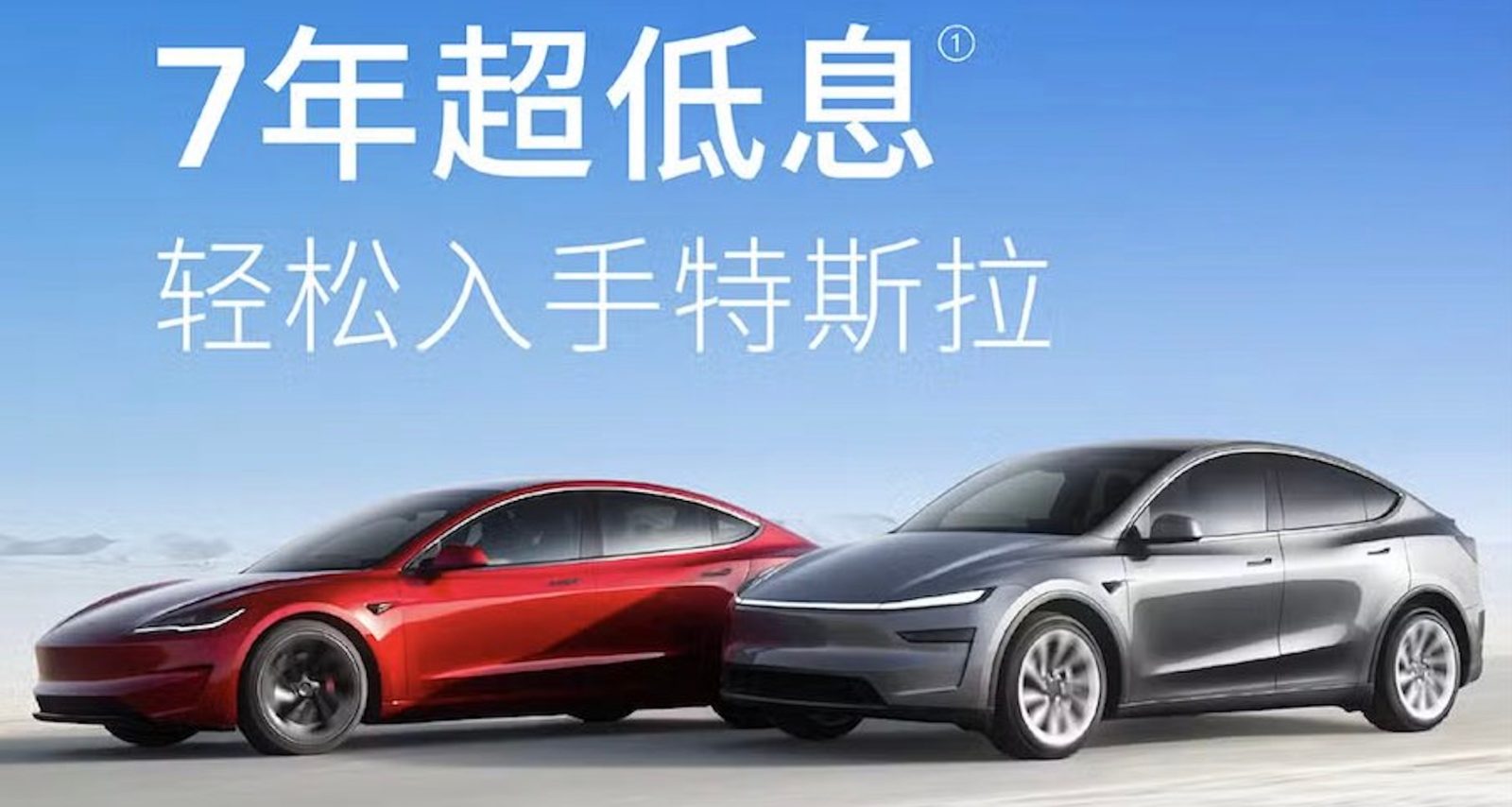
Tesla’s estimated delivery times for all models in China have fallen to just 1-3 weeks, a dramatic reduction from the several weeks to two months quoted late last year. The collapse in wait times signals that Giga Shanghai has cleared its order backlog and has ample production capacity sitting idle.
At the same time, Tesla announced it is extending its 7-year ultra-low-interest and 5-year zero-interest financing programs through March 31, marking the second time the automaker has pushed back the expiration of these aggressive incentives in 2026.
The financing incentives are rapidly becoming the new standard as Tesla’s demand issues are growing.
Delivery times hit record lows
As of February 26, every version of the Model 3, Model Y, and Model Y L on Tesla China’s website shows an estimated delivery window of just 1-3 weeks. That’s a stark change from December 2025, when the Model Y L alone had wait times stretching 4-8 weeks and some Model 3 variants were sold out entirely for January.
The shift tells a clear story: the rush of buyers that flooded Tesla showrooms in late 2025, trying to beat the reinstatement of China’s 5% purchase tax on new energy vehicles starting January 1, which created low supply in early 2026, has already evaporated.
December 2025 was Tesla’s best-ever retail month in China at 93,843 units. By January, domestic deliveries crashed 45% year-over-year to just 18,485 units, the automaker’s lowest monthly figure in the country since November 2022.
Short delivery times are not inherently bad, they mean Tesla can get cars to buyers fast. But when combined with declining sales figures and escalating incentives, the pattern is unmistakable: supply is outpacing demand.
Tesla doubles down on financing incentives
Tesla is now throwing everything it has at stimulating China demand. The company’s latest promotional push includes:
7-year ultra-low interest financing at an annualized fee rate of just 0.5% (approximately 0.98% APR), drastically below the standard 3-6% auto loan rates in China. Monthly payments start as low as 1,759 yuan (~$242) for the Model 3, 2,188 yuan (~$301) for the Model Y, and 2,849 yuan (~$392) for the Model Y L, with down payments from 79,900 yuan (~$11,000).
5-year zero-interest financing is also available as an alternative, with Tesla covering all interest costs.
An 8,000 yuan (~$1,100) insurance subsidy on Model 3 purchases has been extended as well.

This is the second time Tesla has extended these financing offers. The 7-year program originally launched in early January with a January 31 deadline, was extended to February 28, and has now been pushed through the end of Q1.
With each extension, Tesla gradually devalues the urgency it is trying to create with this approach
China’s ‘financial war’ heats up
Tesla didn’t start this financing arms race alone, but it fired the first shot. As we reported in January, Tesla confirmed its first year of sales decline in China, and it responded with aggressive financing and subsidies to open 2026.
The problem is that every major competitor matched Tesla within days. BYD launched its own 7-year low-interest financing program on February 25, covering the Seal, Sealion, Dolphin, and Seagull lineups with daily payments as low as 29 yuan (~$4). Xiaomi, Li Auto, Xpeng, and NIO all rolled out similar 7-year programs, turning Tesla’s competitive advantage into a market-wide baseline.
Chinese media has labeled this the evolution of the price war into a “financial war.” With regulators discouraging direct price cuts, automakers are competing on total cost of ownership through creative financing instead. The result is that Tesla’s incentives, while aggressive on paper, no longer differentiate it from the competition.
Meanwhile, Giga Shanghai is increasingly functioning as an export hub rather than a vehicle for domestic demand. Of the 69,129 vehicles the factory produced in January, 50,644, or 73%, were shipped to international markets. That’s the second-highest export month on record.
Electrek’s Take
The combination of collapsing delivery times and repeated financing extensions paints a concerning picture for Tesla in China. When a company keeps pushing back the deadline on its “limited-time” incentives, it’s telling you the incentives aren’t working as planned.
We’ve been tracking Tesla’s demand problem in China for over a few years, and the trendline has become clear in 2025. Demand has peaked.
Domestic retail sales went from nearly 40,000 units in January 2024 to under 19,000 in January 2026, a 54% decline over two years. The Xiaomi SU7 alone outsold Tesla’s entire domestic volume in January.
Tesla’s 7-year financing at 0.5% interest is genuinely compelling on paper, monthly payments under 1,800 yuan for a Model 3 is remarkable. But when BYD is offering similar terms on cars that cost even less, and when Chinese consumers are increasingly wary of the brand, financing alone won’t reverse the trend. Tesla needs the products to do the talking, and right now, the Model 3 and Model Y are aging against a wave of fresh Chinese competitors.
The short delivery times tell us Giga Shanghai has the capacity. What it doesn’t have is enough Chinese customers walking through the door.


FTC: We use income earning auto affiliate links. More.