The intersection of science and liberty has evolved over the years, and continues to do so in current times, drawing from works of earlier scientists.
Purdue President Mung Chiang sat down with Timothy Ferris, science writer and professor, to discuss the relationship between science and liberty inspired by Ferris’s 2010 bestseller “The Science of Liberty: Democracy, Reason, and the Laws of Nature” on Thursday.

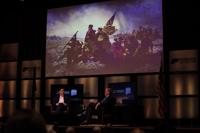
President Mung Chiang spoke with bestselling author Timothy Ferris on Thursday night for his Presidential Lecture Series. Ferris has created several documentaries, including “The Creation of the Universe.”
The Purdue Presidential Lecture Series event was the start of a year-long Purdue campaign celebrating the 250th anniversary of the United States’ Declaration of Independence.
With degrees in English and communications connecting to his passion for science, Ferris has written a dozen books according to a handout from Life at Purdue. He has done projects as a documentarian, TV producer, and has previously worked as a Rolling Stone magazine reporter and editor.

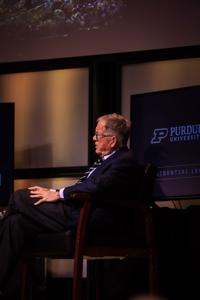
Bestselling science writer Timothy Ferris was interviewed by President Mung Chiang during Thursday’s Presidential Lecture Series. Ferris’s books were named by The New York Times as among the leading books published in the 20th century.
Ferris is currently a professor emeritus at the University of California, Berkeley, with experience teaching multiple subjects at different universities.
Ferris shared some details about the start of his career, going back to his childhood in rural Florida. He said he explored his curiosity about the night sky through reading.
“I would go check out a book and then read it, bring it back a day or two later, and (on the) third (or) fourth visit the librarian told me ‘you can check out more than one book’ … and so I read about astronomy, trying to teach myself about the sky,” Ferris said in the talk. “I was really impressed by the authors of these books … they took the time and effort to explain these things in a way I could understand.”
A main topic of the talk included connections between science and liberty through history. Chiang compared the creation and continuation of the U.S. as an experiment regarding democracy, referencing the technological and social development in ancient Greece and the Renaissance.
Ferris said he felt technology was important for scientific advancements.
“If you look at Renaissance science, the figures we all learn about in school, Johannes Kepler, determine the planets moving in ellipses rather than in circles,” Ferris said. “That was made possible by technology.”
Ferris also said Astronomer Galileo Galilei was able to make a telescope after he found out it had been done in Holland, which he said was the most liberal country in Europe.
Another key talking point focused on artificial intelligence. Chiang talked about the idea of whether or not AI was reducing people’s liberties in how machines would do work for them. Ferris disagreed with this concept, believing that AI is helpful assistance.

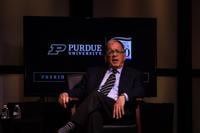
During Thursday night’s Presidential Lecture Series, Timothy Ferris discussed the relationship between science and liberty and how the two are intertwined. The concept is based on a book he wrote in 2010.
“I have on my desk, my observatory, a Neanderthal hand axe (that is) 36,000 years old,” Ferris said. “It’s from that tool making that all of this came … (Neanderthals) didn’t make these tools because some wise man told them to, but because some wise man figured out how to do it, (and) that others followed that example.”
Ferris said some feel hesitant towards AI, but believes the human species has been successful through technology.
“It may come some day that we build something that has some horrible result, but we can’t avoid everything because someone can imagine a horrible result,” Ferris said. “And I’m not just saying that because that’s what my chat GPT told me.
Sophomore in physics and philosophy Jacob Dowd and sophomore in economics and political science Eric Oesterling were given the opportunity to ask Ferris questions; Dowd asked Ferris who his intellectual heroes are.
Ferris said he saw Albert Einstein and Richard Feynman as inspiring individuals and recommended reading texts by the ancient Greeks. Ferris also said Feynman took a scientific approach to defining liberalism.
“Feynman has also mentioned the science of liberty, because he had an astounding ability to identify a problem quickly to find a solution he wants,” Ferris said.
Dowd said he found it interesting that Chiang and Ferris discussed if science and liberty were paired.
“As a philosophy major, when you hear necessary and sufficient, you get really happy, because these are very fun technical words,” Dowd said. “The ideas here are: If science is a necessary condition for liberty, we can’t have liberty without science.”
Dowd said he enjoyed engaging with and attending the event recommending the fireside chats to Purdue students.
“I want to go to medical school, so this was a very enriching kind of experience,” Dowd said. “I think they’re great opportunities.”