
In Villa de Zaachila, a municipality in the southern Mexican state of Oaxaca, the winds of change bring music. It spreads through the unpaved roads and mingles with the fine dust that rises at the slightest provocation.
For more than four decades, this place received thousands of tons of garbage from the state capital, Oaxaca de Juárez, and its metropolitan area. But the Santa Cecilia School of Musical Initiation, located a short drive from the city center, has been a driving force in town, broadening horizons for children and entire families, who, over the past 15 years, have learned to master a wind or string instrument. What was once an area filled with tons of accumulated garbage and trucks hauling all kinds of waste is now transforming into a place that offers university opportunities, local bands, and a unique cultural perspective… things that have been achieved only through a community effort.
The Santa Cecilia School is located in Vicente Guerrero, which originally was a settlement founded in the 1980s by garbage collectors. The district, with 15,910 inhabitants, has high levels of marginalization and poverty: 38% of residents don’t have social security and, of the 5,292 homes, 34% don’t have drinking water, 12% don’t have drainage, and 1% lack electricity.
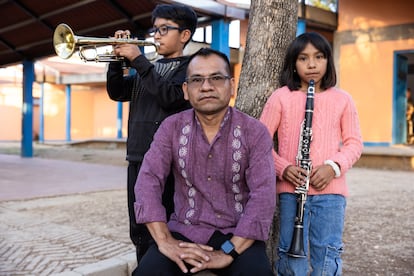
This precariousness was the reason why, in 2011, Father José Rentería and a youth group launched a project to promote art and culture. Modesta Hernández, general director of the Santa Cecilia School, recalls how the initiative began with the support of the parents’ committee and the priest. “Every Sunday, the mothers would go to the Saint Bartholomew Church to sell pork rinds, sandwiches, and snacks, to finance the music teacher’s salary. But the increase in enrollment led us to look for other forms of funding,” she explains.
With the support of the Air France Foundation, the Pittsburgh-based Tash Inc., Don du Choeur — a Swiss non-profit — as well as the Saint Bartholomew Apostle Parish and the Banda de Musica (a French association), they were able to build five classrooms, 12 individual rooms, and two storage rooms in 2019.

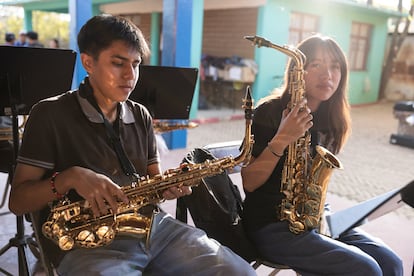
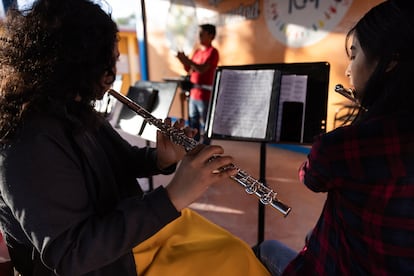

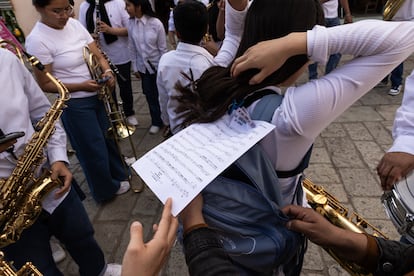
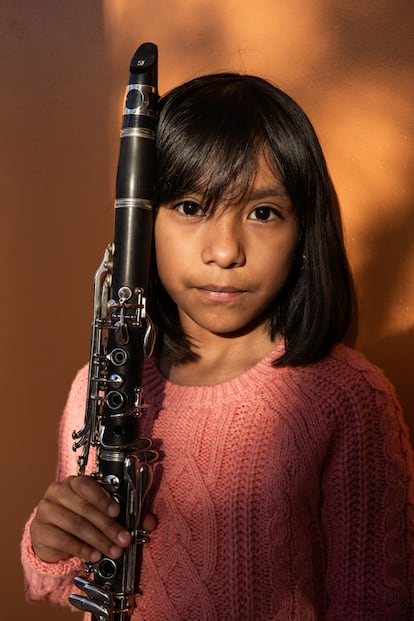
The school’s coordinator, María de los Ángeles Ramírez Mijangos, points out that this infrastructure has allowed them to maintain an enrollment of 208 students for wind and string instruments, as well as a staff of 11 teachers. She adds that the program lasts six years: the first year focuses on musical initiation, while the remaining five years are dedicated to instrumental performance and instruction in musical concepts.
The institution, she affirms, has been a haven for children. Prior to its creation, there were no recreational options — much less cultural ones — for the local children and youth. Their efforts have borne fruit: 11 students from the Santa Cecilia School have been admitted to institutions of higher education, including the National Autonomous University of Mexico (UNAM) and the conservatories of Mexico City and Puebla. Furthermore eight bands, which play regional music, have been formed in the community.
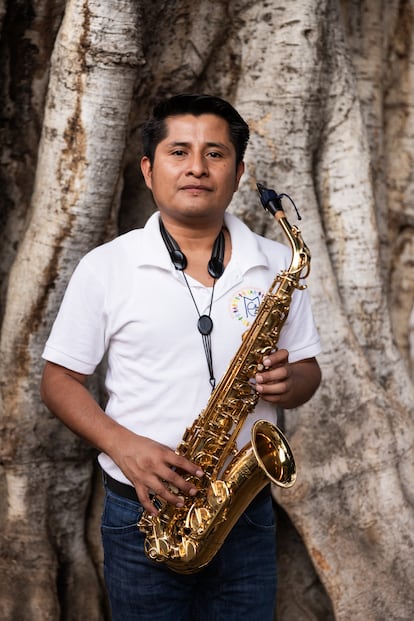
Manuel José José has been the director of one of these bands since 2016. He believes the main challenge is getting young musicians who are currently training at high-level institutions to return to the town and share their knowledge with their peers. Also a saxophone teacher, he has led his band at various events, such as the inauguration of the Felipe Ángeles International Airport, as well as at the 2023 D-Day Festival Normandy, where they performed in Paris. “I feel privileged to be the band director and that the children allow me to be a part of their musical lives, to motivate them [so that they] dedicate themselves to their instruments,” he says.
Eva Lepiz
Eva Lepiz
Musicians’ stories
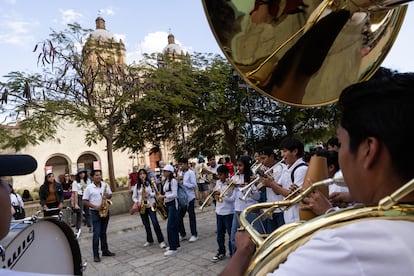
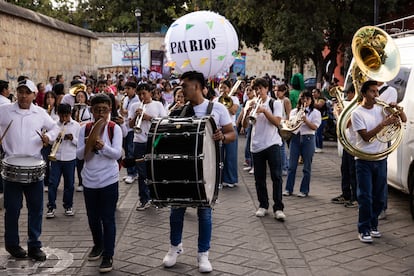
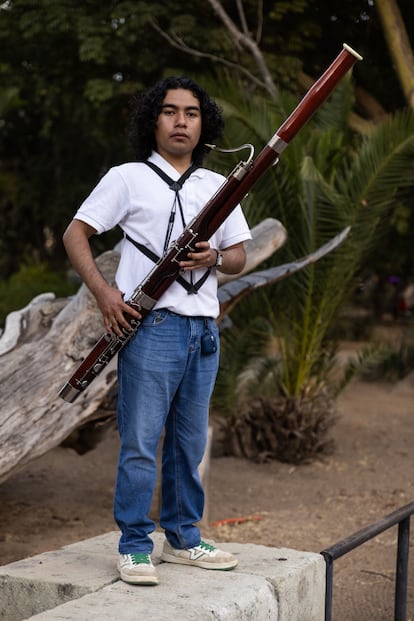
José Alberto Durán Hernández is a bassoon student at the UNAM, in Mexico City. Currently on vacation, he’s accompanying the band that trained him to downtown Oaxaca, to play in la calenda — the procession — that departs from the iconic Church of Santo Domingo de Guzmán. Calendas are processions that are adorned with music, dances, and flowers. At the age of nine, this now 20-year-old entered the Santa Cecilia School, studying clarinet. However, in Paris, he met bassoon teachers who inspired him to dedicate himself to that instrument.
“Music is a catalyst for change in people; it gives you a different perspective on life. Being able to make music is a privilege that, in addition to giving you knowledge, allows you to see other places; [it] gives you a sense of belonging,” he says.
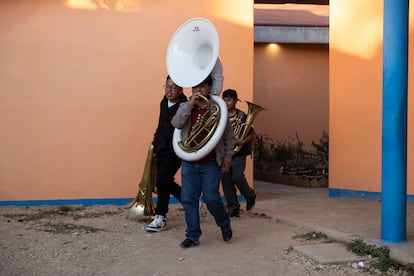
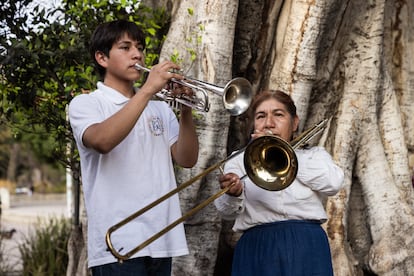
For Margarita José López, a 56-year-old trombonist and member of the Banda de Música association, this institution allowed her to fulfill her dream of playing an instrument, as it did for her sons, Obed and Josué López José. The latter is a trumpet player and participant in the procession.
Karen Cecilia Martínez López, an 18-year-old saxophonist, also comes from a musical family tradition: her grandfather and father are musicians. She learned to play an instrument at the age of six and has been attending the Santa Cecilia School for the past year.
A resident of the district of Vicente Guerrero, she acknowledges that musical instruction has made a significant difference in the area, especially in terms of security and the reduction of violence. “We young people have a space where we can learn, interact, and develop ourselves, away from violence,” she says.
Back in 2023, the district — along with 50 communities belonging to Villa de Zaachila — joined forces to close the municipal landfill. Poverty still persists, accompanied by ecological damage, such as leachate (liquid generated by decomposing garbage) running through the streets… but the mountain of garbage that once surrounded the residents is now a distant memory. Today, they hope to be recognized for the work done by the Santa Cecilia School, a birthplace of great musicians.
Sign up for our weekly newsletter to get more English-language news coverage from EL PAÍS USA Edition