
Photos by Ralph Freso / Slideshow
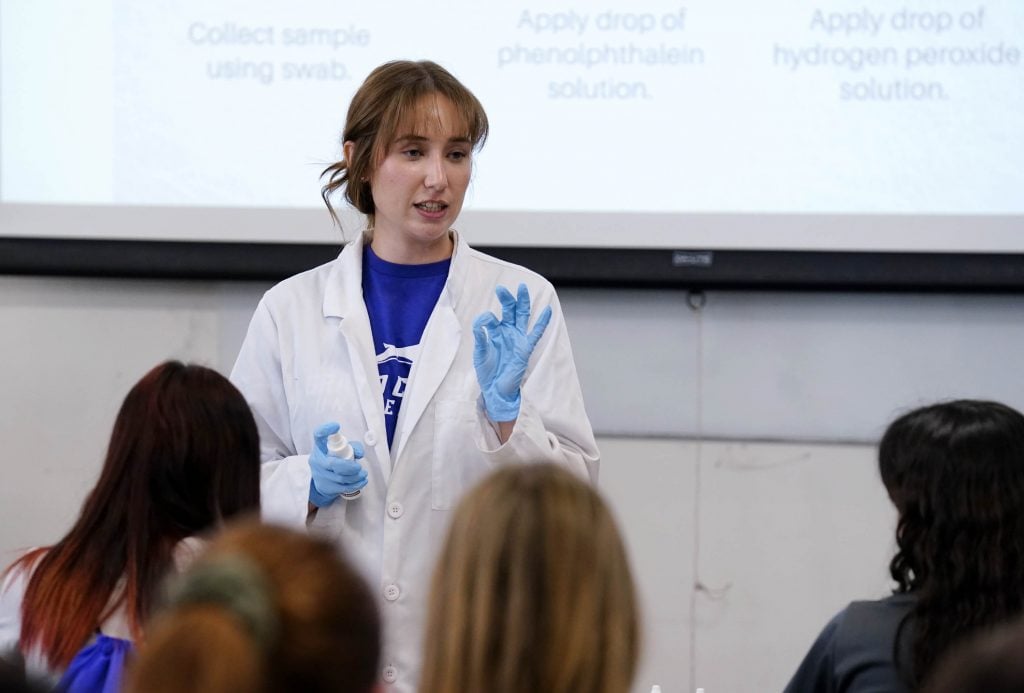
Ella Hodges, looking very science-y in her lab coat, couldn’t contain her zeal as she stood in front of a classroom packed with high school juniors and seniors readying themselves to do a blood analysis during Grand Canyon University’s Forensic Science Day.
“The most exciting thing here is just getting to see behind the scenes of what real forensic science processors do, things that are commonly completed in day-to-day activities,” said the GCU senior forensic science major. “And, who doesn’t love seeing a bright pink color change on a fun little swab? I mean, that’s the fun part. … It’s engaging while still being educational.”
Seeing that bright pink color means blood could be present. More importantly, it means a possible step toward solving a crime.
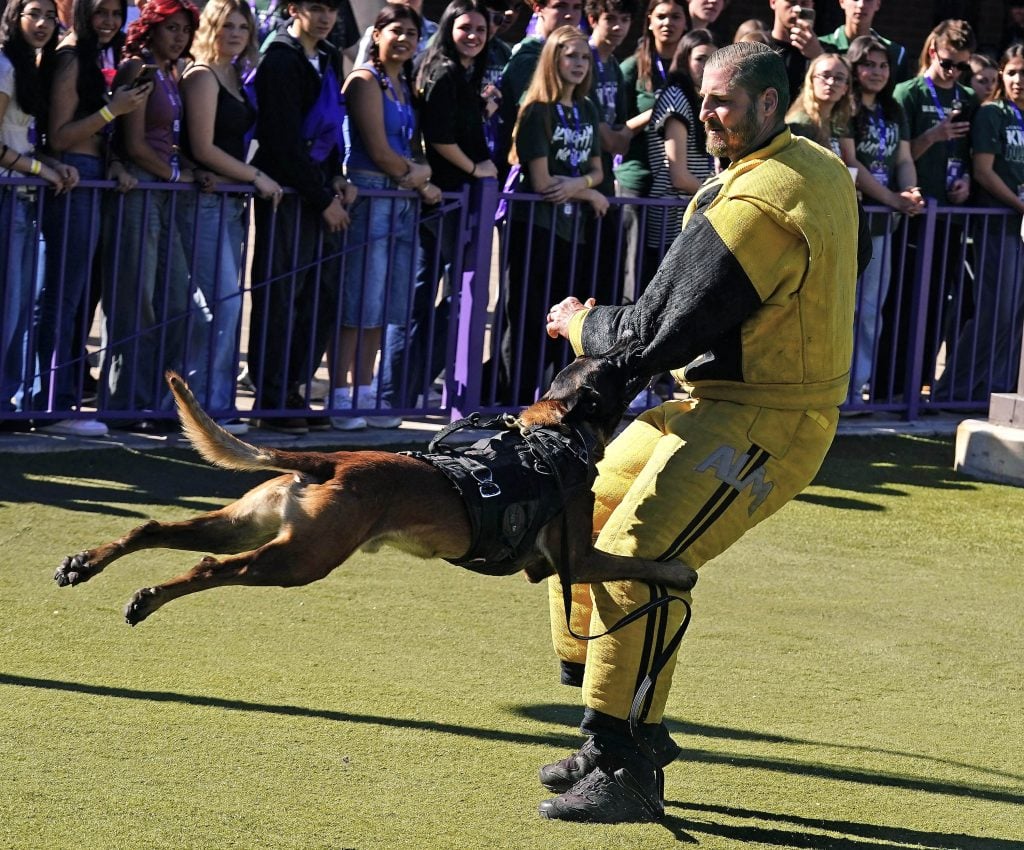
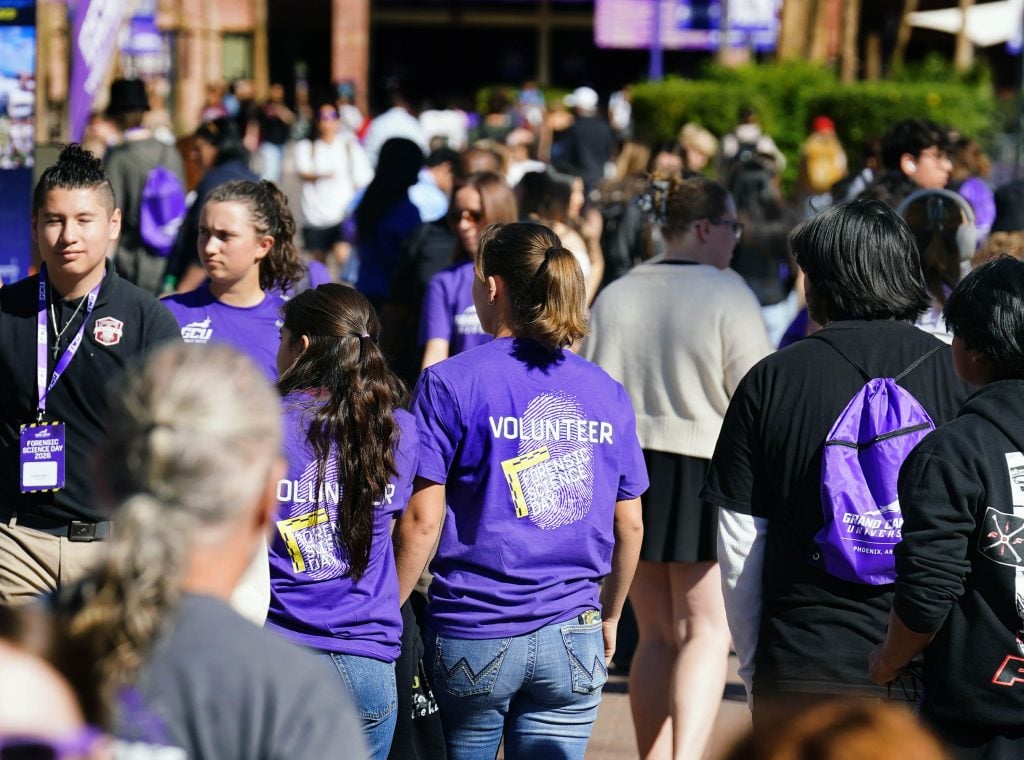
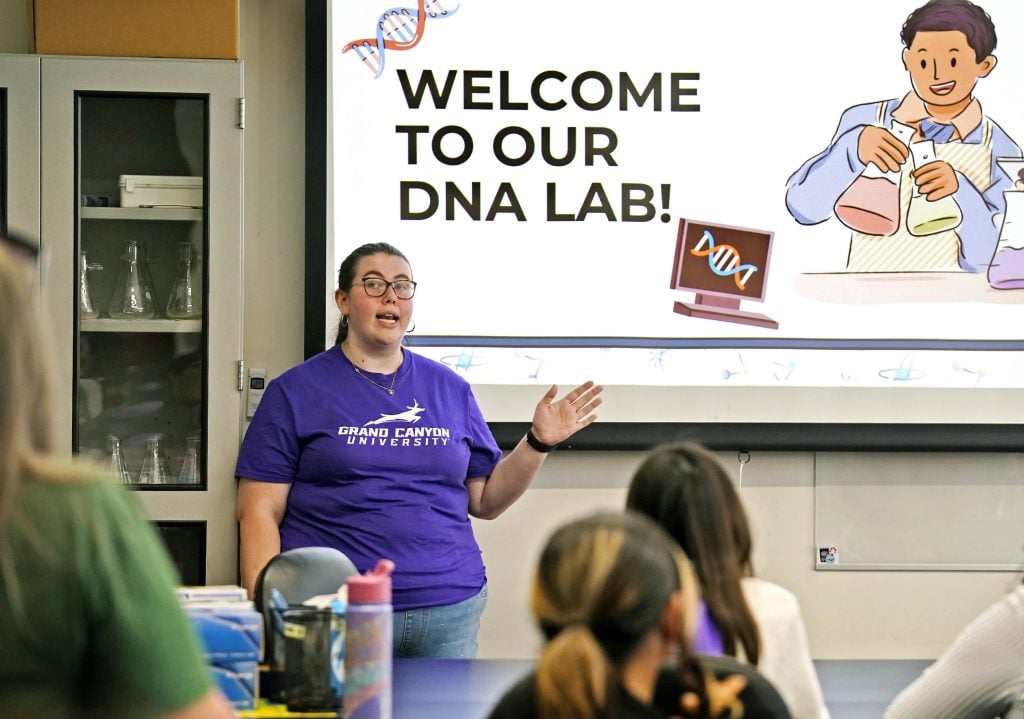
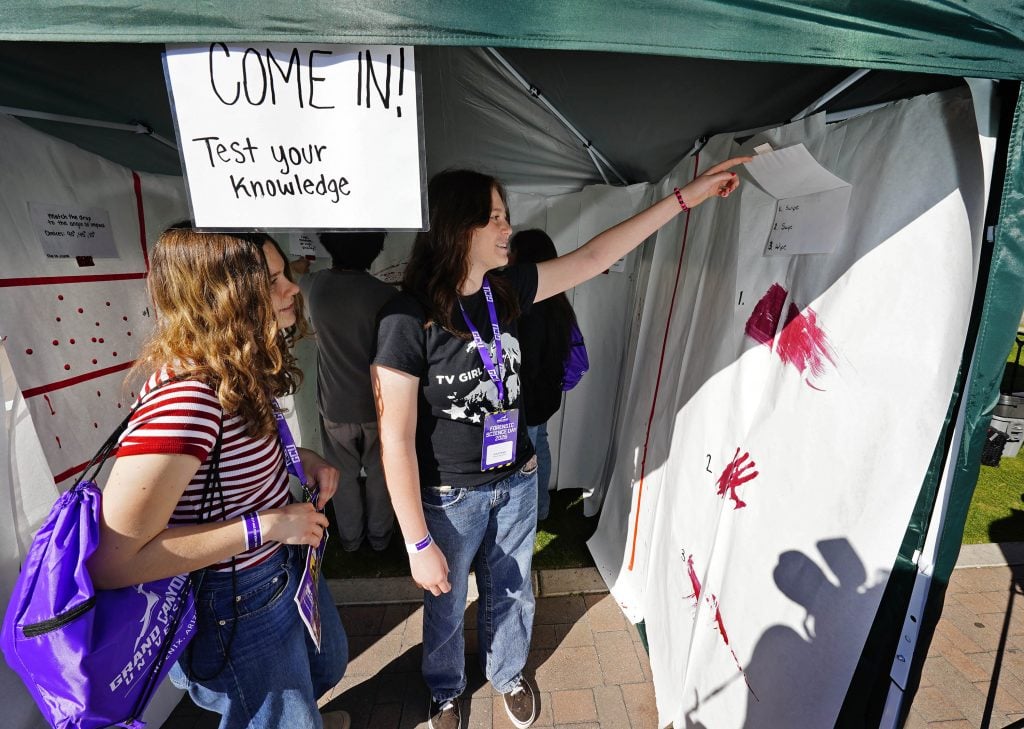
Hodges was part of a team of GCU students leading the blood analysis activity, just one of a slew of goings-on Thursday during Forensic Science Day, which featured blood spatter and fingerprinting booths, speakers, a police canine demonstration, scavenger hunt, crime-scene challenge and cadaver and DNA lab tours.
Some 2,600 students from high schools and community colleges were expected to stop by the university to up their knowledge of forensic science and law enforcement – and learn about GCU’s forensic science programs in the College of Natural Sciences.
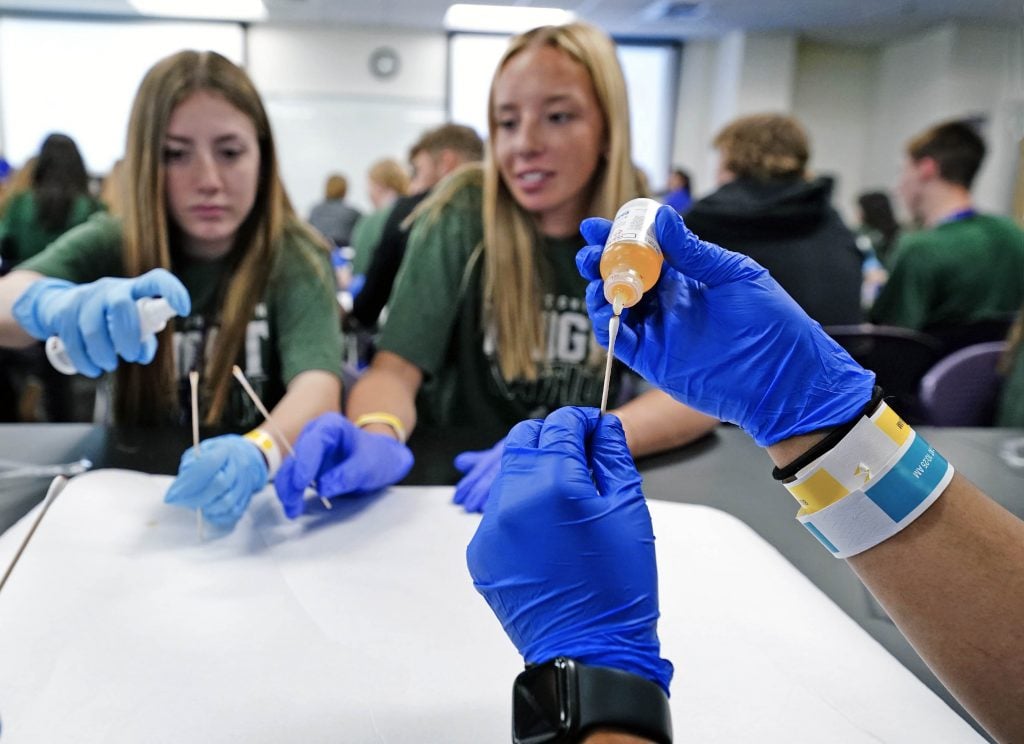
In the blood analysis activity, known as the Kastle-Meyer reagent test, students dripped synthetic blood onto a cotton swab then followed that up by adding drops of reagent and hydrogen peroxide.
“If it doesn’t turn pink within the first minute, it’s a negative,” said GCU graduate assistant Kaitlyn West.
An interesting aside?
These presumptive tests can give a false positive if fresh horseradish is involved – or other substances with high peroxidase activity, including potatoes and bleach.
Just one floor up from the blood analysis activity in the Technology Building, Hanz Murella, a student worker in the Cyber Center of Excellence – a hands-on space where GCU students learn to fight cybercrimes – was taking a breather between digital forensics sessions.
Students stopped into the center for a session of capture the flag, diving into a digital escape room of sorts where they acted as investigators to solve a cyber-related crime by finding codes and decrypting them.
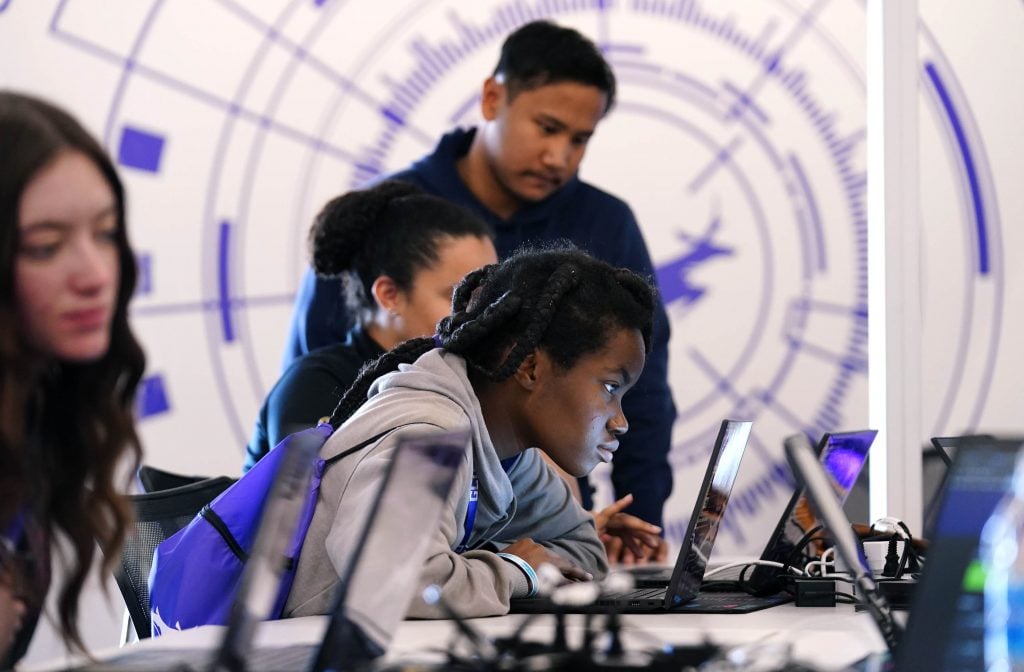
“We have a lot of challenges,” Murella said, including an OSINT, or open-source intelligence background check that involves gathering, analyzing and using publicly available information to build a profile of an individual or organization.
Murella said what he loved about Forensic Science Day was “just seeing the enthusiasm” among the students. “A lot of them are new to this kind of stuff.”
Outside the Technology Building, throngs of high school students readied themselves to head into the cadaver lab, where cadavers are kept for anatomical dissections. It’s uncommon for undergraduate students, like those at GCU, to have access to cadavers, which are more common in medical or graduate schools.
Forensic Science Day attendees also headed into Global Credit Union Arena to listen to speakers such as Michael Beddow of the Phoenix Police Crime Lab, who helmed a talk on forensic firearm examination.
He spoke about the rifling, or spiral pattern, inside the barrel of every firearm, that creates impressions on bullets.
Firearm and toolmark examiners use these impressions as evidence to try to match a bullet to a firearm that someone may have used in a crime.
And he shared a misconception with students during his talk.
Criminals often think that scratching off a serial number from a gun means the gun isn’t traceable.
But Beddow said that isn’t necessarily true if you just deface the surface of the firearm. Stamping a serial number into metal compresses the crystalline structure below the surface, and firearm examiners use several techniques to try to detect that number. One of those techniques is chemical etching, which involves applying reagents to the area that was defaced. The reagents eat at the stressed metal faster than the surrounding metal, revealing the number.
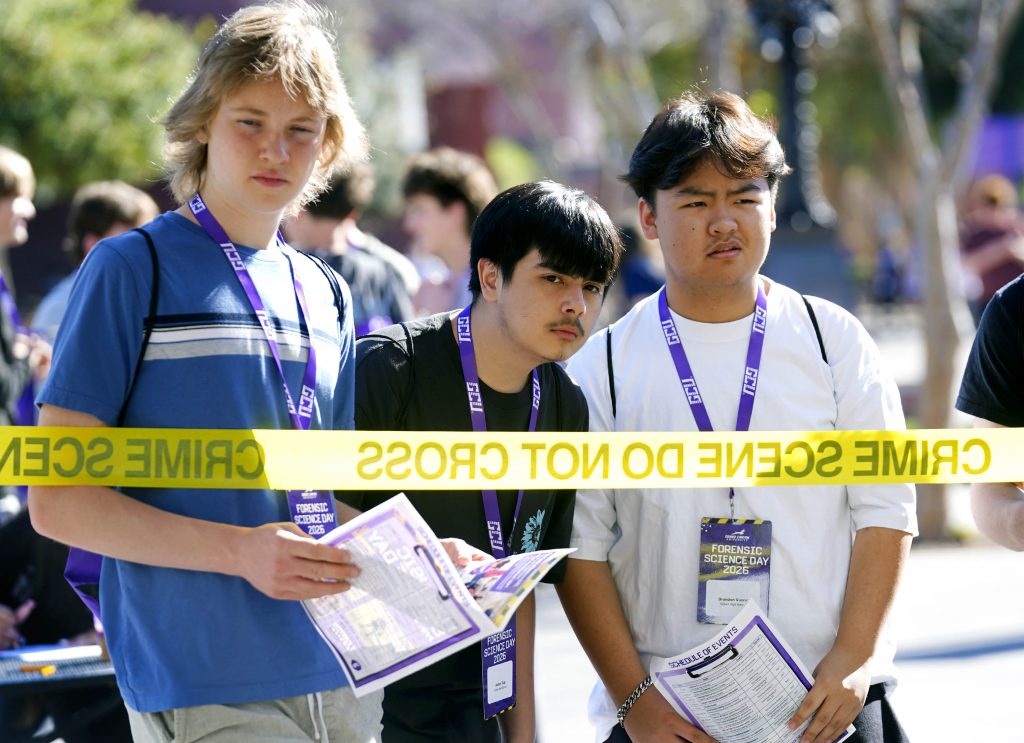
In the mock crime scene area, Michelle Armendariz Rocha of Dream City Christian put her deductive faculties to work to try and explain how the splayed out mannequin on the ground, representing a victim, might have been murdered.
“I think he was grabbing his stuff and he fell back and got hit, that’s why there’s blood everywhere,” she whispered to her friend group.
He was murdered – “and robbed” – added classmates Morgan Beadle and Madison Robinson.
They were next headed to the profusion of exhibits on the Promenade.
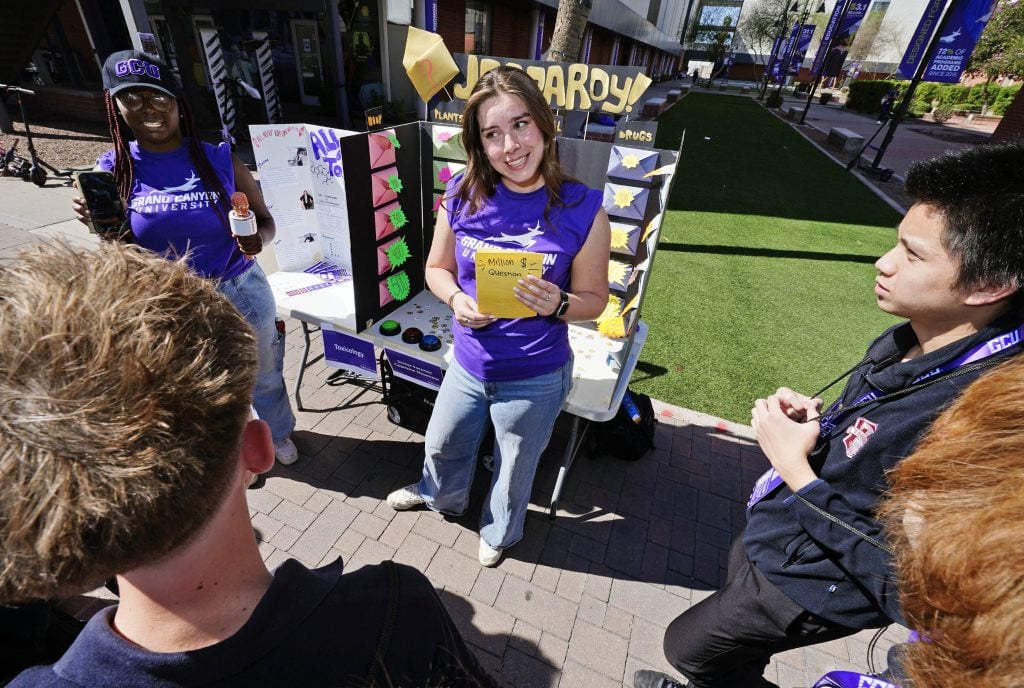
Several GCU seniors peppered the Promenade to present their capstone projects, such as forensics science major Maame Osei-Fordwuo, who partnered with Dani Parra and Sam Alvarado at the toxicology table.
The students tried to make their presentation fun by creating a “Jeopardy”-type game.
One high school student picked the category “body” for $100.
“This is the body’s largest organ,” which acts as a protective barrier against injuries, bacteria and UV light, Parra read.
The student couldn’t come up with the answer (which was skin).
Another student hit the jackpot with the next question in the body category for $200: “These are the body’s bean-shaped organs …”
“Kidneys?”
Correct! Candy prize won.
Osei-Fordwuo became interested in forensic science, she said, “when I was in eighth grade, I was reading a book called ‘Stalking Jack the Ripper,’” though she’s thinking of applying to medical school. Osei-Fordwuo is interning with the Maricopa County Medical Examiner’s Office and also has volunteered with the Denver Police Department in the city where she’s from.
And she keeps busy in Dr. Ramesh Velupillaimani’s Antimicrobial Lab undergraduate research group, studying the antibiotic benefits of fruiting bodies, such as mangoes.
Senior forensic science major Alexis Cho was on the Promenade, too, with her team, displaying a senior capstone assignment on bite marks.
High school students looked at bite mark impressions and tried to match them to what made the impression.
What she learned during the project, “For me, it’s definitely the concept of how unreliable bite marks are, but they’re still used in court,” she said.
That unreliability has to do in part with the skin distorting bite marks because of swelling and elasticity. Then there’s the possibility that a bite mark is caused by an animal, and it’s difficult to discern whether a bite mark is animal or human.
Cho noted the court case of Ray Krone, called the “Snaggletooth Killer.” He spent a decade in prison, including two years on death row, after being found guilty of killing a Phoenix bartender in 1991 based on bite mark evidence.
DNA evidence proved that he did not commit the murder.
Cho was attracted to forensic science because her grandfather used to work in the intelligence field in Korea. “He’s my hero,” said Cho, who is interning at the detention center of the Glendale Police Department. “I’ve always admired him. I wanted to follow in his footsteps, do something that will help people.”
GCU student Annalie Pineda-Esquivel was showcasing her team’s project on fingerprint development and helping high school students take their fingerprints using magnetic powder and glass. She admired the curiosity of the high school students at Forensic Science Day.
“I love talking to the kids,” Pineda-Esquivel said. “It’s my favorite part because they’re so interested.”
Lana Sweeten-Shults, manager of internal communications and editor of GCU News and GCU Magazine, can be reached at [email protected].
Related content:
GCU News: IT, cyber capstones are on the case with forensic science projects, more
GCU News: On the case: First students graduate with GCU master’s in forensic science