
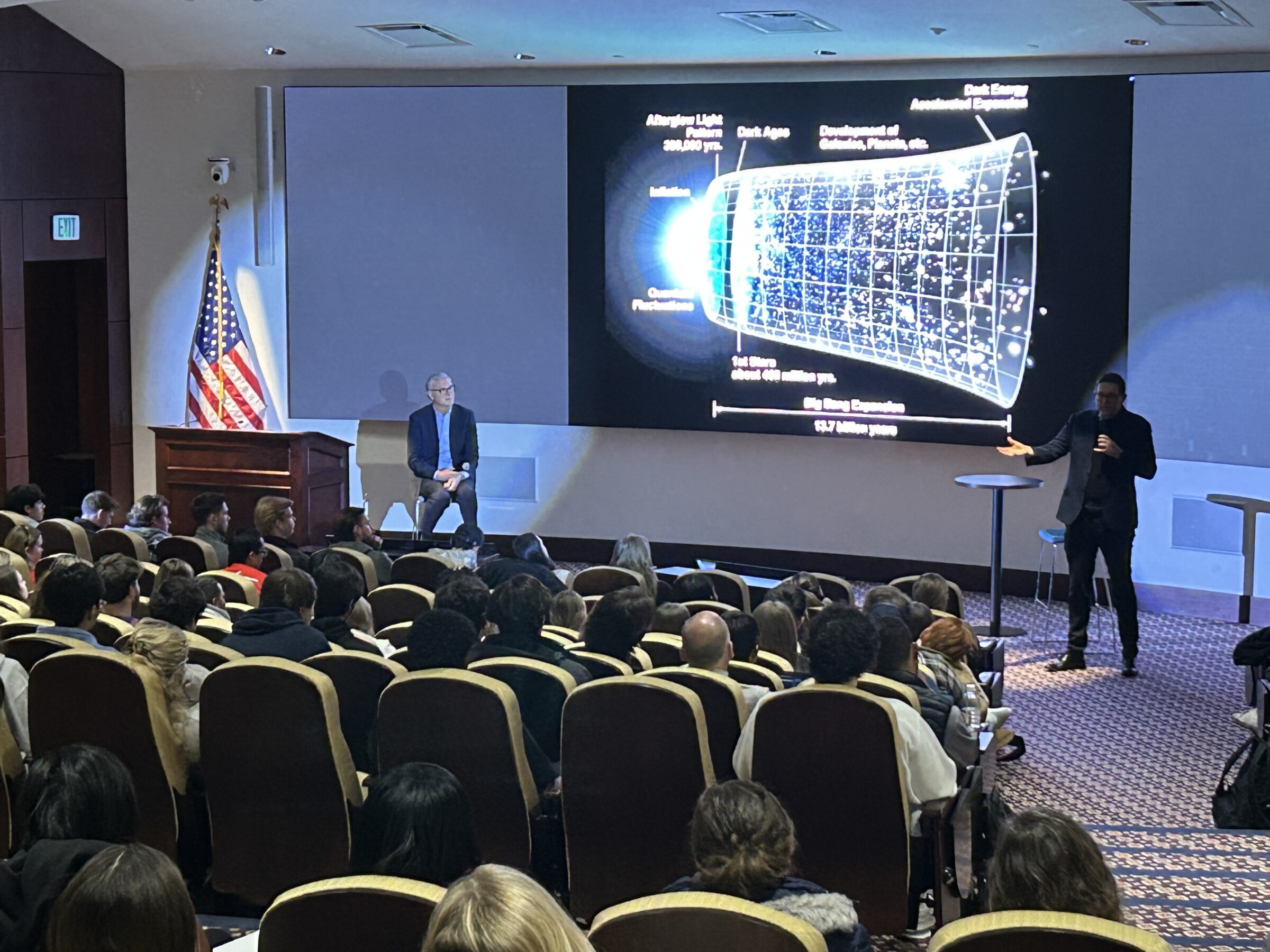
I recently had the privilege of speaking at High Point University, ranked the best-run university in the country, and at Duke University, my alma mater, on the cumulative case for God drawn from cosmology, the origin of life, and the centrality of information in biology.
I was joined by Dr. Rice Broocks, whose training in philosophy and history complemented my scientific expertise. Over the past several years, we have also addressed students together at several other universities, such as Berkeley and MIT, engaging in questions at the intersection of science, philosophy, and Christian thought. Last year, I spoke at the University of Washington, and the presentation, along with the Q&A, was recorded. The consistently positive response reflects a deep hunger among students to examine foundational questions of truth, meaning, and purpose.
Freedom to Ask Questions
Dr. Broocks and I labored to create an atmosphere in which listeners from any philosophical or religious background felt respected and safe to share their ideas. During the question-and-answer period, audience members raised deeply thoughtful questions, including:
- How can we infer that Earth was designed if we do not know the total number of planets? I addressed this question in a recent article (here).
- In what ways can evolutionary theory be integrated with faith, and which evolutionary claims conflict with traditional religious beliefs?
- To what extent is modern science consistent with various religious doctrines?
- If God is an all-powerful creator who is directly involved in the world, why does so much evil and suffering exist?
- What role does evidence play in Christianity, if religion is supposed to be grounded in faith?
- Why should anyone even pursue the ultimate truth? Isn’t skepticism the easiest option?
The final question was asked by a freshman philosophy student. I responded that skepticism should be a last resort rather than a starting point. If truth is knowable, we should pursue it as our highest priority. Discovering what is true provides the most coherent framework for living well, with implications that could extend beyond this life. By analogy, an engineer who designs a bridge according to the true laws of physics will produce a far more reliable structure than one built on mistaken assumptions. In the same way, aligning our worldview with reality has practical implications in every area.
Life-Changing Impact
The interactions were both intellectually profound and deeply personal. Many indicated that they had never before recognized the strength of the evidence for God. Others stated that they greatly appreciated the opportunity to engage the most foundational questions of life.
What has been most rewarding is seeing the impact of the presentations. One student stated that he was an atheist but wanted to learn how to know God. Another started crying during a presentation and later confided that she had a supernatural encounter with God during the talk and, as a result, wanted to find a church. Another student told me that he came as an agnostic, but the evidence “rocked his world.” He now saw religion in an entirely new light. Others commented that their faith was greatly encouraged and that they gained greater confidence to discuss it with others. Over the years, many have recounted that various versions of the presentation shaped the course of their lives.