
Today, UCF unveils a $4 million high-resolution transmission electron microscope, significantly expanding advanced materials research capabilities across the university and opening new opportunities for collaboration with industry partners throughout Florida.
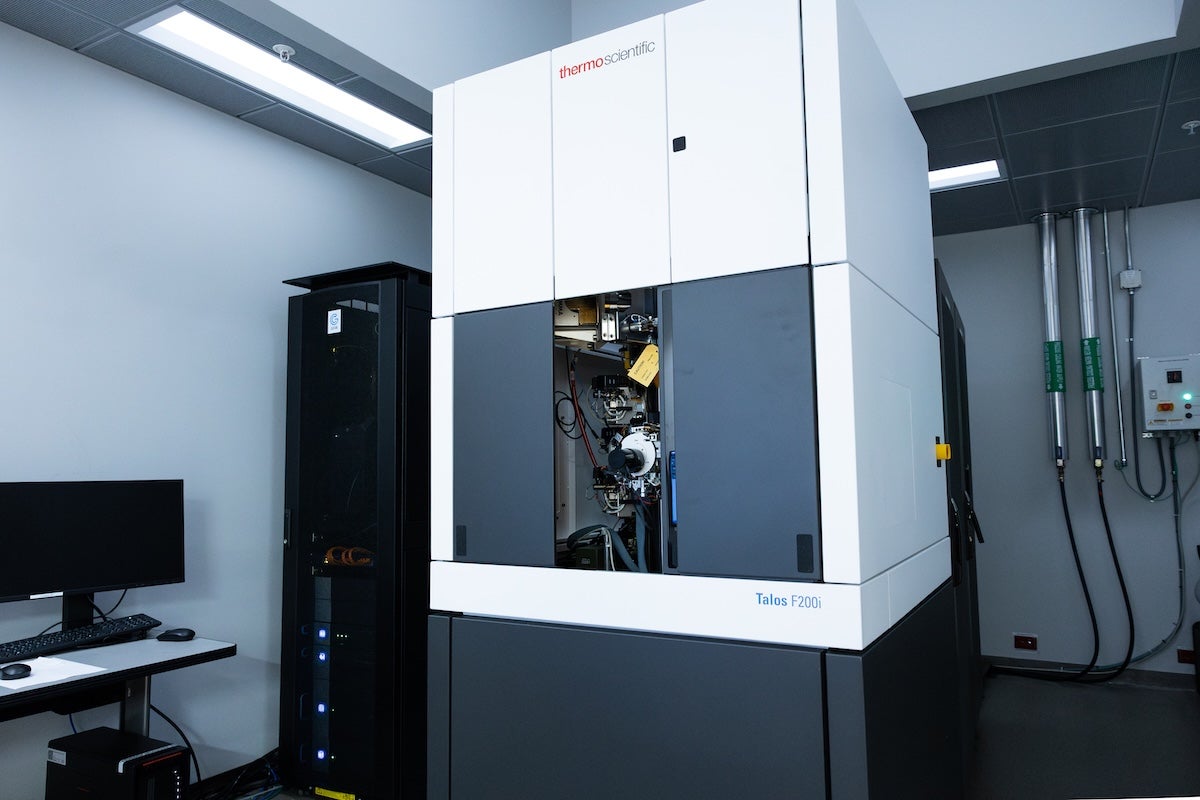
The Thermo Fisher Talos F200X analytical transmission electron microscope enables researchers — both at UCF and in industries across Florida — to observe and analyze materials at the atomic scale. Equipped with advanced nanoanalysis tools, the instrument allows direct observation of elemental, chemical, electrical and magnetic states, dramatically enhancing what scientists can measure and understand.
The instrument will be housed in UCF’s AMPAC Materials Characterization Facility (MCF), directed by Professor Jiyu Fang, and will operate as a shared university resource supporting interdisciplinary research and external partnerships.
“The new Thermo Fisher Talos F200X analytical transmission electron microscope will revolutionize materials science and engineering at the nanoscale,” says Professor Sudipta Seal, chair of the Department of Materials Science and Engineering. “Its advanced analytical capabilities will enable unprecedented insight into structure–property relationships, accelerating innovation across next-generation semiconductors, quantum materials, space and hypersonic systems, and cutting-edge biomedical applications.”
“This instrument is a catalyst for discovery,” says Vice President for Research and Innovation Winston Schoenfeld. “By giving our researchers and students the ability to see and understand materials at the atomic scale, UCF is unlocking new pathways for innovation across energy, aerospace, semiconductors and beyond.”
A Unique Capability in Florida
While other institutions in Florida operate microscopes within the Talos series, UCF’s system offers a distinct combination of capabilities.
It is the only Talos F200X in the state equipped with both a cold field emission gun and a super X energy dispersive X-ray spectroscopy detector. This configuration significantly enhances energy resolution and high-contrast imaging, enabling exceptionally precise chemical mapping at the atomic scale.
According to Professor Akihiro Kushima, the cold field emission gun allows advanced atomistic-scale analysis even for beam-sensitive materials — samples that can be damaged under conventional imaging conditions. The improved resolution and signal collection make it possible to analyze delicate materials in ways that were previously difficult or impossible.
In addition to supporting engineering and computer science research, the instrument will expand capabilities in fields such as planetary science, where nanoscale characterization of extraterrestrial materials can provide new insight into the origins and composition of planetary bodies.
Supporting Florida’s Innovation Ecosystem
Beyond academic research, the microscope is expected to strengthen partnerships with Florida’s high-tech industries.
The Talos F200X enables deep structural understanding of advanced materials, opening new opportunities for collaboration with companies across aerospace, defense, biotechnology, pharmaceuticals, electronics, semiconductors, energy and environmental sectors.
Kushima notes that the microscope is already supporting collaborations with local industry partners developing advanced battery materials. Using the Talos F200X, researchers can study how material structures evolve during charge and discharge processes, providing deeper insight into reaction mechanisms and helping optimize performance. The acquisition was made possible by the UCF Office of Research, with support from the Office of the Provost.
Training the Next Generation
The Talos F200X will be incorporated into undergraduate and graduate coursework in electron microscopy and advanced characterization techniques. Students conducting research can also gain hands-on experience after completing required training.
Understanding materials at the nano and atomic scales is essential in advanced manufacturing and semiconductor sectors, where structural insights inform synthesis optimization and failure analysis. Students trained in advanced characterization techniques such as transmission electron microscopy are highly valued in industry, positioning UCF graduates to contribute directly to Florida’s advanced manufacturing and semiconductor workforce.
Industry partners interested in utilizing the AMPAC Materials Characterization Facility may request instrument time by contacting ampacmcf@ucf.edu.