
Get a daily rundown of the top stories on Urban Milwaukee
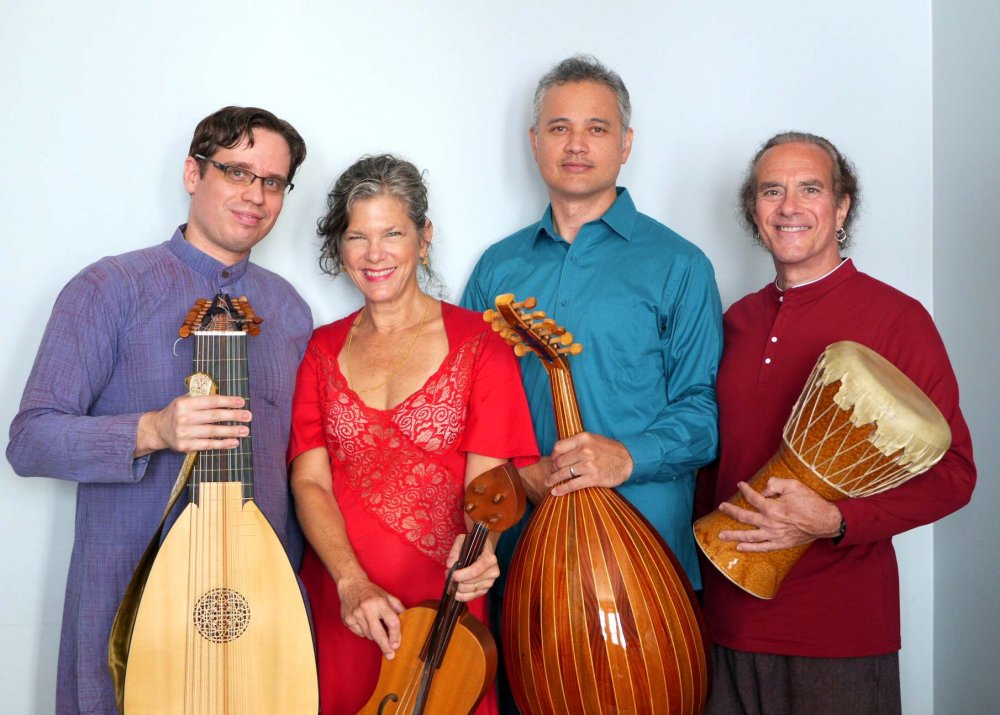
ALBA Consort. Photo from Early Music Now.
Early Music Now hosts the ALBA Consort on Saturday, March 7, in a six-century tour of early secular songs from cultural centers across the Mediterranean. The concert, Romance of the Rose: Songs of Love and Wonderment, draws on diverse threads: the interaction of cultures stretching from Persia to Spain, trade routes centered in Venice and Cyprus, and Christian, Jewish and Muslim communities that often shared the same regions, though not without tension.
The ALBA Consort features four accomplished early music performers: Margo Andrea, artistic director, mezzo-soprano and vielle; Carlo Valte, oud and guitar; Jason Priset, lute, vihuela and baroque guitar; and Rex Benincasa, percussion and voice.
The choice of instruments is central to the musical selections. Fretted string instruments — the lute, the baroque guitar and the vihuela (a plucked instrument related to the guitar) — are well suited to the scales and harmonies of Western music, where their fixed frets provide clarity and consistency of pitch. Unfretted string instruments, by contrast, can play any pitch and are capable of the semitones common in Arabic and Persian music. These include the oud, “grandfather” to the lute, and the vielle, a bowed instrument that preceded the viola da gamba. ALBA will be joined by guest artist Karen Lindquist on Renaissance harp — an instrument capable of producing some of the semitone pitches more difficult to play on the modern harp.
Consider the variety of settings that shaped this repertoire: Andalusian Spain became celebrated for a remarkable openness to artists from Muslim, Jewish and Christian communities, nourished by close contact with Persian scholarship — though this flourishing faced increasing pressure as Christian rulers from the north gradually gained control. The Maritime Republic of Venice extended its influence down the Adriatic to Greece, Cyprus and Egypt, while Cyprus itself had passed through the hands of numerous powers — Phoenician, Egyptian, Byzantine and others — leaving layers of cultural inheritance. French rulers held sway at various times over parts of Italy, Jerusalem and Armenia. The Christian world was itself divided between Roman and Byzantine liturgies and spheres of influence. Meanwhile, Persian and Armenian power had waned as new forces reshaped the region. Across all of this, trade routes served as corridors of cultural exchange, carrying not just goods but musical ideas, instruments and traditions across boundaries that were porous even when they were contested.
Changes across time were as important as changes across geography. Eastern musical traditions matured earlier than Western classical music and, in some respects, more elaborately. The maqam — a sophisticated framework of musical theory — specified rhythms, characteristic melodic frameworks and intentional relationships between poetry and music, developments that Western classical traditions did not pursue in the same way. Western music moved from chant and simple melody toward complex polyphony and counterpoint, rooted in an appreciation of how musical keys could drive harmonic development. But this path also meant simplifying scales and standardizing instruments in ways that left little room for the semitones and complex rhythms central to Eastern music. These were not simply parallel traditions — they intersected and influenced one another.
The musical journey of this concert is filtered through secular song. The rose carries spiritual symbolism across many philosophies and religions — Jewish, Christian, Islamic and Sufi traditions among them. Awed by its beauty, the poet suffers from love and longs for union with the “beloved,” a figure representing both earthly and divine love.
Get a daily rundown of the Milwaukee stories
Artistic director Andrea addresses the concert’s theme:
That’s why the rose is the symbol: the petals are infinite. You keep peeling away, and there’s really no end — it’s a symbol of infinity. It’s not a linear voyage from Spain to Persia. It’s more like the language of the clouds — they swirl, like a rose, and you don’t know where you are literally in time or geographically. And because remember, we’re also creating a modern interpretation of these things — especially instrumentally, and especially with notation that can’t really be fully defined.
The musical choices are extraordinarily varied. A Renaissance dance, Canarios, is followed by a Claudio Monteverdi song that reveals Ottoman influences on an early Western Baroque composer. Abdul Qadir Maraghi, a Persian-rooted composer working in the Islamic world, is paired with an anonymous Cypriot ballad featuring complex Western polyphony. Two works by Guillaume Dufay, a Franco-Flemish composer celebrated for his innovative sacred music, reveal his interest in Eastern themes, with influences that may have reached as far as Armenia. Songs from the Cantigas de Santa María, commissioned by the Iberian King Alfonso X of Castile, provided Catholic pilgrims with music written to an Arabic meter, also the basis for a traditional Greek Sephardic Jewish selection.
Contemporary perspectives are also represented. Komitas arranged ancient Armenian folk songs in the early 20th century. More recently, Reza Vali was commissioned by the ALBA Consort to compose settings of four Persian mystic poems from the 13th and 14th centuries, drawing from Eastern traditional music.
Early Music Now concerts often focus on historically grounded interpretations of a specific time and place, drawing substantially on the Western classical tradition. The ALBA Consort offers a broader and illuminating perspective on the polyglot environment that surrounded much early music — particularly the rich interchange among peoples across the Mediterranean world over several centuries. Not all of these influences were absorbed into Western classical music, and this concert keeps the roots of alternative Eastern traditions clearly in view.
The concert begins at 5 p.m. at St. Paul’s Episcopal Church, 914 E. Knapp St., in downtown Milwaukee. A pre-concert talk will be offered at 4 p.m. Parking is available in the Lincoln Center of the Arts lot across Marshall. Tickets may be purchased online or at the door.
Early Music Now will next feature music from China, with the Chinese ensemble Silk & Bamboo performing on traditional Chinese instruments, including the erhu, pipa, zheng and dizi. That concert, on April 18, 2026, will return to St. Paul’s Episcopal Church.

Existing members must be signed in to see the interactive map. Sign in.