
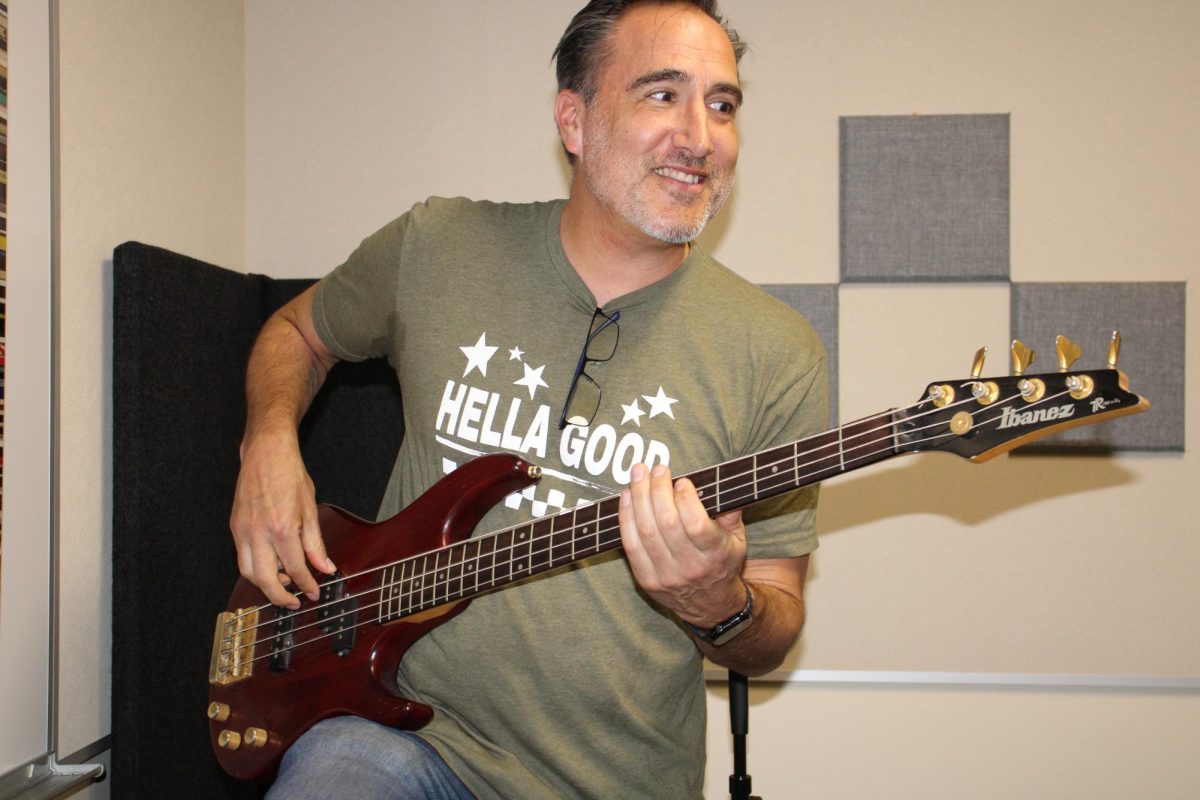
Michael Najar, Palo Alto High School Visual and Performing Arts teacher, plays an electric bass guitar in the new “music lab,” a dedicated music creation room on the second floor of the Media Arts Center. According to Najar, the new room is the beginning of his efforts to change the audio and music production courses to move away from digital-only learning. “I’m talking to my colleagues here in the building [Media Arts Center] to see if we can start finding a balance of making more stuff hands-on, in terms of music craft.”
Audio Music Production students at Palo Alto High School are playing with an expanded range of musical tools and physical senses following the opening of a “music lab” in the Media Arts Center this month.
Michael Najar, Visual and Performing Arts teacher, repurposed a podcast recording room located on the second floor of the MAC into a dedicated space for music creation.
Inside the room, various instruments and musical tools, such as a keyboard, synthesizer, DJ equipment, microphones, guitars and bass guitars are available to encourage students to play around more with music outside of digital programs through the integration of physical learning.
“We need to be in a class that embraces touching, feeling and creating with your hands and eyes and your ears,” Najar said.
Najar said that the new lab will likely not be fully integrated in the music production curriculum until the 2026-2027 school year.
“For next year, when I know the lab is working and I have everything in the place that I want to have in it, then I’m going to actually make a curriculum dedicated to it,” Najar said.
Najar said that he feels this transition is increasingly important as artificial intelligence becomes more relevant in the world of music production.
“AI is now built into a lot of what these music apps can do,” Najar said. “It’s resisting that temptation to just prompt the music software to do it [making music] for you.”
Music programs that use AI are becoming increasingly popular. Suno, an app that generates songs based on user prompts, has 2 million subscribers, according to The Hollywood Reporter. ACE Studio is a program that can generate vocals based off of a given melody. FL Studio, one of the most popular music creation apps, has various AI tools, such as a stem-separation tool that can separate specific instruments from an audio file for sampling purposes.
According to Najar, the most important part of creating music is the “human experience,” something that cannot be replicated with modern digital programs and AI.
“The best part of my love for making music is the human aspect of … sharing, communing, creating and failing together,” Najar said. “If you’re making sounds and you press on a keyboard, you know what you’re trying to get. It gives you feedback. It tells you what it’s trying to do. If I just recreate that in the virtual world, that’s an experience. It’s not a human one, but it’s an experience.”
This sentiment is shared by junior Jack January, a musician who took Najar’s Audio Music Production course in the 2023-2024 school year, who said he thinks AI often strips creativity out of music.
“When it comes to AI in music, it should be frowned upon,” January said. “The whole reason music is listened to is because it’s artistry and it’s coming from a human.”
January said that he thinks having more non-digital components as a part of the class is a positive change.
“We were working pretty much exclusively with digital software like Logic Pro and the instruments provided there [in Audio Music Production], but I think it’s really important to use the physical equipment,” January said.
According to January, learning how to work with physical equipment is essential for future artists.
“Over time, a lot of people use digital audio workspaces and a lot of different plug-ins, and they won’t really get familiar with the actual physical hardware,” January said. “When you go into the real industry, and you start working in real studios, you’ll find yourself using a lot of that hardware.”
January said that he thinks access to the new lab will help students learn without a disadvantage.
“I would have been able to progress a lot faster [in my music] if I had access to nicer microphones … all these different things that a lot of people need to excel in their music,” January said. “Why don’t we give more access to these tools so that they [students] can excel in their field?”