
How do scientists quantify the value of a river? Zeb Hogan, research professor and Stefan Lovgren, research faculty in the Department of Biology coauthored an article with Rafael J.P. Schmitt, an assistant professor at UC Santa Barbara, which attempted to capture the full value of the Mekong River. “The Mekong: The Most Valuable River in the World” was published last week in the German journal Spektrum.
The article is the result of conversations during a conservation workshop led by Hogan and attended by his coauthors at the University of Nevada, Reno at Lake Tahoe. Hogan has studied the Mekong for decades and Lovgren has reported on the Mekong and Hogan’s work there for news outlets including Mongabay and National Geographic.
The Mekong River flows through six countries in southeast Asia, from China to Vietnam, and is one of the world’s most productive fisheries. The fishery is under threat from dams, overfishing, sand mining, pollution, intensifying droughts and unpredictable floods. Over 60 million people rely on the river for livelihoods, food, transport, energy and cultural identity. The many ways that a freshwater ecosystem contributes to the surrounding communities are often invisible to most people, and some remain hidden even from those most familiar with the ecosystem. The contributions may also be impossible to quantify.
“The natural capital and ecosystem services of freshwater ecosystems like the Mekong are often undervalued, which leads to short-sighted environmental degradation and unsustainable development,” Hogan said.
Elizabeth Koebele, an associate professor in the Department of Political Science who has studied policymaking on the Colorado River, attended the workshop at Lake Tahoe. She, along with postdoctoral scholar Gina Gilson, coauthored an article with Hogan and biology professor Sudeep Chandra for the Nevada Water Environment Association and the Nevada Water Resources Association about how much Nevada’s rivers are worth.
“In arid regions like the Southwestern U.S., a single river must often provide water for copious demands, whether from cities, agriculture, industry, or other human uses,” Koebele said. “In these places, valuing a river’s natural capital is critical, as the health of the river and the ecosystem services it provides undergird the ability for the river to provide for all other uses.”
The Mekong article highlights some of the quantifiable contributions of the river. The Mekong provides habitat for roughly 200 billion fish larvae each year and many of those larvae are part of the two million tons of wild captured fish, comprising $10 billion of the global economy. Yet those numbers are decreasing due to, among other threats, development efforts. Analyses show that dam construction will impair the ecosystem to such an extent that any economic gains from the hydropower produced will be surpassed by economic losses in the river’s productivity due to impeded fish migrations and flood pulses. The World Wildlife Fund estimates that the past 25 years of human activity have resulted in a loss of $55 billion in ecosystem services, including natural flood mitigation, fish catches and other capacities. Sand mining has significantly impacted coastal stability and agricultural productivity in the Mekong River delta.
The examples above are a very small portion of the ways ecosystem values can be quantified, and while the numbers are compelling, the researchers emphasize that there are many more services provided by the river that are difficult to quantify. For example, beyond the monetary cost of losing species which may be fished for food, the ecology and biodiversity of the river is impacted in sometimes incalculable ways and the cultural connections of local communities to the species and the species’ intrinsic value can’t be expressed in dollar amounts.
“One of the reasons why people may be uncomfortable with valuing a river is because many people see water and river ecosystems as essential to life. In other words, many people recognize rivers as being worth so much more than their monetary value,” Gilson said. “It’s much harder to put an appropriate value on the spiritual, cultural, and inherent values of rivers, and we need to keep working on better ways to account for diverse values in decision-making.”
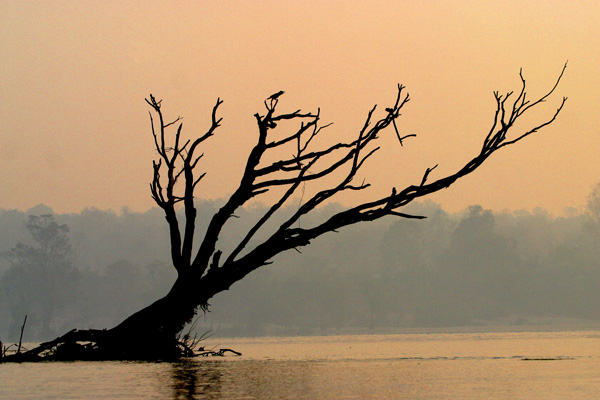
Non-economic perspectives like narratives and storytelling are crucial to conservation efforts and should be considered along with numbers, the researchers say, and can be just as powerful as economic valuations when advocating for conservation of natural resources.
“When we take a more holistic approach to valuing freshwater ecosystems, we make better development decisions with more, longer-term benefits for humans and nature,” Hogan said.
The challenge of calculating the value of freshwater ecosystems isn’t limited to the Mekong. Pyramid Lake, Walker Lake and the Colorado River all provide critical resources for people and animals, Hogan said, highlighting the global nature of issues related to water management and both the enormous challenges but also tremendous benefits of quantifying an ecosystem’s full value.