
In Conversation with Whitney Terrell and V.V. Ganeshananthan on Fiction/Non/Fiction
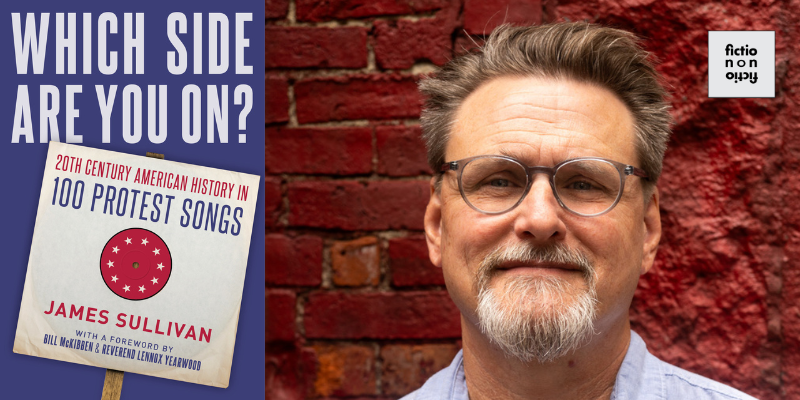
Pop culture critic James Sullivan joins co-hosts V.V. Ganeshananthan and Whitney Terrell to discuss the history of American protest music. Sullivan, the author of the book Which Side Are You On?: 20th Century American History in 100 Protest Songs, talks about how music has been an important part of inspiring and supporting protest movements from anti-Vietnam War efforts to the Black Lives Matter Movement and present-day protests against ICE. Sullivan considers the importance of protest music to facilitate camaraderie, build morale, and change minds. He explains how the way a song is sung can transform it into protest, even if the lyrics don’t change; he comments on recent Super Bowl halftime shows and their political relevance. He also reflects on songs that not only protest, but also honor political martyrs. Sullivan reads from Which Side Are You On?
To hear the full episode, subscribe through iTunes, Google Play, Stitcher, Spotify, or your favorite podcast app (include the forward slashes when searching). You can also listen by streaming from the player below. Check out video versions of our interviews on the Fiction/Non/Fiction Instagram account, the Fiction/Non/Fiction YouTube Channel, and our show website: https://www.fnfpodcast.net/ This podcast is produced by V.V. Ganeshananthan and Whitney Terrell.
Which Side Are You On?: 20th Century American History in 100 Protest Songs • Island Cup: Two Teams, Twelve Miles of Ocean, and Fifty Years of Football Rivalry • 7 Dirty Words: The Life and Crimes of George Carlin
Music
“I Didn’t Raise My Boy to be a Soldier” • “We Shall Overcome” • “Waist Deep in the Big Muddy” • “Which Side Are You On?” • “Try That in a Small Town” • “Man in Black” • “Streets of Minneapolis” • “American Obituary” • “Mississippi Goddam” • “You Don’t Own Me” • “The Times They Are A-Changin’” • “Blowin’ in the Wind” • “This Land Is Your Land” • “The Preacher and the Slave” • “Casey Jones (The Union Scab)”
Others
ICE OUT SING-IN Resistance Songbook • ‘Streets of Minneapolis’: 32 protest songs inspired by the city’s ICE resistance • Alfred Hayes • The Man Who Never Died by William M. Adler
EXCERPT FROM A CONVERSATION WITH JAMES SULLIVAN
V.V. Ganeshananthan: We’ve been talking about how prevalent songs about political martyrs are and how they come to be, and there are so many: Joe Hill, John Brown, Michael Brown, George Floyd, Alex Pretti, Renee Good, we could go on and on and on. In your book, there are others as well. I’ve been interested lately in how we think about these protest songs, both as a means of change and as a way to memorialize those we’ve lost. I think about in the book where Joe Hill says, “Don’t mourn, organize,” and sometimes those moments overlap. I teach at the University of Minnesota, where Alex Pretti was a 2011 graduate of the College of Liberal Arts, and the university administration held a community gathering that included some space to honor his life. They invited a faculty violinist, Stephanie Arado, to perform, and I think, gave her no parameters but a time limit. Then when she came, she had an ICE-critical message on her clothing, and they did not let her perform.
James Sullivan: Wow. At an Alex Pretti memorial. That tells you how terrified the universities are of Trump and the administration.
VVG: Obviously. So, I heard about this, and I’m a member of the arts faculty as a creative writer, and I went to look up the song she was going to play which was this incredibly heartbreaking, very short piece that was just for solo violin. I was really sad, because it seems like our community had missed a moment to mourn Alex Pretti. Their failure to allow her her right as an artist to protest had also ruined this community moment where we should have been mourning him. I wonder if you can talk a little bit about the intersection of protest and mourning?
JS: You mentioned a few of the names from the Black Lives Matter movement, a few of the individuals who were killed in police confrontations, which is something that clearly continues to go on today, and was happening before that movement. But this is another example of how it’s a little bit mind boggling to me when people say, “Where are the protest songs?” There were dozens of songs that came out 10-ish years ago that were of the Say Their Name variety. We were talking earlier about Vic Mensa, the rapper, Vic Mensa’s song 16 shots, which he wrote in the aftermath of the police murder of one of those individuals, Laquan McDonald. Janelle Monae wrote a song called “Hell You Talmabout,” which was almost literally written around the refrain of “say their names.”
Whitney Terrell: She’s from Kansas City, Kansas, Janelle Monae, my neighboring hometown.
JS: Very good. But there were any number of songs about those victims and trying to memorialize them in song. It’s just another example to me that protest music is everywhere, if you know where to look for it. And again, to go back to a point I made earlier, it’s a lot easier as a songwriter to tell a story about one tragic death than it is to tell—there’s an old phrase that was accredited to Stalin, or at least he used it, “One death is a tragedy. A million deaths is a statistic”—and it’s a lot easier to write a song about a tragedy than about a statistic. It’s sad, but true that when events cause the unjust deaths of folks, like during the Black Lives Matter movement, or like the ICE monitors in Minneapolis, songwriters are going to step up and have something to say about it. I’m really sorry to hear how your school handled that particular incident, because that’s not helpful to anybody. A memorial service is supposed to be a healing event, and music should be obviously a part of that. If you can’t wear an anti-ICE T-shirt to an Alex Pretti memorial, there’s something wrong there.
WT: One thing that struck me about all of this in the book is that some of these protest songs were written about specific incidents, like Kent State, and the song that we talked about early on where the woman tore the calendar off and wtote on the back. They’re written right under pressure. Neil Young’s song “Ohio,” which was about Kent State, happened right away. He just sat down and wrote the song as soon as he heard about it happening. There’s something about that, reaching that emotional boiling point, where an incident can finally make you say the thing that you want to say. You talk about N.W.A.’s song, “Fuk Da Police,” which also has echoes of what people are saying about ICE now, like chanting “Fuck ICE.” It’s got to be related in some way to that original protest song.
JS: One of the things that I keep harping on is this idea that there’s a lot more protest music than people think about. There are entire genres of music. Hip-hop is certainly one that were born out of protest. That’s black America saying “we still get disrespected.” Fifteen or so years after the Civil Rights Movement supposedly magically solved all the race relations problems in America, hip-hop launched in the late 1970s and early ’80s. It’s always been a home for protest. Punk music is another obvious example. Punk has always been about rebellion and rejecting the status quo. In my mind, even rock and roll itself is a kind of protest music. It began in the ’50s as the voice of the youth saying “We’re not going to just follow in our parents’ footsteps. We have voices and thoughts of our own.” Protest music is and has always been alive and well.
Transcribed by Otter.ai. Condensed and edited by Rebecca Kilroy.