
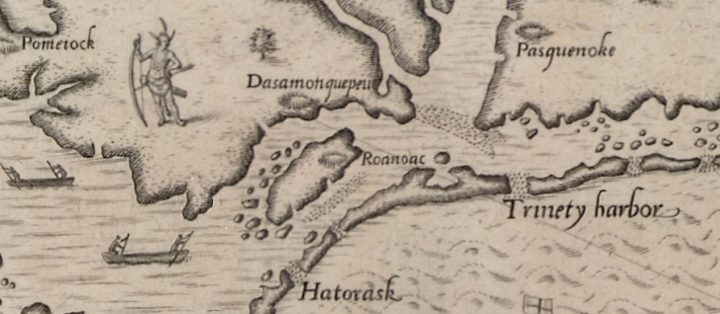
Archaeologists and historians are going to share their evidence of mixed Elizabethan-Algonquian material culture at sites on Hatteras Island during the March installment of the “Science on the Sound” series.
“The Smoking Gun?: New Radiocarbon Dates and Hunting Practices Linking Hatteras Island to Fort Raleigh in the Sixteenth Century” is scheduled for 6 p.m. Thursday, March 26, at the Coastal Studies Institute on the East Carolina University Outer Banks Campus.
The public is encouraged to attend the program being offered at no charge or view the presentation via YouTube. “Science on the Sound” is a monthly, in-person lecture series highlighting coastal topics.
The nonprofit Croatoan Archaeological Society and the University of Bristol have uncovered evidence that “strongly suggests Hatteras was the location where at least some of the ‘lost’ colonists re-settled when they went missing between 1587 and 1590,” organizers said.
“These objects have been cautiously interpreted, however, since European objects may have been traded long after those who originally brought them to the Carolina coast had passed away,” they continued. “Here we summarize past findings and describe the clearest evidence to date that the 1587 colonists were present on Hatteras Island: biogeochemical, radiocarbon, osteological, and metalwork evidence that demonstrate the presence of late sixteenth century firearms and hunting practices on Croatoan land.”
Beth Scaffidi, Mark Horton and Scott Dawson are presenting.
Scaffidi is an assistant professor of Anthropology and Heritage Studies, director of the Skeletal & Environmental Isotope Laboratory, or SEIL, and co-director of various archaeological field research programs in Peru. She uses bioarchaeological isotopes, palaeopathology and spatial analysis to investigate how interactions between ritual, landscapes and resources co-constitute human and environmental health.
Horton is the pro vice-chancellor of Research and Enterprise and professor of historical archeology at the Royal Agricultural University of England. He specializes in landscape archeology and archaeological science methods as applied to maritime and Colonial contexts around the globe and emphasizes public outreach and conservation of material culture.
Dawson is an area historian, director of the Croatoan Archaeological Society, and owner of the Lost Colony Museum in Buxton. He has been co-directing archaeological excavation of Cape Hatteras sites with Horton and society volunteers for over a decade.