
Thousands of rally-goers in 33 locations nationwide gathered today at Stand Up for Science events in a “national day of action” to express support for one another and highlight the necessity of science in policymaking in a time of heightened uncertainty for the science community and beyond.
Stand Up for Science, a nonprofit advocacy organization, first organized rallies in March 2025. The group was inspired by the 2017 March for Science, which occurred during President Donald Trump’s first term. Since the 2025 rallies, academic and federal scientists in the United States have continued to grapple with funding uncertainties, staffing cuts at federal agencies, and increasing disregard for science within federal policymaking.
During the first year of Trump’s second term, the administration “has gutted the scientific integrity infrastructure of the government,” said Gretchen Goldman, president and CEO of the Union of Concerned Scientists and a speaker at this year’s flagship rally in Washington, D.C. “There’s firing of scientists, dismantling of federal programs, disregard of congressional mandates on science, and an affront on the role that science should play in government decisions.”
“We’re fighting to save science, we’re fighting to protect health, and we’re fighting to defend democracy,” said Colette Delawalla, founder and CEO of Stand Up for Science and a psychology doctoral student at Emory University.
Science and Democracy
“We’re now in a situation where the people who are deciding how science funding gets spent are political appointees who don’t want the scientific ecosystem to exist to benefit the public.”
Delawalla said this year’s gatherings focused more on the degradation of science in federal policy and less on funding concerns. She said organizers this year are worried less about the overall amount of funding for science and more about “science being misused as a weapon and independent centers of thought being compromised by government entities.” Science has been particularly ignored in recent childhood immunization recommendations and the recent repeal of the 2009 Endangerment Finding, she said.
“We’re now in a situation where the people who are deciding how science funding gets spent are political appointees who don’t want the scientific ecosystem to exist to benefit the public,” Delawalla said. “They want it to exist to benefit and further enrich the billionaire class.”
Stand Up for Science asked rally-goers to engage in four specific policy campaigns:
Standing Up for Science
At the Washington, D.C., rally, Goldman delivered a speech outlining ways in which the Trump administration has devalued “decades of rigorous scientific research.” She emphasized that science plays an important role in the checks and balances of federal power and lamented that those checks and balances seem to have diminished. Like Delawalla, Goldman used recent vaccine recommendations and the EPA’s repeal of the 2009 Endangerment Finding as examples.
“A scientific determination that global warming emissions are bad for our health and the planet—repealed under Trump’s EPA, because they don’t think they have to listen to us,” Goldman said. “My fellow scientists, we have our assignments. We must speak out. We must act. And we must keep doing the science that they want you to stop,” she told the crowd.
At the rally in Boston, held at the Boston Common, hundreds of people listened to Nobel laureates, medical doctors, undergraduate and graduate students, and professors speak about the importance of science funding and political action to support science. The gathering was kicked off with a rendition of “We Shall Overcome” from local musical group Rosie and the Resisters.
“It’s discouraging, and that’s one of the reasons why I’m here. How can I help to maybe turn the ship around?”
Though speakers turned their focus to concerns about vaccine recommendations and the integrity of science within policy, science funding remained a focal point as well.
Liam Synnott, an undergraduate biology student and researcher at Tufts University, attended the Boston gathering to express his concern about funding uncertainties and the future of science careers. “Definitely, some of the researchers at Tufts have lost grants and lost funding, and aren’t able to take on grad students, or they have to pause certain projects,” he said. “It’s just really disheartening…so I feel like it’s important to use my voice however I can to help get that funding back.”
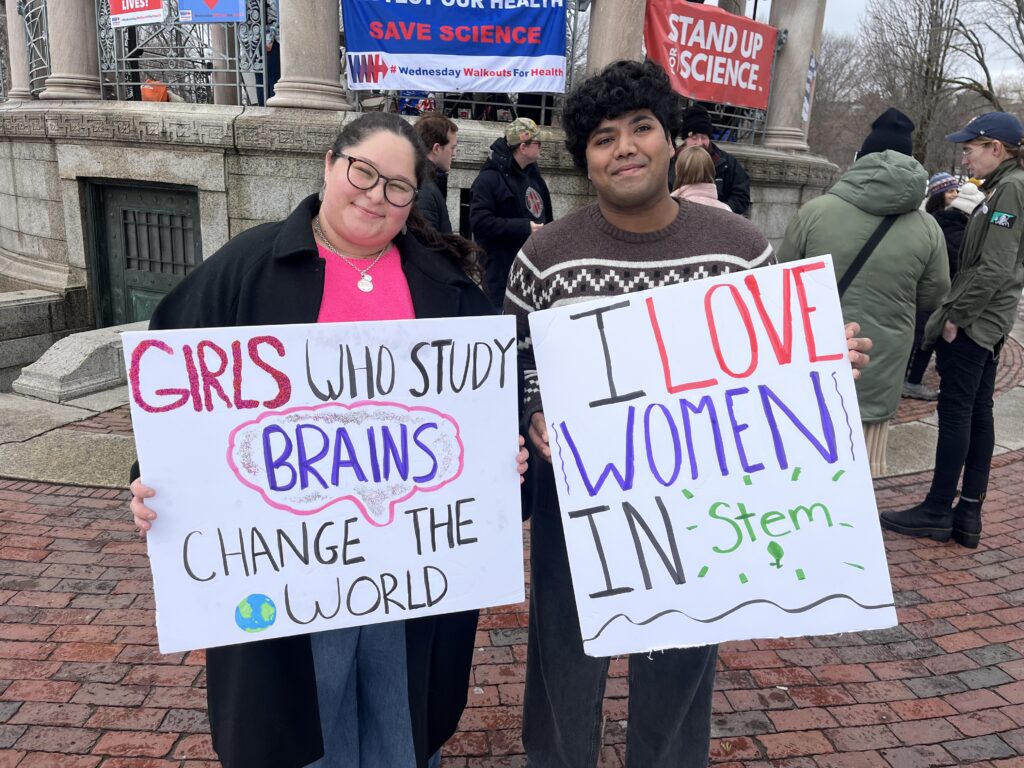
Joseph Pascucci, a neurobiologist who is actively applying to doctoral programs, views recent federal science policy changes as a hindrance to graduate education. “Seeing [PhD] programs being cut down actively is tough,” he said. “It’s discouraging, and that’s one of the reasons why I’m here. How can I help to maybe turn the ship around?”
The consequences of recent federal science policies mean that Boston “will lose our historical role as a magnet for the best and the brightest to come here to learn and study science,” Boston rally organizers said in a statement.
Thomas Michel, a professor of medicine at Harvard Medical School and an organizer of the Boston event, urged the crowd to take their momentum beyond the rally. “I want you to leave this rally with more than just a good feeling,” he said. “I want you to leave here with a plan for action.”
—Grace van Deelen (@gvd.bsky.social), Staff Writer