
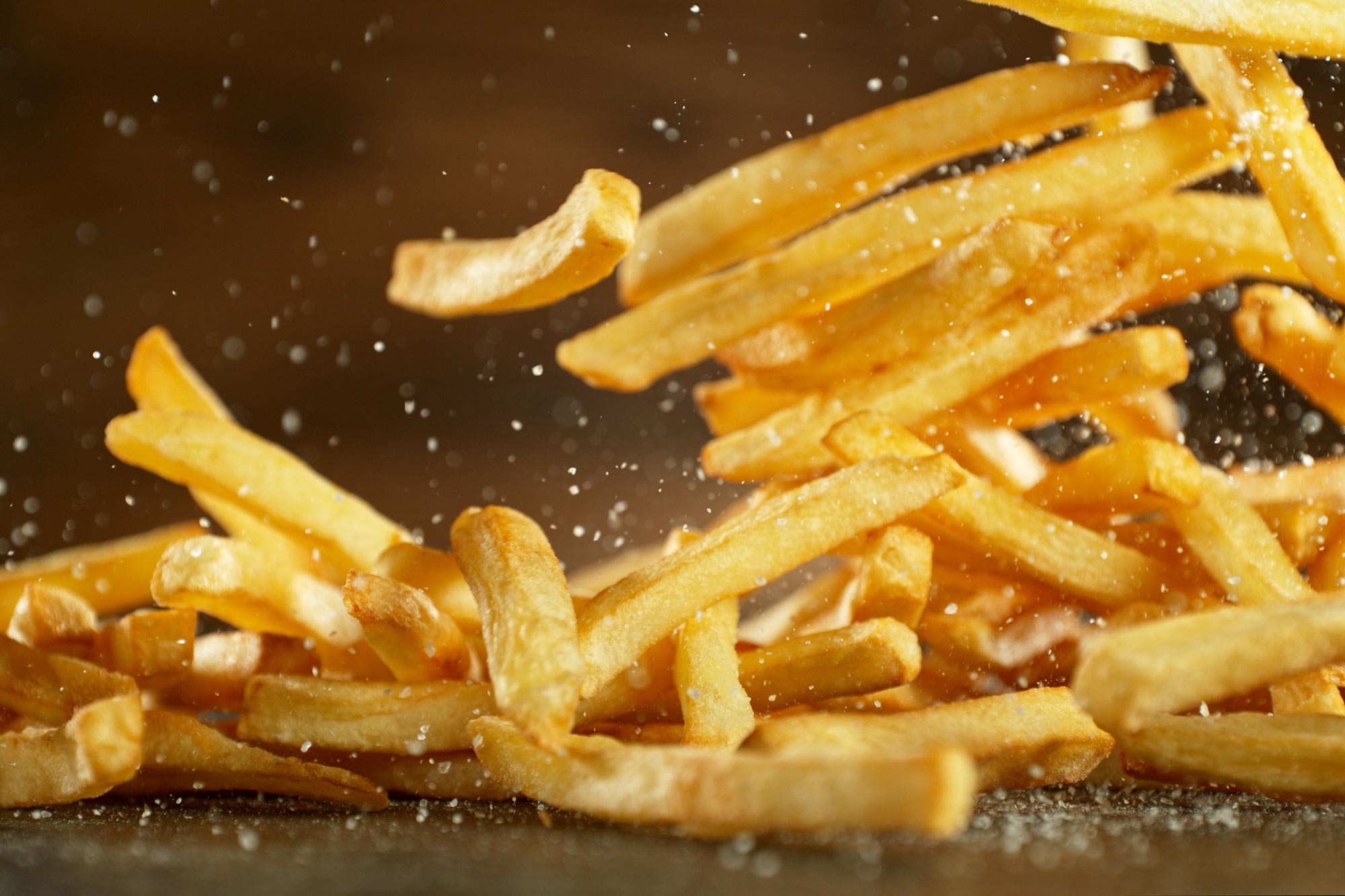
A new study suggests that combining microwave heating with traditional frying could reduce oil absorption in foods like French fries while maintaining crispness.
Fried foods are widely enjoyed, but their high fat content is linked to health concerns such as obesity and high blood pressure. If food producers can create lower-fat versions that still deliver the same taste and texture, consumers may find it easier to choose healthier options.
Researchers at the University of Illinois Urbana-Champaign have been studying a technique known as microwave frying to better understand how it affects foods like French fries. Their findings suggest that pairing traditional frying with microwave heating could produce fries that remain crispy while absorbing less oil and requiring less cooking time.
“Consumers want healthy foods, but at the time of purchase, their cravings often take over. High oil content adds flavor, but it also contains a lot of energy and calories. My research team studies frying with the aim of obtaining lower fat content without significant differences in taste and texture,” said principal investigator Pawan Singh Takhar, professor of food engineering in the Department of Food Science and Human Nutrition, part of the College of Agricultural, Consumer and Environmental Sciences at U of I.
Investigating Microwave Frying
Takhar and Yash Shah, a doctoral student in FSHN, recently described their research in two scientific papers that examine how microwave frying changes the cooking process of French fries.
For the first study, the Illinois team worked with researchers at Washington State University. The collaborators developed a specialized microwave fryer capable of operating at two different frequencies, 2.45 gigahertz, which is similar to a typical household microwave oven, and 5.8 gigahertz.
To prepare the samples, the researchers rinsed and peeled potatoes, cut them into strips, then blanched and salted them. The potato strips were fried in soybean oil that had been heated to 180 degrees Celsius (356 degrees Fahrenheit). During and after cooking, the team monitored temperature and pressure and also evaluated the fries for changes in volume, texture, moisture content, and oil absorption.
Why Oil Enters Fried Foods
According to Takhar, one of the main challenges in frying is preventing oil from soaking into the food during and after cooking.
At the start of frying, the tiny pores inside the potato are filled with water, which leaves little room for oil to enter. As heating continues, that water begins to evaporate. The resulting empty spaces allow oil to be pulled into the food through a process driven by negative pressure.
“Think about a straw in a drink. If you push air into the straw, it creates positive pressure and any liquid will be pushed out. But if you suck on the straw, the liquid moves upward. Now, imagine food materials have lots of tiny straws. When there is positive pressure, the oil stays out. But if there is negative pressure, the oil starts moving in,” Takhar explained.
Researchers estimate that as much as 90% of the frying process occurs under negative pressure, which creates a constant tendency for oil to be drawn into the food. Reducing the amount of time spent under these conditions is key to limiting oil absorption. Extending the period of positive pressure can help keep oil from entering the food structure.
How Microwaves Change the Process
“When we heat something in a conventional oven, the heat moves from outside to inside, but a microwave oven heats from the inside out, because the microwaves penetrate everywhere in the material. The microwaves oscillate water molecules, causing more vapor formation and thus shifting the pressure profile towards the positive side. The higher pressure in microwaves helps reduce oil penetration,” Takhar said.
Alongside their laboratory experiments, the researchers conducted a second study that used mathematical modeling to analyze the frying process in greater detail. This approach allowed them to examine how different conditions influence the movement of heat, moisture, and oil during cooking.
The team evaluated factors such as temperature, pressure, volume, texture, moisture, and oil content under microwave frequencies of 2.45 GHz and 5.8 GHz, as well as under traditional frying conditions. Their results showed that microwave frying led to faster moisture loss, shorter cooking times, and reduced oil absorption.
“However, if you just use microwave frying, you get soggy food. To obtain a crispy texture and taste, you need conventional heating. Therefore, we propose combining the two approaches in the same unit. Conventional heating maintains the crispiness, while microwave heating lowers the oil intake,” Takhar said.
The researchers note that large continuous fryers used in commercial food production could potentially be upgraded by adding microwave generators. Because these components are relatively inexpensive and widely available, the team believes this combined frying approach could be practical and cost effective for large scale food manufacturing.
References:
“The Effect of Conventional and Microwave Frying on the Quality Characteristics of French Fries” by Yash Shah, Xu Zhou, Juming Tang and Pawan Singh Takhar, 3 August 2025, Journal of Food Science.
DOI: 10.1111/1750-3841.70441
“Predicting the quality changes during microwave frying of food biopolymers by solving the hybrid mixture theory-based unsaturated transport, and electromagnetics equations” by Yash Shah and Pawan Singh Takhar, 2 December 2025, Current Research in Food Science.
DOI: 10.1016/j.crfs.2025.101264
The research was funded by USDA National Institute of Food and Agriculture (Awards 2020-67017-31194, ILLU-698-308, and ILLU-698-926).
Never miss a breakthrough: Join the SciTechDaily newsletter.
Follow us on Google and Google News.