
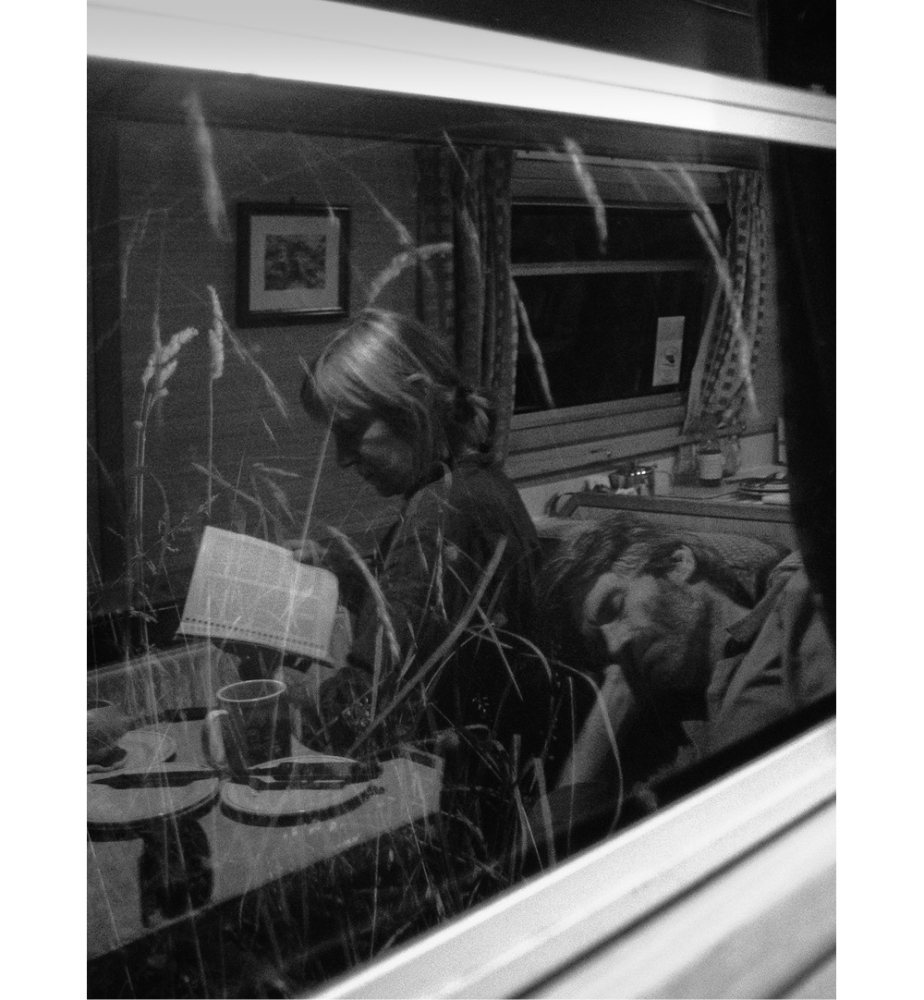
 With Peter Oswald, on a rented houseboat in Wales, 2021. Photograph by Joe Oswald. All photographs courtesy of Alice Oswald.
Most of my conversations with Alice Oswald took place at her home, Adelaide, a ramshackle cottage with a red door in Devon, southwest England. This past January, when I made my first visit, Oswald came to the station to collect me and her octogenarian aunt, who’d taken the same train from London and who lives mostly in the house across from hers. On the drive, the two women discussed whether a flock of birds that had risen from a clearing we’d passed were fieldfares or starlings.
Oswald has known Adelaide all her life, having spent holidays there as a child. Her paternal grandmother first lived in the house for a few months with her family at the end of World War I; in 1940, when she was traversing the area by bicycle, looking for a refuge from the bombs targeting Britain’s cities, she remembered it, tracked it down, and bought it, by then in disrepair. Two years ago, Alice and her husband, the playwright Peter Oswald, purchased it from her relatives, and moved from Bristol to live there year-round. In the living room, a small wooden table looks out onto the long garden, which extends toward a bank of trees, and, beyond that, fields and the river Torridge. Next to the desk is a bookshelf devoted to editions of the Odyssey and critical works on Homer. We conducted most of our sessions in the dining room, lighting the log-burning stove in the cold weather. Oswald showed me the letterpress pamphlets and ephemera she has published with her friend Kevin Mount, a typographer, and we explored the woodlands, which in the spring brimmed fluorescently with bluebells. She nimbly navigated tree roots, identified birds by sound, and jumped fences to avoid farmers, accompanied by her Jack Russell–collie mix, Holly. In the summer, we swam in the river, Oswald lamenting its sickened state. During our last dip, as we observed the coffee-colored water in the late afternoon, we considered how, had we swum that morning, we might have avoided the release of the day’s farm effluent.
Oswald was born in 1966, the daughter of Priscilla Mary Rose Curzon, a well-known garden designer and writer, and Charles William Lyle Keen, a banker. She is the author of eight books of poetry, including Dart (2002), for which she won the T. S. Eliot Prize. The book-length poem is the result of two years of conversations with the people who live and work on the river Dart, including a tin-extractor, a dairy worker, a forester, a poacher, and a ferryman. She is best known for Memorial (2011), a mesmeric and undulating version of the Iliad that relies on repetition and simile to conjure the wreckage of war; the poem catalogues the descriptions of the deaths of the more than two hundred warriors who perish in Homer’s text. Memorial was short-listed for the T. S. Eliot before Oswald withdrew it from the running, citing the prize’s sponsorship by the hedge fund Aurum.
From October 2019 to September 2023, Oswald held the role of Professor of Poetry at Oxford; her lectures covered subjects such as the connections between water and grief and between Beckett and moonlight. But in our final meeting, she was more eager to talk about her experiences teaching English and poetry to Palestinian children over Zoom with the Hands Up Project. Being involved in their lives had, she said, made it impossible not to act when the Labour government proscribed support for the activist group Palestine Action, calling it a terrorist organization. In August, Oswald was one of the more than five hundred protesters, nearly half of them older than sixty, who were arrested for holding signs that read I OPPOSE GENOCIDE and I SUPPORT PALESTINE ACTION in Parliament Square. Shortly after our final session, she was again arrested in central London.
INTERVIEWER
When you joined the Palestine Action protest in Parliament Square, did you plan on being arrested?
ALICE OSWALD
I did. I occasionally break the speed limit, but I wouldn’t go out of my way to break the law without thinking about it. One direct consequence of allowing genocide, though, is that, in order to excuse it, you have to pass all kinds of laws that destroy democracy from the inside. I’d been angry for a while, and confused about what to do, and as soon as I was decided, I felt a relief. Still, it was disturbing to see these figures with truncheons, and extraordinary to feel that forming those words on pieces of cardboard had suddenly put us into a different category, that we were now criminals—not just criminals but terrorists. The quiet as people were making their signs was very beautiful.
INTERVIEWER
What happened when they arrested you?
OSWALD
They read me my rights and asked whether I knew I was breaking the law, and did I want to come easily or did I want to be an obstruction. And I said, “I’m happy to be arrested, because I don’t believe it’s an offense,” and that I didn’t want to come easily, and so I lay down and imagined my heaviest self. I was imagining I was made of gold or lead, just enjoying the difficulty the police were having picking me up. They drove us to some tents, where we gave our names and addresses and were given bail. There was a scene with the officer who arrested me, who kept saying that I was Section 12, and the officer who was writing it down, saying, “Are you sure?” Because Section 12 means up to fourteen years in prison. Section 13 is up to six months in prison or a fine. The officer kept saying, “Yep, Section 12,” but when I looked at my form a couple of weeks later, I saw that she had actually written Section 13. It was confusion. They didn’t really understand why they were arresting old women with signs.
INTERVIEWER
Have you always seen yourself as an activist?
OSWALD
No, but I see literature as activist, particularly the epic forms of literature. It’s great to have lyric poetry that explores the self and identity, but the voice you choose gives you what you see, and if your voice is private, your vision will be private. When we ignore the strands of poetry that are dramatic and epic, we lose sight of the fact that poetry has always been about power. Gilgamesh, the Iliad, the Bible, Paradise Lost—all the poems that profoundly shake me are really about how we manage kings. The texture of a life devoted to poetry is activist, in the deep sense. Quite often it’s not activist in the superficial sense. You come at poetry with the momentum of having failed. It’s only when other communication is absolutely impossible that a poem has to exist.
INTERVIEWER
Do you have a momentum now?
OSWALD
There are short poems that are finding their shapes, a series that’s sort of like half hearing a trial and not quite catching it all. I’m interested in the difference between domestic law and international law, because the concept of international law is based on common sense, and I think that literature is the voice of common sense—the place where, for more than four thousand years, we have been trying to work out what a human is and what the dignity of a human is. We’ve drawn on these discoveries to achieve a consensus on what we think human rights should be, which is why, when that consensus gets disregarded by our legal systems, we’re not completely lost—we’ve still got the poems out of which it originally grew.
These poems are slightly based on an image from the Egyptian Book of the Dead, in which the heart is weighed against a feather. In that tradition, the weight of the heart is a measure of truthfulness. Poems have a way of hearing the accusations that put the heart on trial. I’ve always had the question, Why does a poem begin? I like noticing the feeling that something is already interrogating me. That’s partly a response to the catastrophic situation we’re in, because the suffering has gone beyond what the mind can manage, and people are being annihilated with the support of the British government. It’s the same with the environmental question. I find that my mind is often in some kind of law court, either advocating for other creatures or things, or being tried. I’ve been connecting those thoughts to the kinds of pacts that for me are connected to this house, the contracts you make with the natural world that allow you to be in a place, the feeling of living somewhere you don’t own.
INTERVIEWER
But don’t you own the house?
OSWALD
Yes, but it’s very clear that it’s really the insects who own it, and the river that comes right up to the garden. The rain comes through the ceiling. It’s interesting, the way the dead and the natural world are sort of exchangeable. That might sound theoretical, but ancient Greek lament, and lament from everywhere, has always used birds and plants as intermediaries for communicating with the dead. And I feel, when I’m here, a deference toward my uncle and my father, who once looked after the house, that’s kind of interchangeable with the deference I might feel toward a bird or an insect.