
Ben Rhodes tells PC audience military power cannot reshape political systems
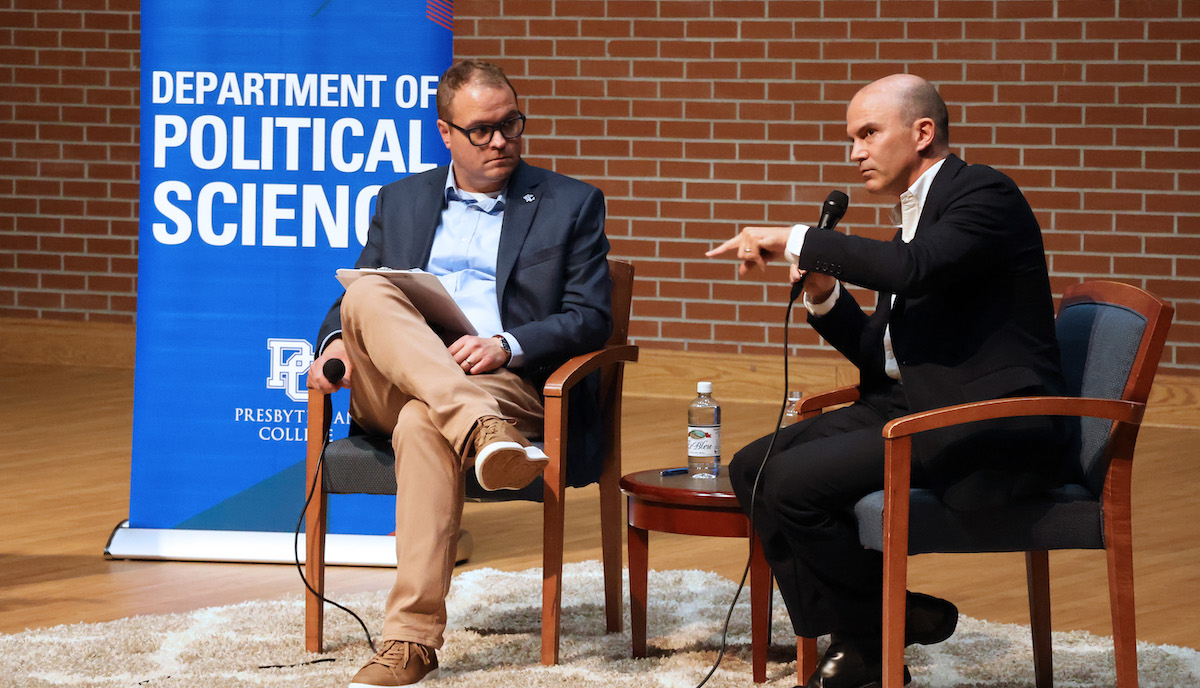
With tensions escalating in the Middle East following recent U.S. attacks on Iran, former White House deputy national security adviser Ben Rhodes told a Presbyterian College audience that the long-term consequences of the conflict may prove far more complicated than its initial military objectives.
Speaking Thursday evening in Edmunds Hall as part of the Samuel Calvin Waters Lecture in Political Science, Rhodes joined Dr. Justin Lance, professor of political science and public policy, for a wide-ranging fireside conversation on global politics, diplomacy and America’s role in the world. The annual lecture series brings prominent political leaders and thinkers to campus to discuss contemporary issues and public service.
Throughout the discussion, Rhodes returned repeatedly to the question dominating international headlines: what comes next for Iran.
Conflict in Iran raises long-term uncertainties
Opening the conversation, Lance asked Rhodes about the implications of U.S. military action targeting Iran’s leadership and military capabilities.
Rhodes described the situation as a historic turning point, warning that the scope of the conflict extends far beyond previous debates over Iran’s nuclear program.
“In the past, the question was whether you should try to resolve concerns about Iran’s nuclear program diplomatically or by bombing those facilities,” Rhodes said. “What is happening now is much bigger than that.”
The United States military can destroy whatever it is told to destroy. What it cannot do is engineer the politics inside of other countries.”
Ben Rhodes, Former Deputy National Security Advisor
He said earlier military planning around Iran had focused narrowly on nuclear infrastructure. The current conflict, he argued, appears to involve broader goals, including weakening Iran’s missile capabilities and potentially reshaping the country’s leadership.
But Rhodes warned that military force alone cannot determine a nation’s political future.
“The United States military can destroy whatever it is told to destroy,” he said. “What it cannot do is engineer the politics inside of other countries.”
Rhodes said the greatest risk is not simply the initial strikes but the uncertainty that follows.
“I don’t understand what the objective is in terms of what comes after,” he said. “You’re destroying things, but what are you trying to build in their place?”

Lessons from past conflicts
Rhodes drew comparisons to recent conflicts in Iraq, Afghanistan and Libya, arguing that attempts to reshape governments through military intervention have often produced unintended consequences.
In Iraq, he said, the collapse of Saddam Hussein’s government triggered sectarian conflict that eventually spilled across borders and contributed to the rise of ISIS. In Libya, the fall of Muammar Qaddafi created a power vacuum filled by competing militias.
Those examples, Rhodes said, illustrate a central lesson of modern warfare.
“We always look strongest at the beginning of a war,” he said. “The question is what happens after the bombing stops.”
Rhodes said the worst-case scenario in Iran would involve a prolonged civil conflict drawing in neighboring countries and triggering refugee flows similar to the Syrian crisis.
Iran’s population of more than 90 million people and its regional alliances mean instability could reverberate far beyond its borders, he said.
Still, Rhodes suggested that the most likely outcome may be a consolidation of power by existing military institutions within Iran rather than a complete collapse of the state.
“The Iranian regime is much deeper than some other systems we’ve seen fall,” he said, referring to the powerful Islamic Revolutionary Guard Corps. “Some kind of military-led government could emerge from that structure.”
Nuclear risks and global consequences
Rhodes also warned that the conflict could encourage other nations to pursue nuclear weapons as a deterrent.
Countries such as North Korea, he said, demonstrate how nuclear capabilities can alter international relationships.
“People around the world look at that and draw conclusions,” Rhodes said. “They see what happens to countries without nuclear weapons and what happens to those that have them.”
He added that instability in the Middle East could undermine U.S. relationships with key regional partners, particularly Gulf states that rely on American security guarantees.
“If you’re a country that’s built your economy on stability and tourism and suddenly missiles and drones are flying through the region, that changes how you think about security,” Rhodes said.
Technology may reshape global politics
While the discussion focused heavily on the Middle East, Rhodes told students that the most consequential global developments may not come from geopolitics at all.
Responding to an audience question about artificial intelligence, Rhodes said the rapid development of advanced technologies could reshape society more profoundly than any political movement.
“It’s quite possible that 30 years from now we’ll look back and the biggest story of this era wasn’t the politics we’re arguing about today,” he said. “It will be what technology did to our economy and our society.”
Rhodes warned that the absence of regulation around emerging technologies could create serious risks, including autonomous weapons and large-scale disinformation campaigns.
He also criticized the influence of major technology companies in shaping public policy.
“In a normal time, governments would be figuring out how to regulate this technology and protect people from its risks,” he said. “Instead we’re largely flying blind.”
Generational change and political engagement
Another question from students addressed the role of younger generations in American politics, particularly the influence of online political communities.
Rhodes said political movements often gain momentum when younger leaders bring new ideas and energy to public life.
“There should be generational change,” he said. “Younger people should be insisting on different priorities and pushing the system forward.”
He also urged political leaders to engage with emerging media platforms and digital communities rather than dismissing them.
“You have to meet people where they are,” Rhodes said.

A conversation shaped by current events
By the end of the evening, the discussion had touched on topics ranging from diplomacy with Cuba to the future of globalization. Yet the conversation repeatedly returned to the uncertainty surrounding Iran.
Rhodes said the unfolding situation illustrates the broader challenge of modern foreign policy: military power can accomplish immediate objectives, but long-term outcomes are far harder to control.
“The longer conflicts go on, the more unpredictable they become,” he said.
For students and community members attending the lecture, that uncertainty made the discussion feel especially relevant.
The Samuel Calvin Waters Lecture Series was established to bring nationally recognized voices to Presbyterian College to discuss contemporary political issues and encourage civic engagement among students and the broader community.
As Rhodes concluded his remarks, he emphasized that understanding complex global challenges requires careful thought rather than simple answers.
“These issues don’t have easy solutions,” he said. “But the more we talk about them and think critically about them, the better chance we have of making wise decisions.”