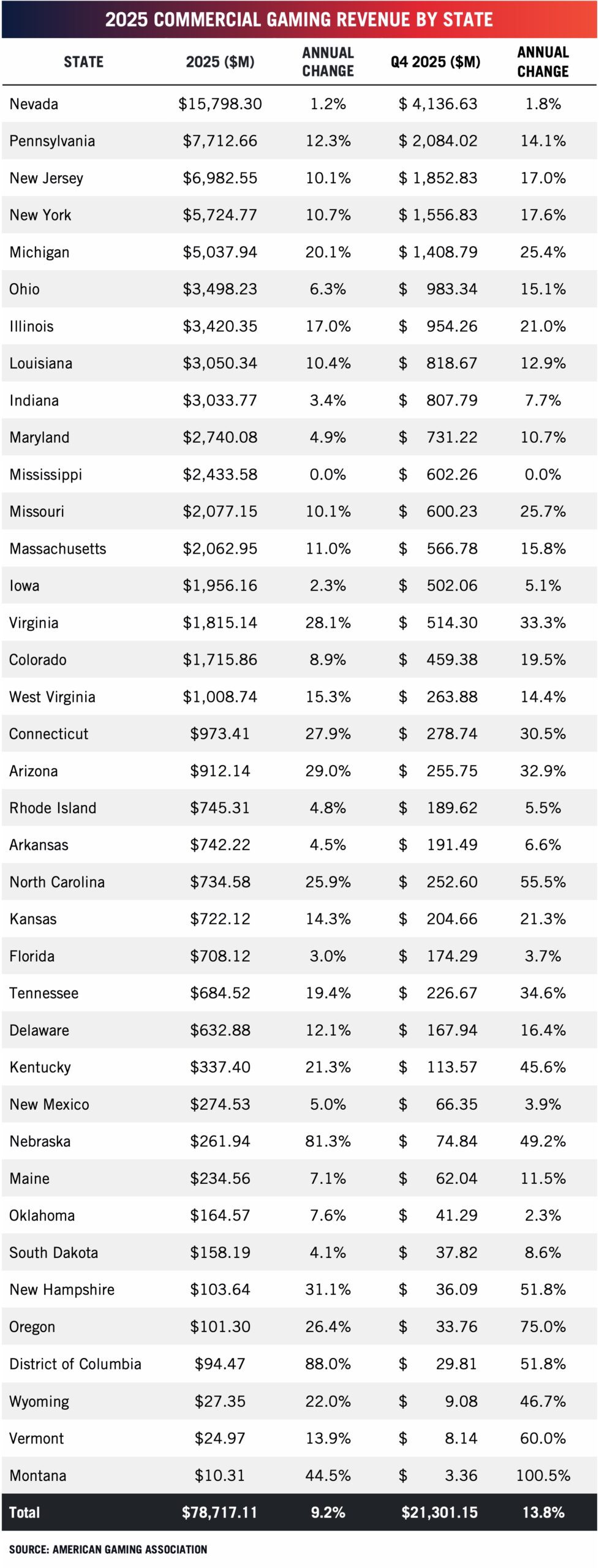
The U.S. commercial gaming industry has posted another record-breaking year, with gross gaming revenue (GGR) hitting US$78.72 billion (£58.43bn), up 9.2 percent year-on-year, marking the sixth consecutive year of growth.
But the celebration comes amid rising political tension between the traditional gaming sector and the emerging world of prediction markets. Despite headwinds, the American Gaming Association (AGA) confirmed that the U.S. legal, state-regulated gaming industry smashed previous records, contributing US$18.09 billion (£13.43bn) in state taxes and supporting 1.8 million jobs.
“For another year, legal commercial gaming in the United States has delivered exceptional results for consumers, operators and the communities we serve”, said Bill Miller, President and CEO of the American Gaming Association.
“These record revenues and tax contributions demonstrate the broad appeal of regulated gaming markets and why strong state oversight remains essential as our industry evolves.”
Growth Across All Verticals
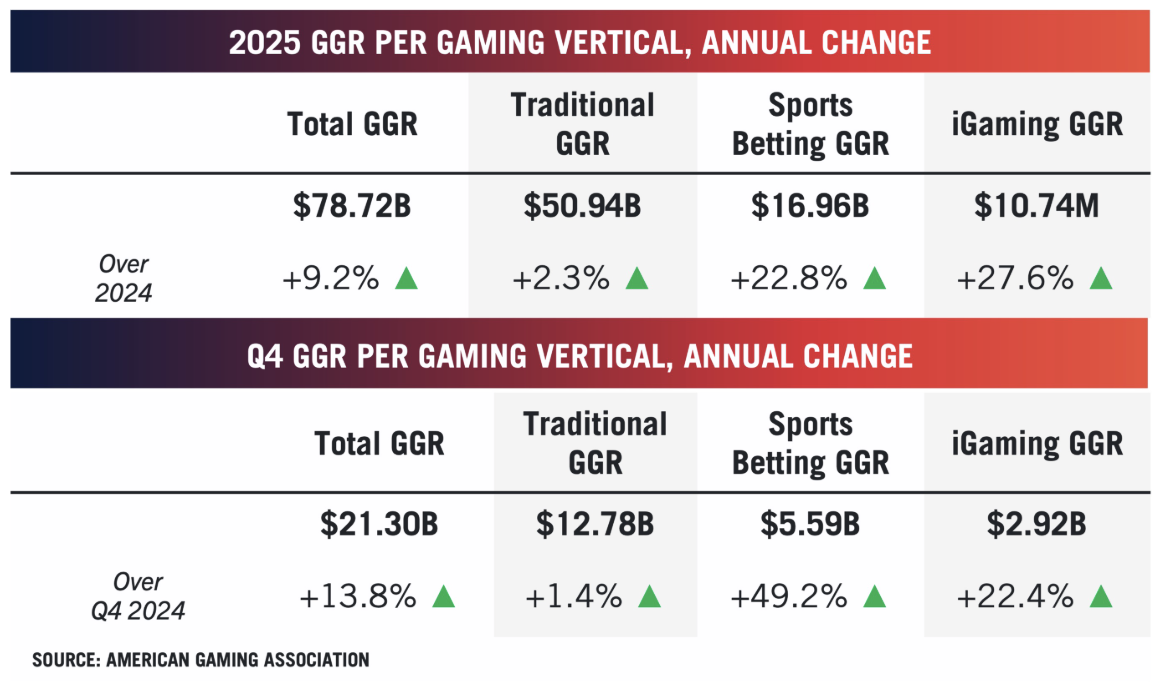
Traditional, land-based gaming dominated the market, generating US$50.94 billion (£37.8bn). While the year-on-year increase was modest, creeping up 2.3 percent, taxes rose to US$11.33 billion (£8.41bn), up 7.2 percent.
More than 134 million Americans visited land-based casinos across the U.S. in 2025, with the Las Vegas Strip contributing more than any other market to total land-based revenue.
Sports betting revenue jumped to US$16.96 billion (£12.59bn), up 22.8 percent. This growth was fuelled in part by Missouri’s launch on December 1, 2025 and the expansion of Washington D.C., which moved from a single-operator to a multi-operator model, leading to a 96 percent year-on-year increase in the territory.
Total sports betting handle reached US$166.94 billion (£123.96bn), up 11 percent. State-regulated sportsbooks generated US$3.71 billion (£2.76bn) in taxes, a 32.4 percent increase. The top markets by GGR were New York, Illinois, New Jersey and Ohio.
iGaming also surged, reaching US$10.74 billion (£7.97bn) in GGR, up 27.6 percent, delivering US$2.59 billion (£1.92bn) in taxes.
No new states launched legal online casinos in 2025, but Maine legalised iGaming for its four federally recognised Tribes. The launch date has not been announced, but it is expected in late 2026.
All 38 states tracked by the AGA saw growth, highlighting what the AGA called “strong consumer enthusiasm for legal, regulated gaming”.
Rogue Cowboys
Despite the impressive results, the AGA did not miss a chance to take a swing at prediction markets while highlighting the challenges facing the industry.
Former New Jersey Governor Chris Christie–widely regarded as the Godfather of U.S. gambling for leading the legal fight in the 2018 repeal of PASPA, and currently a strategic advisor for the AGA–said prediction markets fundamentally disrespect states’ rights.
“These predictive market folks are rogue cowboys”, damaging the integrity of the industry and providing an addictive product unchecked, said Christie.
Commenting on the role of the Commodity Futures Trading Commission (CFTC) in their expansion, he added: “This is not a commodity. This is a bet. Everyone knows what it is. It is not even in their remit to regulate.”
Miller reinforced the message: “With 2025 marking another record year, the industry’s performance reinforces a clear principle. Sports betting belongs under state and tribal regulation. That’s how consumers are protected and how communities share in the benefits.”
To date, the AGA estimates that prediction markets have cost state taxes more than US$500 million (£370m).