
In a recent Quillette piece Jerry Coyne argues that “unlike science, the literary, visual, and performing arts are not about truth.” When he made a similar assertion last June at a Heterodox Academy conference, it “resulted in Louis Menand and John McWhorter telling me, in so many words, to stay in my lane,” he writes. Wary that people might perceive him as “just another narrow-minded disciple of the science-as-hegemony school,” Coyne writes about art from a defensive crouch—but because I’m an artist, and well within my lane, I have no such qualms. Coyne is correct when he writes:
The real value of art … is not that it conveys knowledge that can’t be acquired in other ways, but that it produces emotional and cognitive effects on the receiver, usually conferring an experience of beauty. Art can enrich how we think about ourselves and other people, and, crucially, allow us to view the world through eyes other than our own. Through reflection, this expansion of experience can enhance our knowledge of ourselves. But that is subjective rather than propositional knowledge.
Would-be defenders of art make a serious category error when they insinuate that beauty is inferior to truth—as if beauty were an insufficient goal. But it is impossible to champion art effectively unless you believe that beauty is its own justification. Coyne offers examples of poems and paintings that he admires for their beauty. But he does not go far enough. Beautiful art can guide us through places where scientific truth can’t help us.
Can Art Convey Truth?
Ways of feeling are not ways of knowing.
I’ll use my favourite novel as an example. John Steinbeck recasts the Cain and Abel story in his 1952 saga East of Eden, and his wisest character ponders different English translations of that Bible story with mutually incompatible interpretations. He wants to understand the precise meaning of what God told Cain after he slew Abel, so he consults the original Hebrew to sort out what it really means:
Don’t you see? The American Standard translation orders men to triumph over sin, and you can call sin ignorance. The King James translation makes a promise in “Thou shalt,” meaning that men will surely triumph over sin. But the Hebrew word, the word timshel—“Thou mayest”—that gives a choice. It might be the most important word in the world. That says the way is open. That throws it right back on a man. For if “Thou mayest”—it is also true that “Thou mayest not.” Don’t you see? …
Now, there are many millions in their sects and churches who feel the order, “Do thou,” and throw their weight into obedience. And there are millions more who feel predestination in “Thou shalt.” Nothing they may do can interfere with what will be. But “Thou mayest”! Why, that makes a man great, that gives him stature with the gods, for in his weakness and his filth and his murder of his brother he has still the great choice. He can choose his course and fight it through and win.
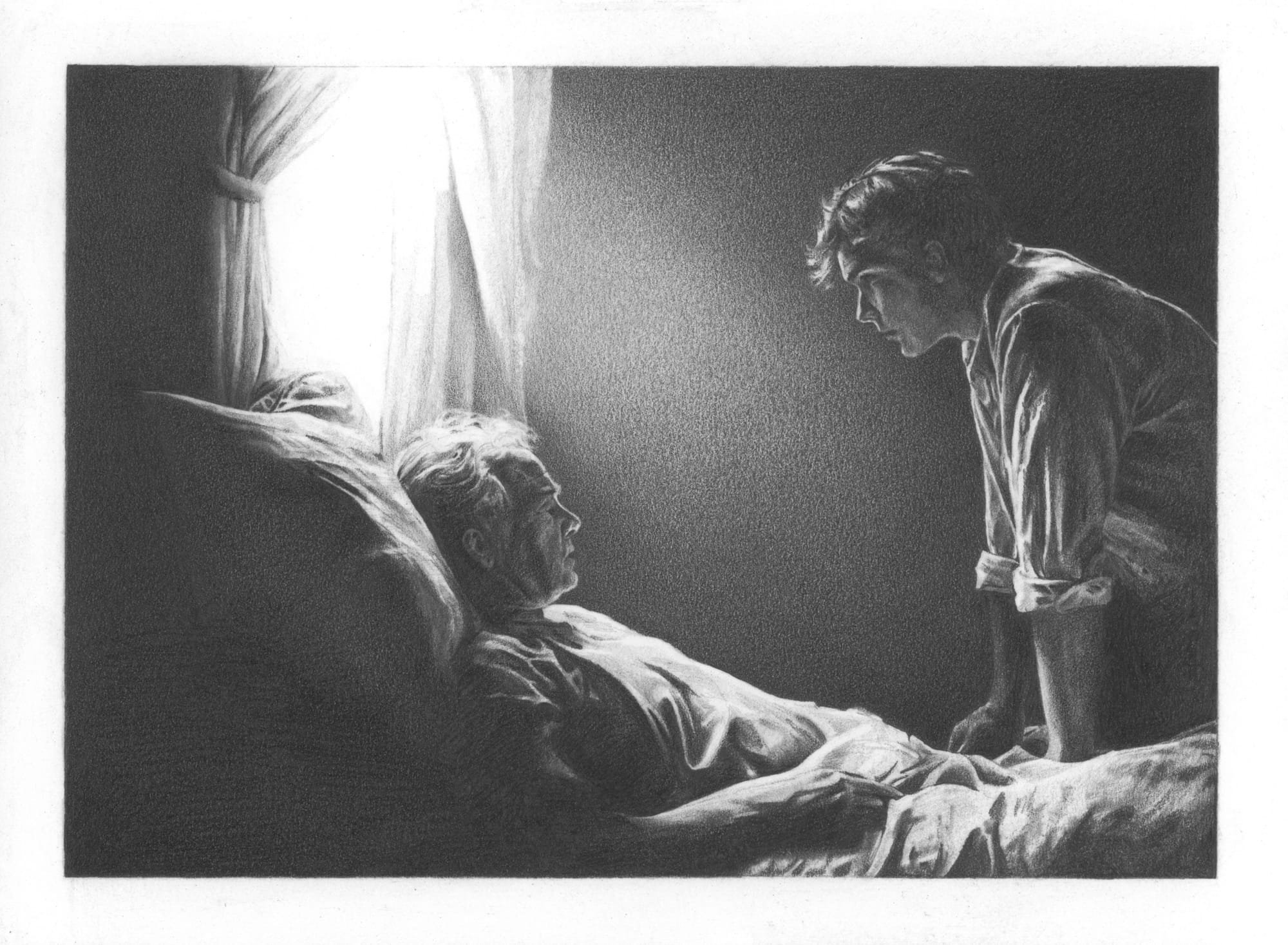
The multi-generational novel culminates in the choices made by a young man named Cal, Steinbeck’s stand-in for Cain. After Cal causes his brother’s death, their bereaved father suffers a stroke brought on by calamitous grief. Seemingly unable to speak anymore, the father manages to whisper one last word to Cal: timshel.
Physicists have long tried to figure out whether we’re living in a deterministic universe, a question with obvious implications for free will. But for now, we don’t know—and maybe we cannot know. Reality can be inscrutable. It is the task of scientists to answer questions like “do we live in a deterministic universe?” And it is the task of artists to summon beauty that helps us bear the uncertainty. These roles are equally important. They are not interchangeable.
Even if we someday discover, incontrovertibly, that free will is mere illusion, that will not diminish the beauty of Steinbeck’s East of Eden. It would add another layer of tragedy—imagine knowing that the characters are hanging their false hopes on timshel. That would change our interpretation, without undermining qualities like the novel’s character development and plot structure. Notice how East of Eden “works” regardless of whether its central theme turns out to be true, because we don’t measure the value of art by how well it gets the facts right.
In A Field Guide to Getting Lost, Rebecca Solnit writes:
[F]or artists of all stripes, the unknown, the idea or the form or the tale that has not yet arrived, is what must be found. It is the job of artists to open doors and invite in prophesies, the unknown, the unfamiliar; it’s where their work comes from, although its arrival signals the beginning of the long, disciplined process of making it their own. Scientists too, as J. Robert Oppenheimer once remarked, “live always at the ‘edge of mystery’—the boundary of the unknown.” But they transform the unknown into the known, haul it in like fishermen; artists get you out into that dark sea.
Artists often treasure the truth, as when Paul Cézanne wrote to a younger painter, “I owe you the truth in painting and I shall tell it to you.” By this he meant an authentic impression of nature grounded in immediate perception, rather than any inherited formulae or conventions. Likewise, Ernest Hemingway claims in his memoir A Moveable Feast that “All you have to do is write one true sentence. Write the truest sentence that you know.”
At the same time, artists have long recognised that they cannot always approach that truth in a straightforward way. Pablo Picasso famously alleged that, “We all know that Art is not truth. Art is a lie that makes us realise truth, at least the truth that is given us to understand.” Similarly, Emily Dickinson advises,
Tell all the truth but tell it slant —
Success in Circuit lies
Too bright for our infirm Delight
The Truth’s superb surprise
As Lightning to the Children eased
With explanation kind
The Truth must dazzle gradually
Or every man be blind—
One reason we may “tell it slant” is that sometimes the truth hurts. We often call this the “ugly truth” because such pain is far removed from the usual experience of beauty. For scientists, the natural human desire to shy away from ugly truths is a hurdle to be overcome. When Nicolaus Copernicus launched the Scientific Revolution by insisting that Earth orbits the Sun, rather than the other way around, this truth was an affront to how sixteenth-century Catholics understood their place in the cosmos and their relationship to God. However beautiful Copernican astronomy seems to us from the comfort of the twenty-first century, back then this truth was a bitter pill. The same truth, then, can seem either ugly or beautiful, depending on the eye of the beholder.
Just as artists treasure the truth, scientists frequently extoll beauty. Ulkar Aghayeva argues that “every practicing scientist has an intuitive sense of what a beautiful experiment is.” She details different reasons why scientists have called experiments beautiful. The aesthetic sensibilities of seventeenth- and eighteenth-century scientists were “centered on nature unveiling its innate beauty,” she writes, while contemporary theoretical physicist Frank Wilczek regards a beautiful experiment as one where “you get out more than you put in” because “beautiful experiments exhibit a strong information asymmetry between the input from the experimenter and the output of the system under study.”
Physicist Richard Feynman once argued with an artist friend about who appreciates beauty more:
He would hold up a flower and say, “Look how beautiful it is,” and I would agree. And he says, “You see, I as an artist can see how beautiful this is, but you as a scientist take this all apart and it becomes a dull thing.” And I think that he’s kind of nutty …
I see much more about the flower than he sees. I can imagine the cells in there, the complicated actions inside, which also have a beauty. I mean, it’s not just beauty at this dimension of one centimeter, there’s also beauty at smaller dimensions: the inner structure, also the processes. The fact that the colors of the flower evolved in order to attract insects to pollinate it is interesting. It means that insects can see the color. It adds a question: does this aesthetic sense also exist in lower forms? Why is it aesthetic? All kinds of interesting questions, which the science, knowledge, only adds to the excitement, mystery, and awe of a flower. It only adds. I don’t understand how it subtracts!
Those interesting questions magnify the beauty of flowers for me, too, and it galls me that someone told Feynman he had less access to beauty because he was a scientist. Nevertheless, by provoking a debate about beauty, Feynman’s friend also fulfilled a central purpose of aesthetic appreciation: endless argument.
Unlike scientific debates, which we hope to resolve so that we may continue building on the body of scientific knowledge, aesthetic arguments are not geared toward the steady march of progress. While accepting “settled science” can be reckless because it may turn out to be wrong, the very concept of “settled aesthetics” is absurd. We never complete the analysis of any given aesthetic experience, in the manner of scientists forming consensus around established facts and then moving on to the next question; rather, we ponder the same artwork again and again, generation after generation.
As philosopher C. Thi Nguyen explains:
Disagreement among the experts in a scientific domain is a sign of incomplete progress; the convergence of expert beliefs is a sign of scientific success. … But our aesthetic life seems designed to mire us in endless disagreement. … We don’t create some settled database of agreed-upon facts; every claim is up for re-interpretation and re-evaluation. … [This] is no failure and no accident. The best explanation of certain norms of aesthetic appreciation is that they are designed to get us stuck here, because we like it.
Nguyen argues that aesthetic appreciation “restores to us what scientific life has so often stripped away—a sense of ourselves as intellectually and perceptually autonomous beings, who can think and perceive for ourselves, who see with our own eyes and engage in our own debates.” With science, stripping away autonomy is good and necessary for discovering truth. Individuals are too limited and fallible to support the scientific enterprise on their own:
The tightly structured and highly collective nature of scientific work seems to arise from our desire to actually get things right. We use experts and inferential reasoning in science in order to cope with the vast, sprawling nature of the world. Our separate minds just aren’t large enough to do it on our own. So scientists create a vast store of publicly accessible data, and then use this collective database to make accurate predictions. This methodology requires a radical degree of trust. Scientific conclusions are based on long chains of reasoning, which cross different specialties. Engineers rely on chemists, who in turn rely upon statisticians and molecular physicists, and on and on. And much of this involves trusting others beyond one’s ability to verify. A typical doctor cannot vet, for themselves, all the chemistry, statistics, and biological research on which they rely. The social practice of science is oriented towards epistemic efficiency, which drives us towards epistemic dependence. Scientific conclusions are network conclusions. …
Our artistic and aesthetic practices offer us a respite from that vast, draining endeavor. We have shaped a domain where we can each engage with the world with our own minds—or in nicely human-sized groups. We have shaped a domain where we can return to looking at particular things directly, instead of seeking general principles. This form of aesthetic life functions as a relief from the harsh demands of our collective effort to understand the world. Our aesthetic life is a constructed shelter from science.
And so, no matter how well beauty and truth complement each other, we should not conflate the value of art with that of science, lest we weaken both. Can scientists reach their full potential without art as a shelter from the psychic cost of surrendering autonomy? Can artists summon beauty into the world if they do not value it as an end unto itself?
In my own experience within the contemporary art world, when I used scientific materials as my art medium, other artists, curators, and museum directors would ask me how my work was art, and not science. My short answer was always, “Because I aim at beauty.” They found this unconvincing, because beauty holds so little cachet that, as the influential art critic Arthur Danto admitted in 2003, it “had almost entirely disappeared from artistic reality in the twentieth century, as if attractiveness was somehow a stigma, with its crass commercial implications.” Tellingly, the scientists I often consulted never considered me one of their own, because it was obvious to them that I was not pursuing truth like a scientist.
It’s notable that people almost never argue that science is primarily about beauty—no matter how often scientists invoke beauty to explain why an experiment is superior, or show, as Feynman does, how scientific knowledge can unlock additional beauty in a flower. Everyone seems to understand that science can have aesthetic qualities without being about beauty, while struggling to accept the inverse: art can involve truth without being about truth. Art is about beauty.
Quillette invites thoughtful responses to its essays.
Selected responses are published once per week as part of a curated Letters to the Editor feature. If selected, letters appear under the contributor’s real name and may be edited for clarity and length.
To submit a letter for consideration, please email [email protected].