
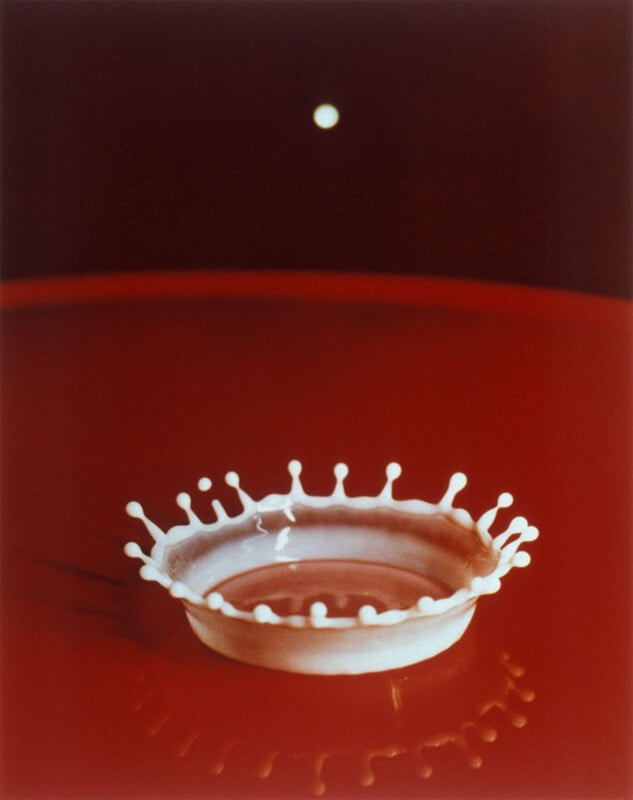
Yesterday, Wikipedia’s Picture of the Day was Harold “Doc” Edgerton’s Milk Drop Coronet, making the famous photo an excellent subject for PetaPixel’s Historical Friday feature.
The striking photo of a drop of milk frozen in the shape of a crown as it hits the surface of a red pan was taken in 1957 by Edgerton, a professor of electrical engineering at MIT.
Edgerton’s nickname was Papa Flash, a moniker he acquired for developing the stroboscope, which subsequently led to strobe photography. Edgerton had worked with Life magazine photographer Gjon Mili for decades to improve flash photography; he pioneered short-duration electronic flash and gained a reputation for being the man who made the invisible visible.
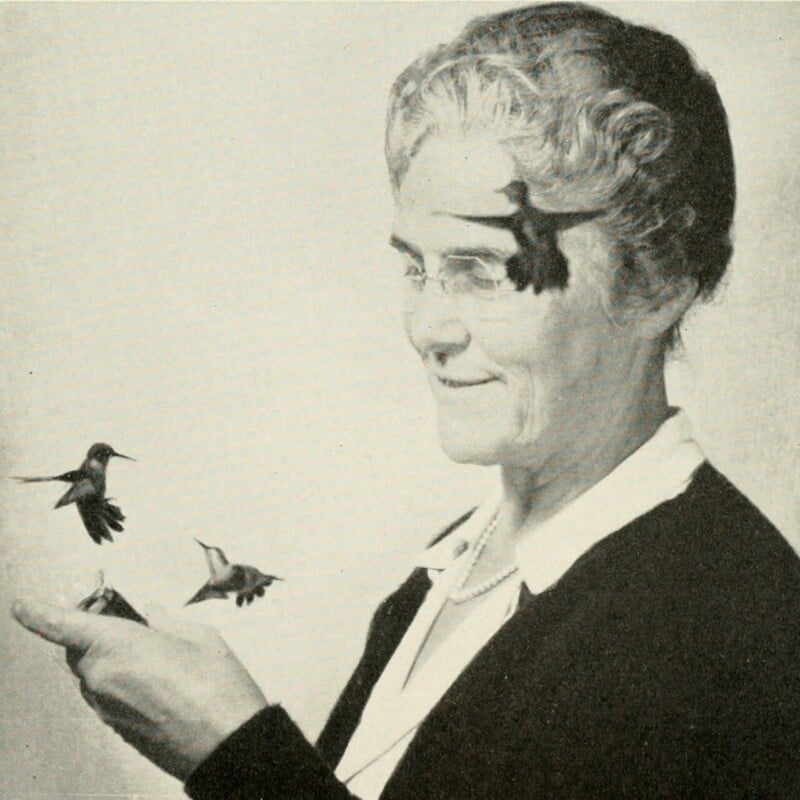
Papa Flash designed the stroboscope in 1932; he had intended to use it to study electrical motors, but he realized that it could be used to freeze moments unseen by the human eye, bullets fired from a gun, hummingbird wings, and drops of liquid.
According to Wikipedia, he released a 1939 book titled Flash! Seeing the Unseen by Ultra High-Speed Photograph, which contained a black and white photograph of a splash of milk forming a coronal shape.
“First, the behavior of liquids is affected by surface tension. The surface layers of any liquid act like a stretched skin or membrane (a drumhead, for example) which is always trying to contract and diminish its area,” Edgerton wrote in the book.
“Second, a spout or column of liquid, beyond a certain length in relation to its diameter, is unstable and tends to break down into a series of equidistant drops. As these drops are formed, they are joined together by narrow necks of liquid which in turn break up into smaller drops.”
Edgerton continued to experiment with high-speed photography, and on January 10, 1957, he took his most famous photograph. Edgerton’s camera used a fast shutter speed of 1/10,000th of a second, but the xenon flashtubes he used illuminated for even shorter than that — about a millionth of a second. “The light itself essentially acts as a shutter,” Kim Vandiver of MIT’s Edgerton Center told Science Friday.
The light was positioned in front of the drip and it was triggered by the milk drop. He aligned its path with a beam of light linked to a detector. As the droplet fell, it momentarily interrupted the light, casting a shadow on the detector and generating a voltage pulse. This pulse then moved through an electrical circuit, triggering a flash after a controllable delay.
Milk Drop Coronet quite literally crowned years of trial and error; there were, of course, hundreds of photos left on the darkroom floor before capturing the photo that Time magazine would include in its list of Most Influential Images of All Time.
But one of the underrated strengths of the photo is how it is printed: using the stunning dye-transfer process championed by photographers like William Eggleston. Most existing prints of Milk Drop Coronet are dye-transfer, and the process remains the superior way of producing color photographs. It’s lucky that the dye-transfer prints do exist because the original negative was reportedly destroyed.