
Taiwan Outstanding Women in Science Awards held an award ceremony in Taipei yesterday, highlighting achievements by the country’s female scientists.
The “Outstanding Researcher Award” was presented to Chang Zee-fen (張智芬), a chair professor at National Taiwan University (NTU) College of Medicine Institute of Molecular Medicine.
NTU Department of Pharmacy assistant professor Cheng Chi-an (程吉安) and National Yang Ming Chiao Tung University assistant professor Yuan Wei-chien (袁維謙) received the Young Scientist of Excellence Award (新秀 獎).
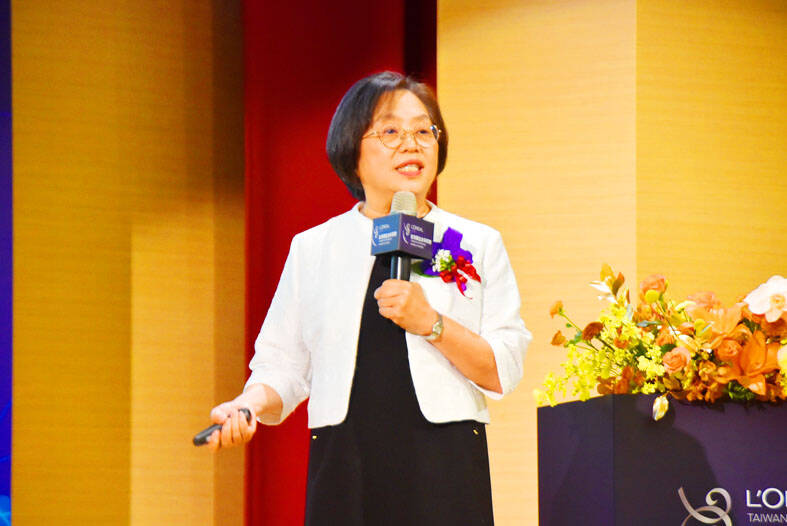
Photo: Wu Po-hsuan, Taipei Times
Co-founded by L’Oreal Taiwan and the Wu Chien- Shiung Education Foundation in 2007, Taiwan Outstanding Women in Science Awards have been called Taiwan’s Nobel Prize for women.
Each year, one recipient is chosen for the Outstanding Researcher Award and two for the Young Scientist of Excellence Award.
This year, Chang was honored for her contributions to the field of nucleotide metabolism and to research on how dysfunctional mitochondria affect the repair of nuclear genes.
Chang said that while many people are frustrated by failures during the research process, she believes the unknown mysteries of science are intriguing.
She also encourages her students to explore things outside of science.
Cheng was recognized for leading her lab in establishing Taiwan’s first exosome ultrasensitive single-molecule protein spatial analysis platform (eSimoa).
She is currently working on applying exosomes to the diagnosis and treatment of cancer.
Cheng, a chemistry graduate who once worked at Taiwan Semiconductor Manufacturing Co. and later as a patent engineer at another company, said her cross-disciplinary experience broadened her imagination in later scientific research.
“Life is a vast wilderness, not a track,” she added, encouraging students to explore without needing to find the right direction on the first try.
Yuan, meanwhile, led her team in identifying the key gene and signal transport path involved in liver cell regeneration and liver tumor formation.
She also led an international team to uncover the molecular mechanism that promotes liver injury reprogramming.
Comparing conducting research to running a marathon, Yuan said as long as researchers keep going, they can overcome all barriers and find their own way.