

We may receive a commission on purchases made from links.
The Hulk is one of the most thematically rich characters in Marvel Comics’ superhero roster. He’s Dr. Jekyll and Mr. Hyde, or Dr. Frankenstein and his creature; a tormented man and a tragic monster all-in-one. The Hulk doesn’t fit neatly into the superhero box where most of his contemporaries lie, but his origin does share a key detail with theirs.
In Marvel’s 1960s comic books, radioactivity was Stan Lee’s go-to superpower-bestowing plot device. The Fantastic Four were transformed by cosmic radiation, Peter Parker got spider powers when a radioactive arachnid bit him, early “X-Men” issues suggested that mutants emerged due to radiation, etc. Remember, this was during the Cold War, when atomic power (and the notion it might destroy us all) was hot on everyone’s mind.
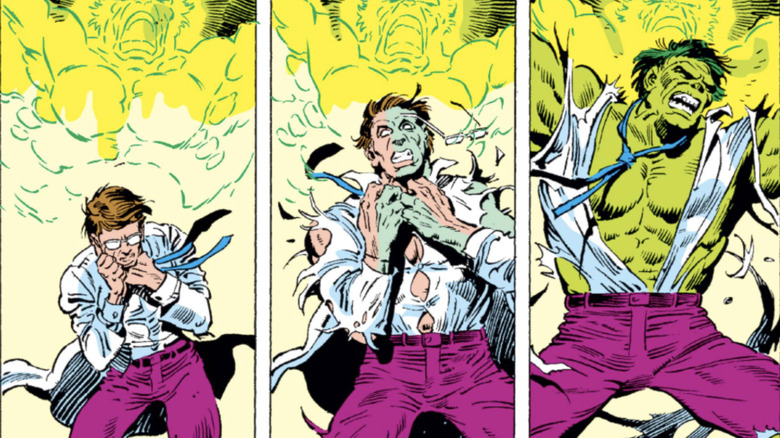
The Hulk fits neatly into this, for his transformative power comes from gamma radiation. In “Incredible Hulk” #1 by Stan Lee and Jack Kirby, Dr. Bruce Banner has built a “gamma bomb” for the U.S. military. When Banner rushes out to save teenager Rick Jones from a test explosion, he is doused in gamma rays, and the Hulk awakens in him.
Though the original “Incredible Hulk” comic series was soon canceled, that initial issue and the Hulk’s origin was a smashing debut. So, why have all the Hulk films — from the 1977 “Incredible Hulk” TV movie pilot to the Marvel Cinematic Universe films — revised it? Oh sure, the live-action Hulks all get their powers from gamma rays that transformed meek scientist Bruce Banner. But the delivery mechanism is always changed into something other than a bomb. That undercuts one of the most important themes of the Hulk: He is the destructive power of the atomic bomb contained in a human-shaped form.
How Marvel movies tweak the Hulk’s radioactive origin
The Hulk fits in with not just other Marvel superheroes but also mid-20th century monster movies that turned fear of the bomb into pulp entertainment. Take 1954’s “Them!” (a film where ants are irradiated into human-eating giants). That same year saw the release of an even more famous nuclear monster movie: Japan’s “Godzilla,” where the eponymous star represents the impossible scale of atomic destruction that only Japan has known firsthand.
When it comes to live-action projects featuring the Hulk, Bruce Banner (or his equivalent) is always conducting some form of medical research when he unlocks his green other self. This goes back to the “Incredible Hulk” TV show, a “Hulk” series that purposefully downplayed comic book stylization. There, Doctor David Banner (Bill Bixby) is trying to find a link between emotional distress and bouts of increased strength. He deduces gamma radiation is the key, tests it on himself, and the Hulk is born.
By comparison, director Ang Lee’s 2003 “Hulk” movie has Bruce (Eric Bana) researching nanomeds designed to induce faster healing in soldiers. And while “Hulk” nails another important part of Bruce Banner’s origin, it still leaves out the gamma bomb. Similarly, in the Marvel Cinematic Universe, Bruce (Edward Norton and Mark Ruffalo) was attempting to use gamma radiation to recreate the super-soldier serum that turned Steve Rogers (Chris Evans) into Captain America.
The Hulk being the result of a super-soldier project comes from Mark Millar and Bryan Hitch’s “The Ultimates,” a comic book updating of the Avengers for the 21st century. This at least preserves the Hulk as a living weapon and might speak to why the movies leave out the bomb: The Cold War is over now, and atomic annihilation isn’t quite the mass fear it once was.
The Hulk’s power comes from the bomb

“The Ultimates” explicitly suggests that superhumans are the next generation of weapons of mass destruction, succeeding the atomic bomb. Nick Fury predicts several times that “the next war will be a genetic one.” You see this same attitude (that genetic engineering will be the next century’s scientific revolution) in various 1990s-2000s pop sci-fi works, notably “Jurassic Park.” Of course, that didn’t exactly pan out. A quarter through the 21st century, and it’s computer technology that’s shifted the world, not rewritten genetics.
The Hulk’s gamma bomb origin is just as much a product of its time as the 1990s’ genetic engineering fad. Note how “Incredible Hulk” #1 is set in New Mexico; in real life, the nuclear bomb was primarily created (and first tested) in that state’s Los Alamos labs. This history received new attention in 2023 with the release of Christopher Nolan’s “Oppenheimer,” a film about the atomic bomb’s primary father, J. Robert Oppenheimer (Cillian Murphy). “Oppenheimer” is no pro-bomb movie, either; rather, it shows the fire that the “American Prometheus” gave us may still one day burn down this world.
Again, the Hulk was inspired by “Frankenstein,” a novel all about the fear that humanity’s creations and lack of responsibility will destroy us. Many have cited Mary Shelley’s book (first published in 1818) as speaking to the new concerns of the industrial revolution, including filmmaker Guillermo del Toro. Before he adapted “Frankenstein” into a movie, del Toro wrote in “The New Annotated Frankenstein” that “[The creature] comes to be at the exact moment at which machines of our own creation usurp our function and surpass our skill and speed, displacing us into anonymity.”
The Hulk embodied similar fears about the atomic revolution in comic book form, unlike Marvel’s movie adaptations.