
In science fiction movies, it is almost a classic narrative that humans are placed in cryogenic chambers and wake up again after decades or even centuries. From “Alien” to “The Three-Body Problem”, this “deep cryogenic sleep” has always been a symbol of future technology. However, in real science, the real problem is not freezing life, but whether the brain’s functions can be restored after all activities have completely stopped.
A recent study published in PNAS has for the first time restored key neural functions in the deeply frozen mouse brain tissue, taking a small step forward in the laboratory for this long – standing science – fiction concept.
For a long time, scientists have been able to preserve neural tissue to a certain extent. For example, some experiments have shown that after freezing and rewarming, neurons can survive at the cellular structure level and even recover some functions. However, the real operation of the brain depends on a whole set of complex processes – neuron firing, cell metabolism, and synaptic plasticity, etc. If these processes cannot be restored, the brain cannot restart. Therefore, the core of the problem becomes: Can the brain restart after all molecular movements have completely stopped at extremely low temperatures?
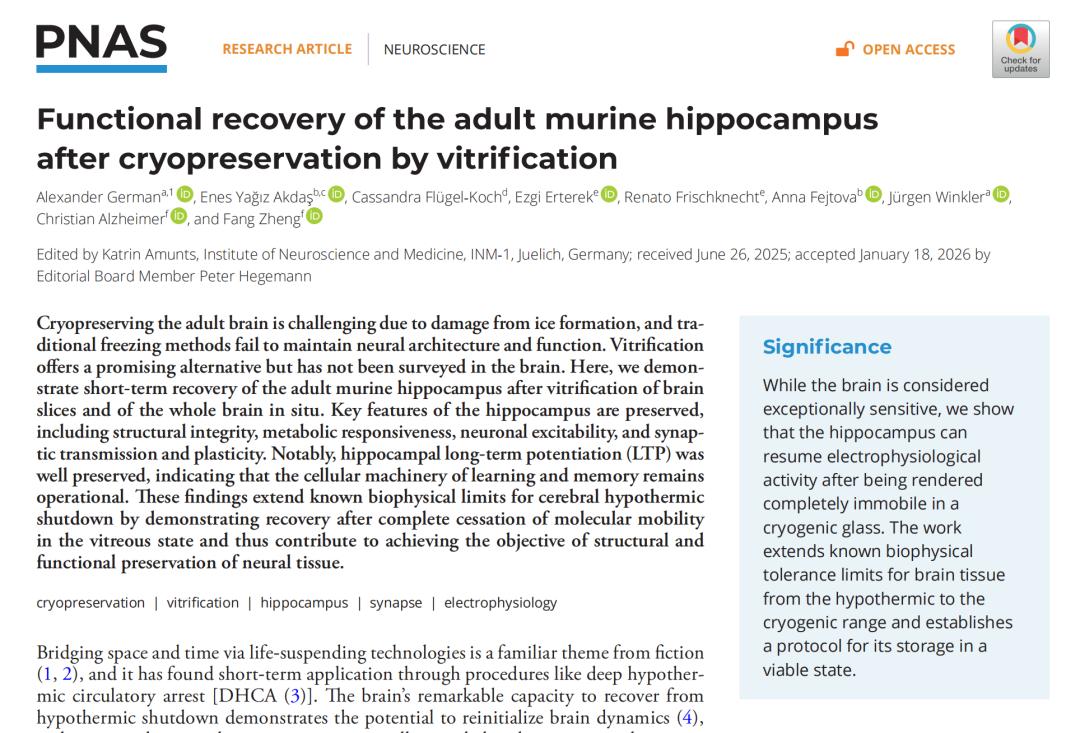
Alexander German, a neurologist from Germany, and his team tried to answer this question. The key challenge they focused on is the damage caused by ice crystals during the freezing process. In traditional freezing, water molecules form ice crystals, and these tiny crystals can pierce or squeeze the nanoscale structures inside cells, damaging cell membranes and synaptic connections. For highly precise neural networks, such structural damage is almost fatal. In addition to the ice crystals themselves, freezing also brings problems such as changes in osmotic pressure and the toxicity of cryoprotectants, making it difficult for brain tissue to recover its functions after rewarming.
In order to avoid ice crystal formation, the research team adopted a freezing method called vitrification. This technology uses an extremely fast cooling rate to make the liquid enter a disordered solid – state structure similar to glass before it has time to form crystals. In this state, molecular motion almost completely stops, but the tissue structure can be “frozen” as a whole. The researchers hoped to verify whether the brain’s functions can be restarted after this completely static state.
They first cut tissue slices about 350 microns thick from the mouse brain, and these slices contained the hippocampus – a key brain region closely related to memory and spatial navigation. After the tissue was pre – treated in a solution containing cryoprotectants, it was rapidly cooled to the temperature of liquid nitrogen (about –196°C), and then stored in a glassy state at about –150°C for periods ranging from ten minutes to seven days. After that, the researchers gradually rewarmed these tissues in a warm solution and detected whether their structures and functions still existed.
Microscopic observations showed that the structures of neurons and synaptic membranes remained basically intact. Tests on mitochondrial activity indicated that the cell metabolic system was not significantly damaged. More importantly, electrophysiological recordings showed that these neurons could still produce nearly normal responses when receiving electrical stimulation. Although there were some deviations compared with the control group, the neurons were still able to fire and transmit signals.
The research team further tested the functions at the neural network level. They found that the hippocampal neural pathway could still produce long – term potentiation (LTP) – a synaptic strengthening mechanism considered to be the basis of learning and memory. In other words, after deep freezing, these neural circuits still retained the ability to form memory – related plasticity. However, since the brain slices would gradually degrade under experimental conditions, these functions could only be maintained for a few hours, so the researchers could only observe these phenomena within a limited time.
After successfully verifying the brain tissue slices, the research team tried to extend the method to the entire mouse brain. They kept the intact brain in a glassy state at about –140°C for up to eight days. However, during this process, the researchers had to repeatedly adjust the experimental protocol to reduce the toxicity caused by cryoprotectants and avoid the shrinkage of brain tissue during the cooling process. After rewarming, the researchers took hippocampal slices from these brains again for electrophysiological recordings, and the results showed that the relevant neural pathways could still produce LTP, which meant that the key neural network structures were preserved during the freezing process.
However, this does not mean that the mouse’s brain can be “resurrected” at the whole – brain level. Since the experiment was conducted on slices, the researchers were unable to verify whether the memories formed by the animal before freezing still existed. Whether the brain can restore consciousness or behavioral functions at the whole – brain level remains completely unknown.
Nevertheless, this study still represents an important progress in the field of neural cryopreservation. Some researchers believe that this step – by – step technological progress is the process by which science – fiction concepts are gradually transformed into real possibilities. For example, Mrityunjay Kothari, a mechanical engineering researcher from the University of New Hampshire, pointed out that this study demonstrated significant progress in brain tissue cryopreservation technology, but it is still quite far from practical application. Especially at the level of large organs or even the whole human body, problems such as heat conduction, mechanical stress, and tissue cracking will become more serious.
The research team is currently trying to extend this technology to human brain tissue. According to their preliminary data , human cortical tissue also showed a certain degree of viability under similar conditions. At the same time, the researchers are also exploring applying vitrification freezing to other organs, such as the heart. Theoretically, if large organs can be preserved in a glassy state for a long time and their functions can be restored, this will provide a brand – new “organ bank” for organ transplantation.
However, to achieve this goal, more advanced cryoprotectants, more uniform cooling and rewarming technologies, and a deeper understanding of the thermodynamic processes of large tissues are needed. At the current stage, this study is more like a proof of concept: it shows that the extremely complex biological structure of the brain may still be able to recover some functions after all activities have completely stopped.
In science – fiction stories, cryogenic chambers mean traveling through time. In real science, this technology is more likely to first change medical practice, such as protecting key tissues during severe brain injuries, ischemic diseases, or the waiting process for organ transplantation. Although it is still a long way from real “cryogenic sleep”, this study at least proves one thing: even if the brain enters a seemingly completely static state, its functions do not necessarily disappear forever. Some key neural processes may still be restarted after thawing.
References: 1. German, A., Akdaş, E. Y., Flügel – Koch, C., Erterek, E., Frischknecht, R., Fejtova, A., … & Zheng, F. (2026). Functional recovery of the adult murine hippocampus after cryopreservation by vitrification. Proceedings of the National Academy of Sciences, 123(10), e2516848123. 2. https://www.nature.com/articles/d41586 – 026 – 00756 – w
This article is from the WeChat official account “Neural Reality” (ID: neureality), author: NR. Republished by 36Kr with permission.