
Editor’s note: The following is an excerpt from the new book Endowed by Our Creator: The Bible, Science, and the Battle for America’s Soul by John G. West, which explores the enduring truths of the Declaration of Independence as America celebrates its 250th birthday this year.
The Declaration of Independence appeals to the authority of the “laws of Nature and of Nature’s God.” As I discuss in my new book, Endowed by Our Creator, America’s Founders used this phrase to refer to the idea that there are laws of morality that are obligatory across time and place and can be known both through reason and conscience and through revelation (the Bible).
Darwinism undermined the Founders’ view.
According to Darwin, specific moral precepts developed because under certain environmental conditions they promoted survival. Once those conditions for survival change, however, so too do the dictates of morality. That is why we find in nature both the maternal instinct and infanticide, both honoring one’s parents and killing them when they become feeble. Natural selection “chooses” whatever behavioral traits best promote survival under the existing circumstances.
To Condemn Evil
A Darwinian understanding of morality makes it very difficult to condemn as evil any human behavior that has persisted, because every trait that continues to exist even among a subpopulation has an equal right to claim nature’s sanction — presumably even anti-social behaviors such as fraud, pedophilia, and rape because they too apparently were favored at some point by natural selection. Of course, one could still justly condemn such behaviors if there existed a permanent moral standard independent of natural selection. But the existence of such a standard is precisely what orthodox Darwinism denies.
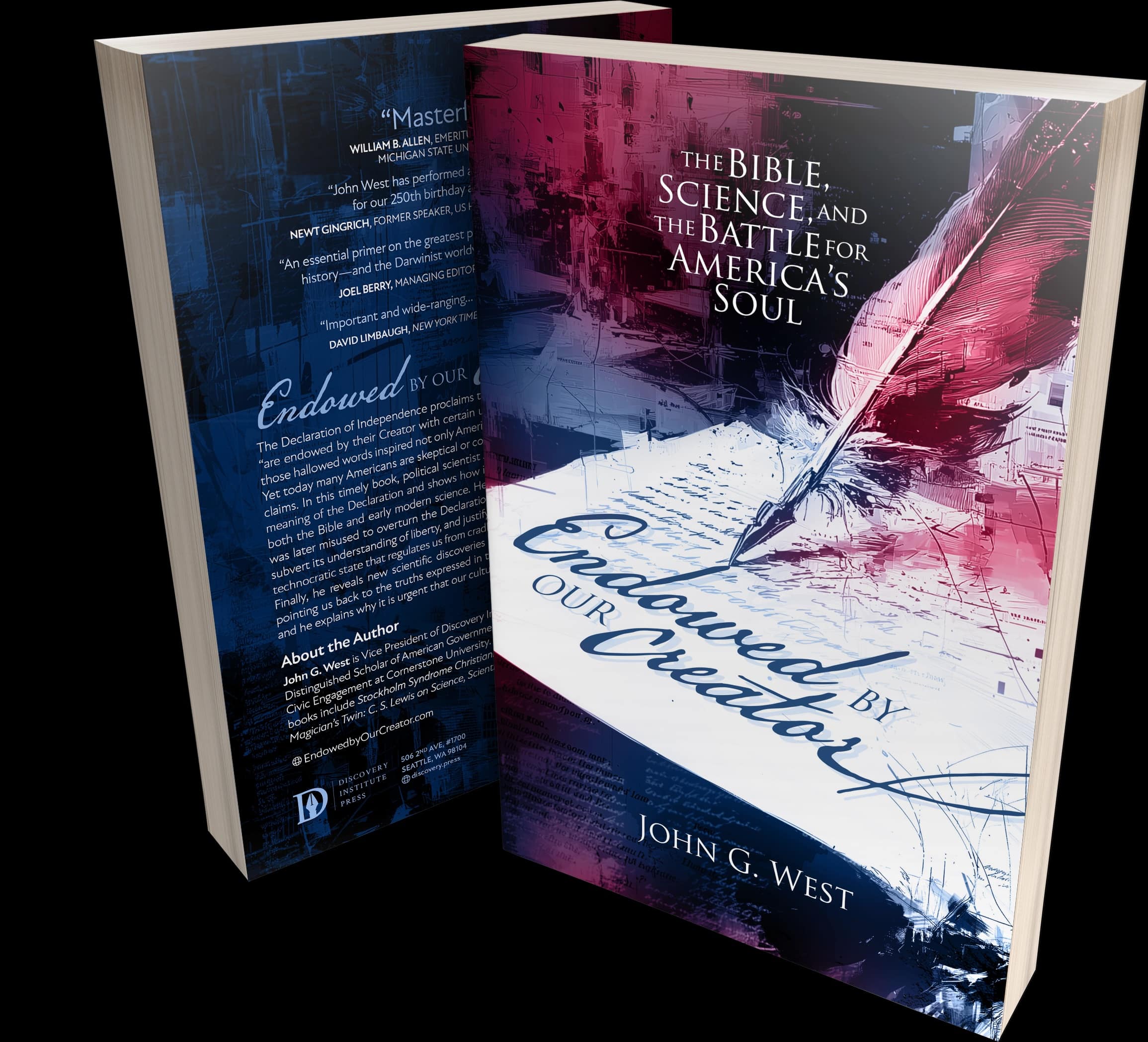 Image credit: Discovery Institute Press.
For the most part, Darwin himself did not press his relativistic analysis of morality to its logical conclusion, but he laid the groundwork for others who came after him, and his ideas helped reshape how people think about morality. For example, 45 percent of Americans now believe that “what is right and wrong evolves over time based on the survival needs of a society.” Robert Wright is correct to observe that the “Darwinian paradigm” has the effect of “nourishing a certain moral relativism — if not, indeed, an outright cynicism about moral codes in general.”
Family Life and Human Sexuality
Nowhere has the Darwinian view of ethics had a severer impact than in family life and human sexuality. The thinker most responsible for the breakdown of traditional sexual ethics in Western culture was Harvard-trained evolutionary zoologist Alfred Kinsey. Adopting a thoroughly Darwinian approach to sexual morality, Kinsey argued that any sexual practice that could be found somewhere among mammals could be regarded as “normal mammalian behavior” and be regarded as unobjectionable.
Today, many evolutionary psychologists have gone beyond mere sexual relativism and are affirmatively arguing against monogamy. They claim that we were bred by Darwinian evolution to have multiple sex partners, which means we are programmed for promiscuity and infidelity. In their view, the very idea of faithful monogamous marriage contradicts our biology and must therefore be abandoned.
One prominent evolutionary psychologist to advocate this view is Christopher Ryan, co-author of the New York Times bestseller Sex at Dawn. In the words of Ryan, “Marriage in the West isn’t doing very well because it’s in direct confrontation with the evolved reality of our species.” Ryan says he wants to save marriage by making it consistent with Darwinian biology. For him, that means redefining marriage to include multiple partners at the same time.
Not Just Relativism
The end result for those who try to embrace a consistent Darwinian world view isn’t just relativism. It is a rejection of all objective standards whatsoever.
The philosopher Nietzsche observed that Darwin’s theory was “true but deadly.” Nietzsche accepted as true Darwin’s account that there is no radical difference between man and beast and that all species and ideas (including moral ideas) are forever in flux. But he understood that this denial of unchanging morality and unchanging biological categories raised the danger of nihilism — complete meaninglessness because nothing can be regarded as really true. Nietzsche’s solution was to call for a “superman” who would create a moral code and impose it on society. Our culture has democratized Nietzsche. Now everyone is their own superman and everyone is encouraged to create his or her own reality, including sexual identity.
An Accidental Process
This can be seen in the current debate over transgenderism. In the pre-Darwinian view, male and female were objective and permanent categories created by God for our good. If you feel uncomfortable as a man or a woman, you can be assured that your biological sex reflects something greater than your feelings and that you should embrace it. But in the Darwinian view, male and female are simply categories produced by an accidental process in natural history that could have produced other outcomes. There is nothing permanent or sacrosanct about two biological sexes. Moreover, natural selection apparently somehow led to your feelings of being “in the wrong body,” so you should feel free to revolt against your body. The only question is whether you have the technical power to change yourself into something else.
Needless to say, this new view of morality is toxic to the Founders’ understanding of liberty. By the Founders’ lights, liberty involved acting within the guardrails of the moral law. But if there is no moral law, liberty devolves into simple libertinism, fueling cultural anarchy.