
The Large Hadron Collider has discovered a new particle, the 80th identified so far by the world’s most powerful particle smasher, Europe’s CERN physics laboratory announced Tuesday.
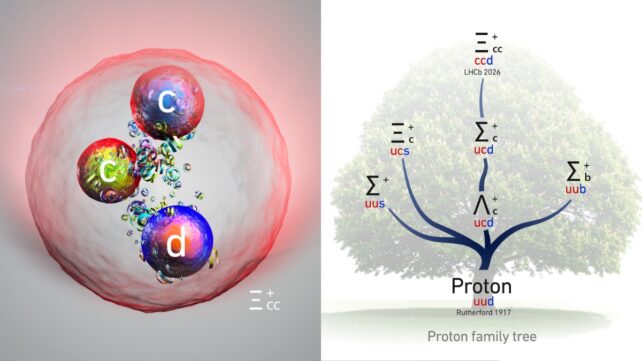
The new particle has been named “Xi-cc-plus”.
Scientists hope the particle – which is similar to a proton but four times heavier – will reveal more about the strange behaviour of quantum mechanics.
All the matter around us – including the protons and neutrons that make up the nucleus of atoms – is made of baryons.
These common particles are composed of three quarks, which are fundamental building blocks of matter.
Quarks come in six “flavours”: up, down, charm, strange, top, and bottom. Each has varying mass, electric charge, and quantum properties.
In theory, there could be many different types of baryons that mix these flavors; however, most are extremely difficult to observe.
To chase them down, the Large Hadron Collider sends particles whizzing around an underground ring at phenomenal speeds until they smash into each other.
This gives scientists a brief chance to measure how the more stable elements decay, then deduce the properties of the original particle.
The newly discovered “Xi-cc-plus” contains two “charm” quarks and one “down” quark.
Normal protons have two “up” quarks and one “down” quark. Because the new particle has two heavier “charm” quarks instead of “up” ones, it has a much greater mass.
Vincenzo Vagnoni, spokesman for the Large Hadron Collider beauty (LHCb) experiment, said it was “only the second time a baryon with two heavy quarks has been observed”.
It is also “the first new particle identified after the upgrades to the LHCb detector that were completed in 2023,” he said in a statement.
“The result will help theorists test models of quantum chromodynamics, the theory of the strong force that binds quarks into not only conventional baryons and mesons but also more exotic hadrons such as tetraquarks and pentaquarks.”
In 2017, the LHCb experiment announced that it had discovered a similar particle, made of two “charmed” quarks and one “up” quark.

The new particle has an expected lifetime six times shorter than this earlier one, making it far more tricky to spot, CERN said.
The Large Hadron Collider is a 27-kilometer (17-mile) long proton-smashing ring running about 100 meters below France and Switzerland. Most famously, it proved the existence of the Higgs boson – known as the “God particle” – in 2012.
Related: Scientists Simulated The Big Bang’s Aftermath, And Found The Universe Was Like Soup
The latest discovery comes as CERN plans to build an even bigger particle smasher, the Future Circular Collider, to continue probing the mysteries of the universe.