
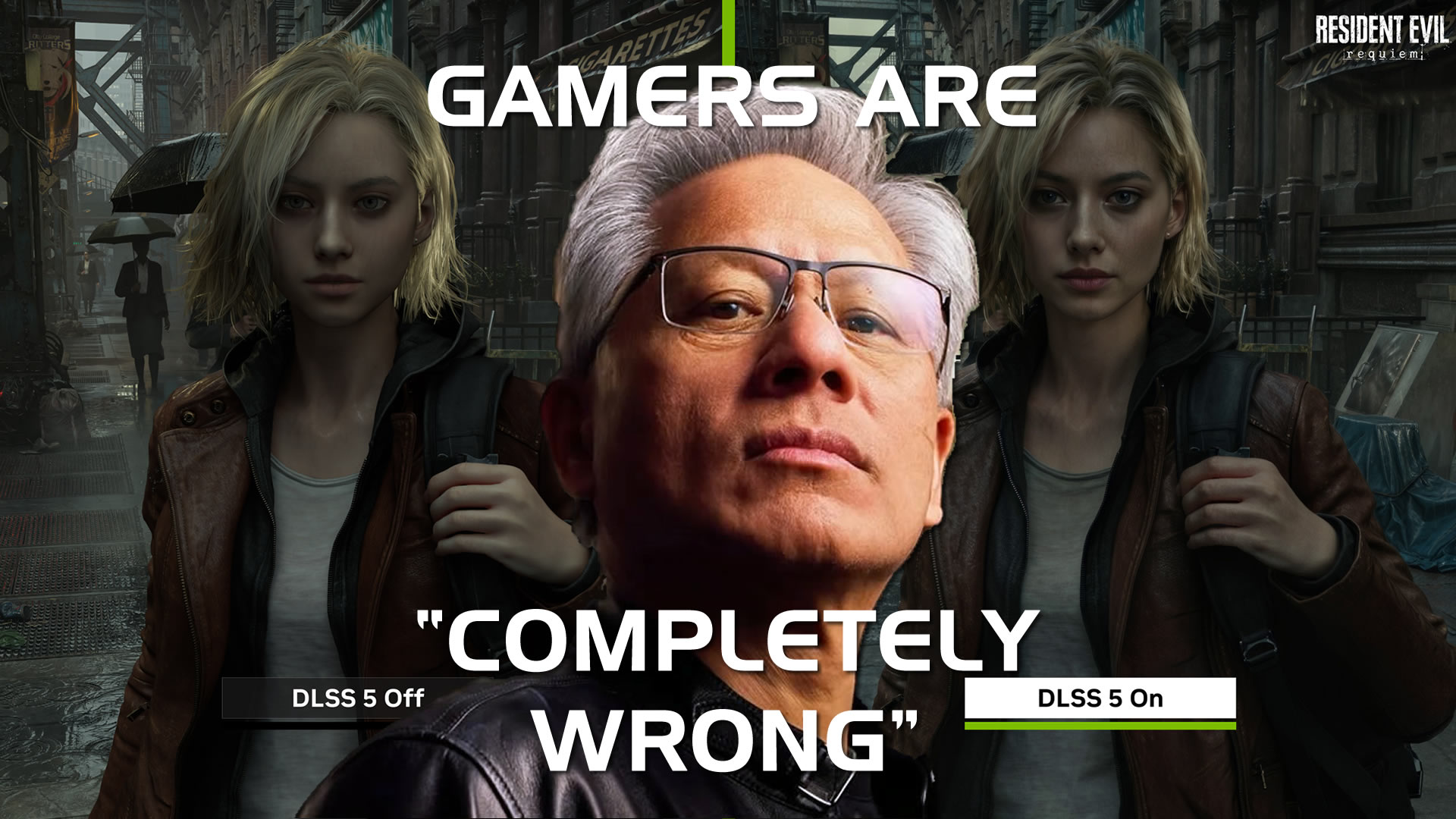
Nvidia unveiled DLSS 5 earlier this week, and to say the least, the tech is controversial. Memes have been flying across the internet, calling the new AI technology little more than an “AI filter”. Gamers are complaining that the tech is changing the look of their beloved video game characters and harming developers’ artistic vision.
When discussing the backlash with Tom’s Hardware, Nvidia’s CEO, Jensen Huang, didn’t mince words. He said that gamers are “completely wrong” about DLSS 5. A lot of people have complained that DLSS 5 changes the geometry and appearance of characters. Huang says that DLSS 5 is controllable and uses a game’s original geometry and textures. It isn’t AI post-processing, it’s “neural rendering.
Well, first of all, they’re completely wrong. The reason for that is because, as I have explained very carefully, DLSS 5 fuses controllability of the of geometry and textures and everything about the game with generative AI,
It’s not post-processing, it’s not post-processing at the frame level, it’s generative control at the geometry level,
All of that is in the control — direct control — of the game developer. This is very different than generative AI; it’s content-control generative AI. That’s why we call it neural rendering.
– Nvidia CEO Jensen Huang to Tom’s Hardware
Is the backlash against Nvidia DLSS 5 justified?
Based on what Nvidia has shown us, DLSS 5 could be a transformative technology for gamers, but it is optional. DLSS 5 is tied to a game’s original graphics, textures, and geometry, so it won’t hallucinate wildly or create characters and objects that don’t exist. As much as the memes try to showcase insane differences in aesthetic and appearance, that isn’t how DLSS 5 works.
DLSS 5 focuses on lighting and materials, and lighting can dramatically impact a scene’s look and feel. Decorators will know that lighting can entirely change the look of a room. Photographers will also know that lighting can have a huge impact on a subject. How many times have you seen a photo and said, “That doesn’t look like me?” Lighting has a huge impact on gaming visuals, which is one of the reasons Nvidia’s been focusing on ray tracing and path tracing in recent years.
Nvidia’s early examples of DLSS 5 are intended to wow people and get people talking, but in practice developers will have control over their content. If they don’t like DLSS 5, they won’t use it. Developers will also be able to control the model and experiment to ensure the game looks how they want it to with DLSS 5.
DLSS 5 is an optional feature
Ultimately, DLSS 5 relies on a game’s underlying visuals to function. It needs to use game models, textures, and motion vectors to work. That means games will still be created as normal, and DLSS 5 will always be optional, at least in its current form. Like all other forms of DLSS, if you don’t like it, don’t use it.
In time, we will all see what DLSS 5 looks like and how it performs in practice. That will be the true test of Nvidia’s technology. Will DLSS 5 look good outside of Nvidia’s cherry-picked examples? Will it be widely adopted by developers? We’ll have to wait and see.
DLSS 5 is due to be released this fall. It will support RTX 50 series graphics cards.
You can join the discussion on Jensen Huang saying gamers are “completely wrong” about DLSS 5 on the OC3D Forums.