
Read more Featured Stories like this in The Strad Playing Hub
The inaugural London Festival of Chamber Music (LFCM), taking place at Smith Square Hall 25-29 March 2026, promises to be a showcase of the finest chamber music, bringing together outstanding international musicians for five days of inspiring performances.
The festival is not only unique for the musicianship it wields, but also for the pedagogical innovation it represents. The festival is combining the prowess of its reputationally established performers with fresh talent: that of Sinfonia Smith Square, the resident chamber orchestra of Smith Square Hall, made up of early-career young classical musicians.
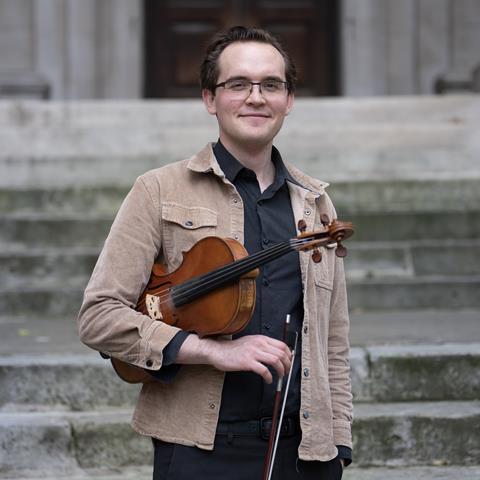
As a violist in this orchestra, I expose my hubris by declaring that this collaboration shall yield artistry of international transcendence. However, in this declaration resides a fundamental truth: the opportunity to learn from musicians of this caliber during the festival through shared musical exploration is unique in the UK and, indeed, the world.
Excited murmurings among my Sinfonia colleagues began months ago when orchestra admin announced François Leleux will be joining the oboes for a concert during the festival. Jaws and coffee mugs crashed to the floor. Embarrassingly, as a violist, my first thought was, ‘Who is François Leleux?’ Thankfully, I suppressed this egregious query and, after some frantic bathroom Googling, I too found my jaw on the floor. But my mouthful of orchestra cookies patooied across the room upon hearing the following announcement that the violas are being joined by Lawrence Power.
As any London conservatory viola student will breathlessly babble, the name ‘Lawrence Power’ represents all things instrumentally enviable, wonderous, inspiring, magisterial, and, indeed, mythical. As a student at the Royal College of Music last year, I distinctly recall hearing him perform Zoltán Kodály’s Serenade, Op. 12 in Wigmore Hall and noting in my diary, ‘if the Gods could sing, they would be jealous this evening’.
Little did I expect to be joining his chorus less than a year later. Sinfonia Smith Square will be active participants in many programmes throughout the LCMF week, including performing in smaller chamber ensembles and symphonies alongside these featured artists, accompanying their concertos, partaking in masterclasses and sectionals, and generally all-around fangirling and fanboying our brains out. There are heroes for everyone at the London Festival of Chamber Music, and thus, everyone is everyone else’s biggest fan.
While these collaborative pedagogical opportunities may be unusual to see during a chamber music festival, they are not unique to the fellowship experience at Sinfonia Smith Square. Eugene Lee, another of the festival’s featured musicians, has been a consistently invaluable and adored mentoring presence throughout the year. Eugene’s gravitas originates equally from his position as Philharmonia’s assistant concertmaster as it does from his pedagogical technique.
I was fortunate to intimately experience his educational prowess during my first week of the fellowship when Eugene asked me to perform with him Tchaikovsky’s Souvenir de Florence Op. 70 alongside LSO’s Benjamin Marquise Gilmore, Philharmonia’s Yukiko Ogura, and RBO’s Lauren Steel. Despite having arrived in the UK from New Zealand eight hours before our first rehearsal, I was immediately struck by Eugene’s ability to deliver direct, acute, and constructive advice through the lens of mutual exploration, thus inspiring, not demanding, the best performance outcome.
When you feel part of a team, you feel a shared responsibility and, ultimately, ability to create great art. Applied to our larger ensemble, this ethos has defined our fellowship experience. Competitors become colleagues when envy is replaced with joint dedication towards achieving group goals.
When argument leads to compromise, ideas become innovative, and struggle transforms into artistry. In this way, friendships are forged, connections are cemented, and ambitions are fostered in preparation for our careers. And, in the end, it results in excellent music. All this, and more, is what the London Festival of Chamber Music will showcase.
For me, the London Festival of Chamber Music represents an opportunity to share generational expertise through communication, teamwork, and mutual inspiration. And is not the majesty we find in music so often attributable to its power as The Great Bridge-builder, The Great Communicator, The Great Unifier, The Great Inspirer?
As someone who has lived with a speech impediment my whole life, music has always been my chosen connective language. Shove me into a room with a herd of growly-faced businessmen or balding stock traders and command me to entertain with words; nay! I’m likely to freeze up, blather about the weather, the suspiciously regularly stale orchestra cookies (a genuine concern), or the ridiculousness of tomato cocktails.
But guide me to a room with musicians and ask us to play something, and ahh! – here is a language we all understand. Here is a language we all feel. Here is how individual voices become one for you, the audience, to hear. To be inspired in turn. So, come! The lure of a twinkly melody is vain and hollow before the promise of genuine human connection. Happily, you shall have both at the London Festival of Chamber Music.