
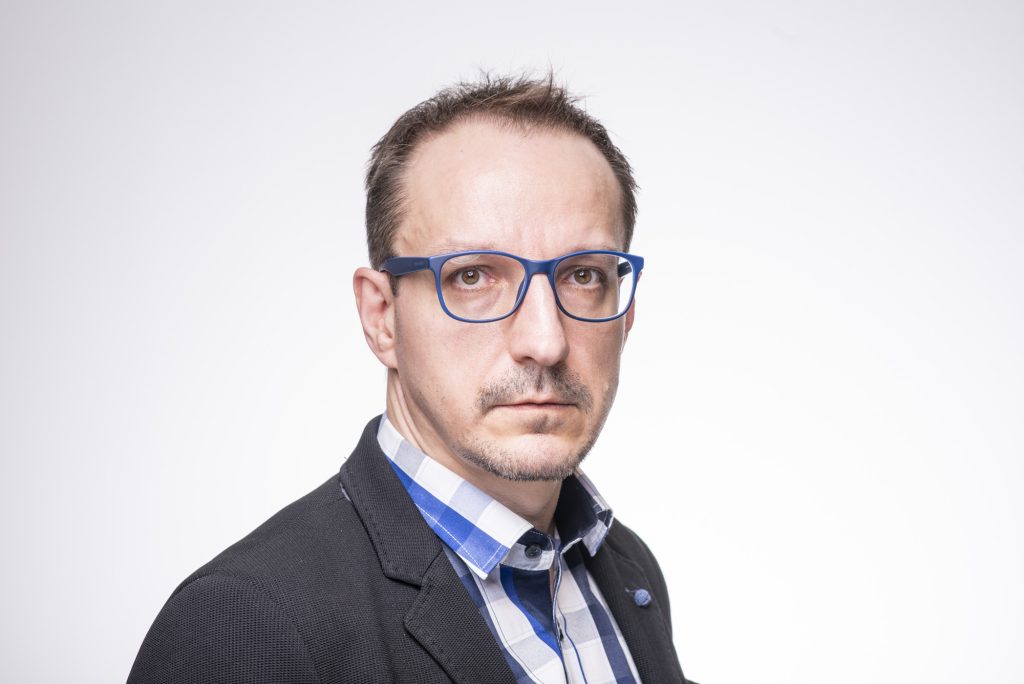
Dariusz Kowalski, PhD, a professor in Augusta University’s School of Computer and Cyber Sciences, has received the 2026 Prize for Innovation in Distributed Computing, an international honor recognizing nearly two decades of contributions to the study of how computer systems communicate and operate reliably.
“I was surprised, to be honest, because competition in theoretical computer science is very tough,” he said. “When I looked at the names of previous awardees, these are really famous people in the distributed computing community.”
The award recognizes cumulative research contributions rather than a single publication. Kowalski was nominated by fellow researchers, who documented nearly 20 years of peer-reviewed work that helped shape understanding in a specialized area of computer science known as distributed computing.
“Dariusz Kowalski is an internationally recognized leading expert in distributed computing,” said Konstantin (Costas) Busch, PhD, professor and chair of the Computer Science department. “His research has impacted many important areas, including wireless communications, network security, distributed consensus and quantum computing. I applaud his accomplishments and congratulate him for receiving this prestigious award.”
Distributed computing examines problems in networked systems where multiple independent computers communicate, perform tasks and coordinate with one another. These problems become especially complex when many systems attempt to send information over shared broadcast channels at the same time.
Kowalski compares it to a classroom discussion.
“A shared channel is like a classroom,” he said. “If more than one person tries to talk at the same time, there is noise and chaos. Good communication requires coordination, but interference is unavoidable when many autonomous systems operate at once.”
His research studies how communication systems continue to function even when unpredictable disruptions occur. By modeling worst-case scenarios and designing reliable communication methods, his work helps improve the stability and efficiency of technologies that rely on digital networks.
Kowalski joined AU in 2019 as part of the early faculty group that helped grow the School of Computer and Cyber Sciences. He spent nearly 15 years teaching and conducting research at the University of Liverpool in England prior to his arrival.
At Augusta University, Kowalski integrates his research into student projects and mentoring undergraduate and graduate students through real-world problem solving.
“Dr. Kowalski’s research spans an impressive breadth in distributed computing, including his noteworthy contributions to wireless and ad‑hoc radio networks, fault‑tolerance and communication efficiency and robustness. His visibility in the international computing research community elevates the stature of Augusta University as a comprehensive research institution.”
Alexander Schwarzmann, PhD, professor and dean of the School of Computer and Cyber Sciences
Through these research experiences, students learn how to identify a problem, model it mathematically, design a solution and apply it to real systems.
“Through research projects, I show students how to approach real-world problems, from modeling interference mathematically to selecting solutions and then applying them back to real systems,” Kowalski said. “I don’t expect students to become professional scientists, but I want them to understand how to think critically and systematically when solving complex problems in their careers.
“I’m trying to think about something entirely innovative and new that others have not yet explored,” he added. “I’m focusing on identifying important areas of computing that remain largely untouched.”
He also emphasized the importance of collaboration in his work, crediting mentors, colleagues and students for contributing to his research.
“My contributions would not be possible without collaboration. Research is not about working alone, but about brainstorming and developing ideas together.”
Kowalski will formally receive the award at an international research conference this summer, where he has been invited to deliver a keynote presentation about his work. He said the recognition is not the end of his research but a motivation to pursue new ideas and emerging areas of computing.
“Dr. Kowalski’s research spans an impressive breadth in distributed computing, including his noteworthy contributions to wireless and ad‑hoc radio networks, fault‑tolerance, and communication efficiency and robustness,” said Alexander Schwarzmann, PhD, professor and dean of the School of Computer and Cyber Sciences. “His visibility in the international computing research community elevates the stature of Augusta University as a comprehensive research institution.”