

The curious math that explains why fashion trends always come back around
Fashion’s 20-year trend cycle isn’t just based on vibes; it can be mathematically modeled
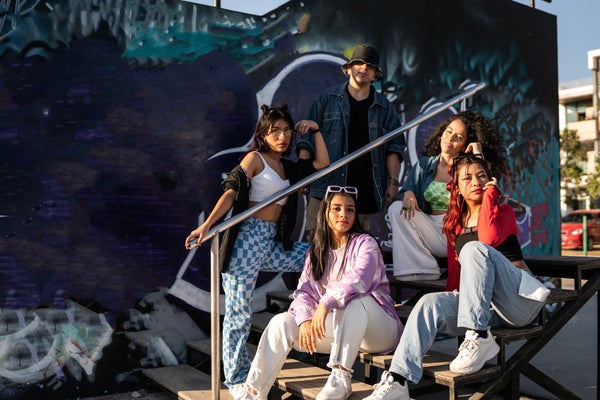
Y2K fashion is back among young people, and a mathematical model shows the trend is right on time.
FG Trade Latin via Getty Images
If you’ve noticed a resurgence in low rise jeans, baby tees and velour tracksuits among the cool kids, know that what you are witnessing isn’t just the return of a trend—it’s math.
Fashion followers know that trends tend to reappear on a 20-year cycle, and a new analysis of more than 150 years’ worth of women’s clothing shows that this cycle isn’t just anecdotal: trends in the hemlines, necklines, and waistlines of dresses really do become cool again approximately 20 years after their last turn in the spotlight.
“I’ve always been surrounded by this idea that fashion comes back and fashion is cyclical, so I started to think: Is it actually true?” says Emma Zajdela, a post-doctoral researcher at Princeton University who conducted the new analysis. “I realized that what we had found in the data actually lined up perfectly with what’s being said in the industry, so that was pretty incredible for us.”
On supporting science journalism
If you’re enjoying this article, consider supporting our award-winning journalism by subscribing. By purchasing a subscription you are helping to ensure the future of impactful stories about the discoveries and ideas shaping our world today.
The analysis relied on data from the Commercial Pattern Archive, a digital database that stores tens of thousands of images of dress patterns dating back to the 1840s as well as runway photos. Using these resources, researchers were able to build a comprehensive fashion database, with more than 35,000 images of women’s clothes.
Zajdela and her team analyzed key features of women’s dresses through time. Looking along the vertical axis from head to toe, the researchers charted how hems rose and fell in periodic curves over time and fit their findings to a mathematical model.
“The mathematical model that we’re using is pretty simple, conceptually,” Zajdela says. “It’s based on this idea from psychology called optimal distinctiveness.”
Optimal distinctiveness essentially says that people want to belong to a group and to still be unique in some way at the same time. When applied to fashion, it means that for a new trend or innovation to be successful, it needs to be different enough—but not too different—from existing things. People tend to want clothing that feels new and unique, but they also typically don’t want to stray too far from what they’ve worn in the past or what others are wearing.
Searching for styles that are both familiar and different can lead some people to gravitate toward more nostalgic designs—especially, for younger generations looking for fashion inspiration, as those styles date from a period of time they didn’t directly experience themselves and so they feel more “new.”
“Every 20 years, you have a new generation of consumers who long for yesteryear,” says Shawn Grain Carter, an associate professor of fashion business management at the Fashion Institute of Technology who was not involved in the study. “We love to go back to the past to figure out how to … introduce something new to that next generation of consumers.”
It’s possible that the 20-year cycle could shift in the future: it takes less time to produce new clothing and social media has given people access to more ideas, speeding up trends. But for now, the mathematical model holds up—there is just a lot more diversity in the recent data, Zajdela explains.
Having established that fashion trends can be described mathematically, the researchers are interested in what similar models can tell us about other areas of human innovation.
“We have this example of fashion, but it shows how human creative endeavors, or innovations, in general might happen,” Zajdela says. “Many other kinds of innovations have this property that they need to be different from the past but not too different.”
The results were presented on Tuesday at the American Physical Society’s Global Physics Summit.
It’s Time to Stand Up for Science
If you enjoyed this article, I’d like to ask for your support. Scientific American has served as an advocate for science and industry for 180 years, and right now may be the most critical moment in that two-century history.
I’ve been a Scientific American subscriber since I was 12 years old, and it helped shape the way I look at the world. SciAm always educates and delights me, and inspires a sense of awe for our vast, beautiful universe. I hope it does that for you, too.
If you subscribe to Scientific American, you help ensure that our coverage is centered on meaningful research and discovery; that we have the resources to report on the decisions that threaten labs across the U.S.; and that we support both budding and working scientists at a time when the value of science itself too often goes unrecognized.
In return, you get essential news, captivating podcasts, brilliant infographics, can’t-miss newsletters, must-watch videos, challenging games, and the science world’s best writing and reporting. You can even gift someone a subscription.
There has never been a more important time for us to stand up and show why science matters. I hope you’ll support us in that mission.