
Surely someone at Capcom has noticed the coincidence. For a game series that’s built around bioweapons, zombies and mutating monsters, Resident Evil has seen its own steady evolution.
The franchise started as a puzzle-box survival horror game, then made a sharp turn into action with the release of Resident Evil 4. It veered a little too far into action with Resident Evil 6 and since then the series has been trying to find a middle ground between horror and adrenaline. It’s toyed with various camera perspectives, lead characters and plot scenarios, trying to strike this balance.
The core problem being: How can you scare the player when the playable character is a shotgun-wielding zombie-destroyer by the end of the game? The power creep ultimately undermines the horror. It’s hard to feel afraid when you’re all-powerful. But keeping the character weak and vulnerable also detracts from the fun.
Resident Evil Requiem’s latest iteration’s solve for this is pretty simple: they compartmentalise the game across two characters — Grace Ashcroft, the mousy FBI analyst, and series stalwart Leon S. Kennedy. While this is very much Grace’s story, you play as both, alternating between them as the game progresses.
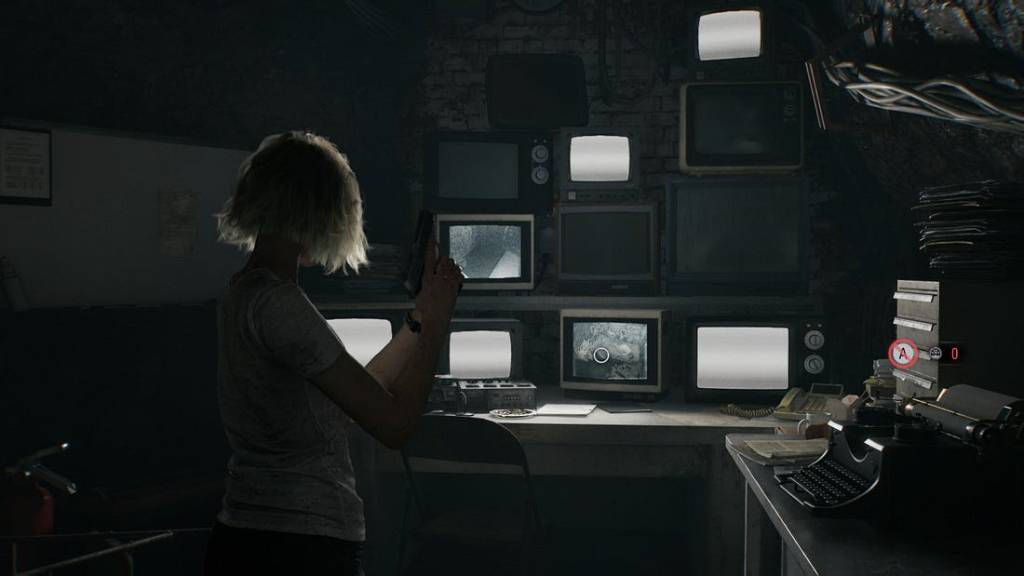
Grace’s sections are pure survival horror and, big call, some of the best I’ve played to boot. The best regular weapon she gets is an upgraded pistol. Beyond that, she uses her brains to survive. She can craft items, (using mutated blood, don’t think about it too deeply) and the majority of her gameplay revolves around environmental puzzles.
Leon, on the other hand, comes in packing just about everything aside from a rocket launcher. He gets all the boss fights, can parry incoming attacks, and is a literal bioweapon-mincing machine.
In the spirit of evolution, this review is also going to be a bit different.
Welcome to the chat
I’ve brought in another Resident Evil superfan, Scanlines, to help me break down this game. It’s a long discussion, and we go into a lot of detail. So if you are looking for a quick verdict: We both loved this game and felt it was up there among the series best. Though, its duality and plot create a few issues.
With that: I’ll pass it to him. What are your initial impressions? What do you think?
Scanlines: I think Capcom’s decision to split the game in this manner — though not without a few minor issues — was a stroke of genius. I was nervous to start this game and the heavy cutscenes in the first hour made me wary, but it all turned out great.
Ever since Resident Evil 7, Capcom has been juggling three different generations of Resident Evil fan — classic fans, action fans and modern fans — in a way where it always felt like one of those groups was losing out. Resident Evil Village is my least favourite of the modern RE titles and where I felt this friction the most; fans of classic survival horror like me were forced to play a contrived first-person shooter sequel to the best survival horror game since the GameCube, and action fans couldn’t even enjoy Village in third person until some time after release. In essence, the Grace, Leon split in Requiem turns one of modern Resident Evil’s Achilles’ heels into its biggest selling point.
Not up for the survival horror and stalker enemy? Just a few hours in and you’ll get to indulge in the Leon S. Kennedy power fantasy. Prefer survival horror? Well, Grace is the protagonist of the story — more so than Leon — and the first half of the game is survival horror Resident Evil at its most tense.
Modern Resident Evil fans get a game that isn’t a truncated version of something that released on the original PlayStation 30 years ago, and it advances the story. Everyone wins.
I’m going to echo your big call, Harrison. I replay these games every year — original hardware, headphones on, in front of the glow of my CRT or at my computer in the dark — and not since Resident Evil 2 Remake in 2019 have I felt the level of tension and dread Requiem provokes. Some jump scares had me flying out of my seat. The way certain mechanics from the very best of the survival horror era are reused put a massive smile on my face when I realised what was going on and how I was supposed to be using the Haemolytic Injector.
Grace’s half of the game is a sweet, short dose of the finest survival horror ever crafted… but I felt Leon’s half didn’t quite live up to past adventures; the enemy variety, set-pieces and weapons roster don’t hold a candle to games like Resident Evil 4 or 5. I’d be interested to know if you felt the same way.
Harrison: Yeah, you are bang on. I think we’re going to be agreeing for most of this article.
Before I delve into Leon, I just wanted to add: whoever came up with the idea to make the zombies just that bit more human with this new mutated T-virus — absolute stroke of genius. It adds a level of characterisation to the enemies that just isn’t present in many other survival horror games.
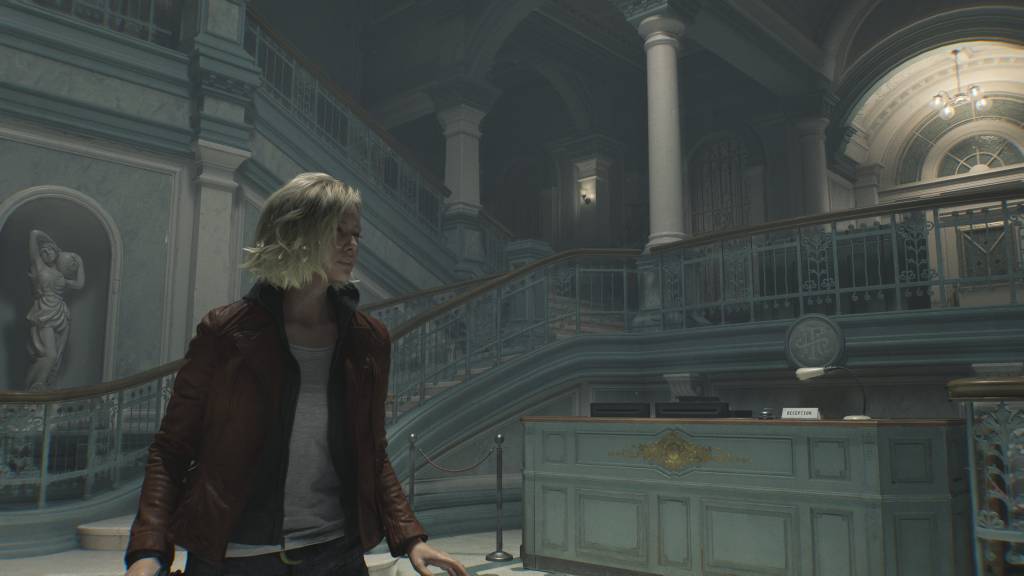
Enemies focus on light switches, which you can use to distract them, or attempt to clean up after corpses you leave in your wake. Others literally apologise while going for your jugular. These aren’t just monsters — they are victims. This is almost always the case with Resident Evil games, but it really hits home hard here. It’s innately more creepy than lifeless corpses lurching around the place.
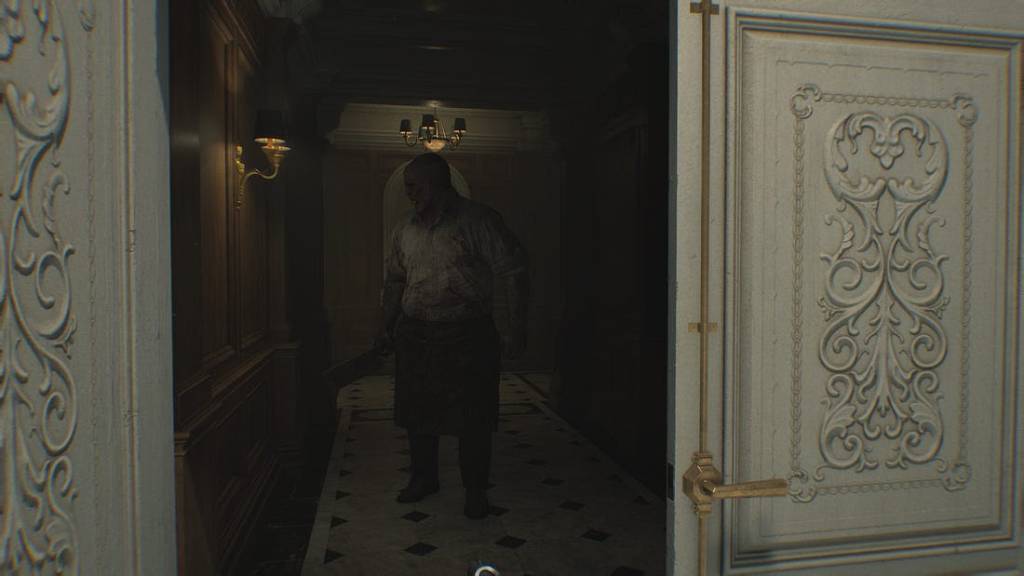
Scanlines: That part of the new zombies took a long time to settle for me. When I first encountered the Chef in the kitchen, a combination of my juvenile humour finding his voice and dialogue funny, the heavy cutscenes at the beginning and a lingering bitter taste in my mouth from Resident Evil 8 set alarm bells ringing — but after my first hour in the Care Centre I really fell in love with the concept.
Gunning down one zombie and hearing it whimper “Sorry” as I waited to see that tell-tale blood pool to know the deed was done was a moment of emotional poignancy this series rarely hits.
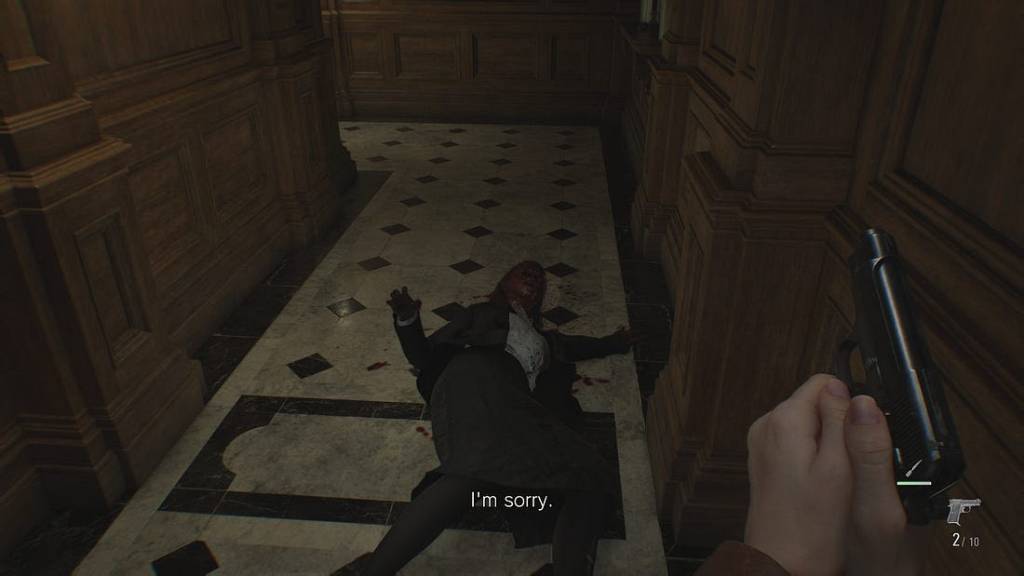
Obviously this is a reference to RE3 Remake, but as you say, it reminds the player that these people are victims of bio-organic weapons and recontextualises every horrifying monster as an innocent you’re forced to put down. That feeling never left me.
Harrison: Speaking of lifelessness — this brings me to your earlier question. While it was interesting to return to Raccoon City in the second half of the game, it was a very dull, colourless environment. As you would expect from a place that survived a nuclear fallout, I guess.
Yes, it was riddled with easter eggs from past games, including a few nods to the very niche Resident Evil Outbreak 1 and 2. And it’s the ultimate power fantasy watching Leon essentially quash legions upon legions of undead.
However, this part was the most forgettable for me. Cool, yes. But I think the environments lend so much to these action games, because you are essentially doing the same thing for a few hours. This is a tricky one to parse — it’s not bad by gameplay standards more broadly. The combat scenarios designed for this section are top notch compared to other action shooters.
The tilted-over building where you use the glass floor as a weapon. The elevator ride from hell down a dilapidated apartment block. Even the weird gas station fight segment with a chainsaw. It’s all outstanding in hindsight. And I appreciated Leon’s weapon upgrade system and the linking of kills to points — reminiscent of the arcade modes in prior games.
Scanlines: I’m going to take this opportunity, now that we’re discussing art style and graphics, to say I played using the third person camera rather than in first and that in general the presentation of Requiem didn’t blow me away. The facial animations are all quite stiff and there were moments where I noticed some very muddy-looking textures; the dreaded yellow paint and yellow tape also make a return, and I hate how you can’t turn the film grain off in this game. The drab colours in Raccoon City exacerbate all of this.
This was such a difficult area to evaluate. I agree that the set-pieces are all outstanding and I loved the easter eggs — I burst out laughing at the hidden Tofu one — but part of me feels a bit sad that the PlayStation 1 version of the RPD has been erased from history here. They make a big song and dance about returning to Raccoon for the first time in about 25 years, but we’re not really returning to it, are we?
We’re revisiting the 2019 remake, not classic Resident Evil. The upgrade system was brilliant but I do miss the weapon variety from RE4 Remake — I felt like I was waiting for a new set of guns that never materialised.
Harrison: That’s such a great point. This is a nostalgia trip without the nostalgia. Though, I replayed Resident Evil 2 Remake after finishing this, and it hits a bit harder now because of this new game.
After finishing Requiem, I can’t help but long for more of what we got within the first few hours with Grace. As we both know, she has another moment later in the game, but it’s quite linear in comparison. I just wanted another sprawling survival horror section to cap off Requiem. The Rhodes Hill hospice was the game for me.
Scanlines: It’s funny to think that the biggest issue with Requiem is probably that it should have given us more. I’m happy to feel that way about it, especially after Resident Evil Village — a game I felt dragged on and on. It is a shame about the linearity, though; that late-game stealth section involving a certain classic enemy was top-tier, and the juxtaposition in gameplay served to highlight how far Leon has come.
Harrison: That’s a good jumping-off point for another discussion. Changing gears a little: given we’re both well versed in Resident Evil canon, what do you think about the game’s plot and Victor Gideon as the big bad? There’s also a world where Jill Valentine or Claire Redfield could have been in this game rather than Leon.
Scanlines: In general, I feel the franchise has come to rely too much on legacy characters, especially Chris and Leon. I would have preferred Claire or Jill, but let’s face it — they have neither the marketing power that shareholders like nor the meme potential that the internet sees in any Leon appearance.
I was always comparing Requiem to Resident Evil 7 while playing. That was the last time we were introduced to a major new character. I think I speak for most of the fanbase when I say that Ethan Winters wasn’t particularly interesting or well-handled; Ethan had too much background and dialogue to be a player self-insert, yet Capcom were obsessed with hiding his face for a while there.
That game’s big twist was excellent too — it recontextualised a disconnected story into an integral part of the modern timeline. By comparison, I felt Grace was a little cheated in Requiem. Her character arc isn’t all that strong, and despite having a much more interesting personality and closer ties to the canon than Ethan, she lacks agency. Leon and Gideon’s actions force her into situations — Grace doesn’t follow a mission like, say, STARS Alpha Team in RE1.
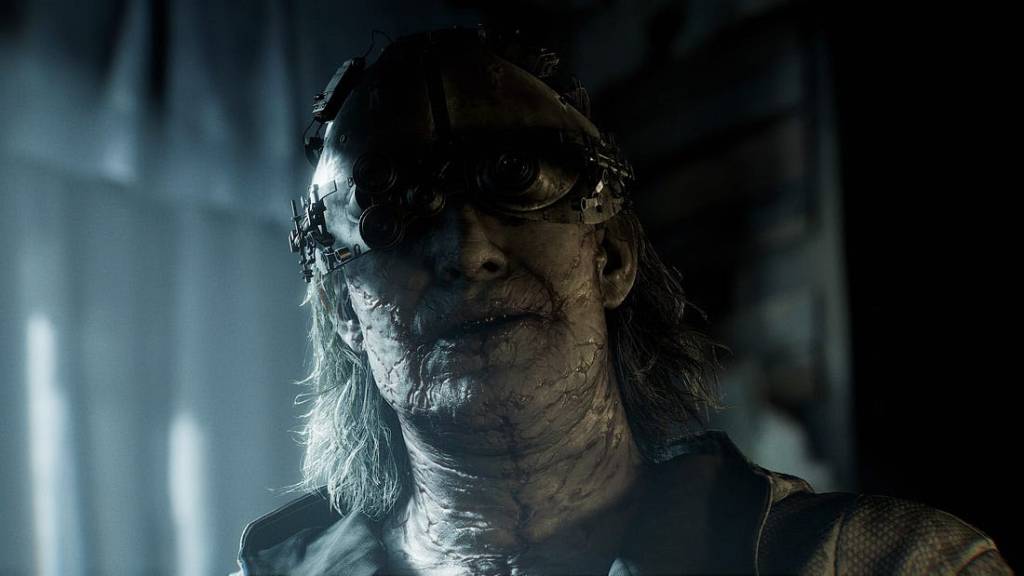
On the plot more broadly — I’m not a fan. I was seriously disappointed when a certain character was killed off unceremoniously in a cutscene, and the big plot MacGuffin felt much too far-fetched. Gideon was delightfully creepy and I enjoy his lore, but I have to say — as a Resident Evil GameCube super fan, with that remake being my third favourite game ever — my heart did sink a little that RE1’s sequels got all the nostalgia bait. We returned to the series’ origin and somehow managed to completely ignore the first game.
Harrison: I’d actually never thought of that, which is a shame — I agree, the remake of the first Resident Evil game rocks and holds up to this day.
Plot-wise: I think they started strong but didn’t really know how to finish it. For a game built around honouring the series, there aren’t any real lasting implications from it.
Scanlines: I agree on the lack of lasting implications; for a game that was supposed to be about tying up loose ends… we sure have a lot of new ones.
Harrison: Yes, they did end up adding in another mysterious group to keep tabs of. I’m running out of red string for my Resident Evil conspiracy pinboard!
We’ve covered a lot of ground in terms of gameplay and story. One way I always like to cap off my reviews is by looking at the value of the game — its cost relative to its gameplay.
It’s not cheap. Capcom bumped the price up in Australia to $107 AUD ($69 USD), around $10 more than their last title. For that, I got a solid 12 hours of gameplay. It is designed to be replayed, but without too much variation. Insanity mode features slightly changed item placement and enemy difficulty, but that doesn’t have me rushing in for a second run.
How I pine for the days when a second character featuring in the game meant an entirely different playthrough. We seem to be getting further and further away from that with Resident Evil. That said, I reckon I’ll replay this over the years. For me, it’s a no-brainer if you love survival horror or Resident Evil. Though these games do go on sale, I could totally understand others waiting for that. What do you think? Any closing thoughts?
Scanlines: I’m glad you brought this up, Harrison, because the price versus value debate is one I have a lot of thoughts on. Modern gaming reminds me a lot of GameCube-era Nintendo sometimes — during that console’s heyday, a lot of their games had excessive bloat in order to inflate the runtime. Wind Waker being longer than Ocarina of Time sounded better on paper until you realised the extra length was hunting for Triforce Shards. Where am I going with this? I don’t think hours equate to value.
Most of the greats aren’t particularly long games and nobody cares — what matters is that you enjoy the experience and don’t feel ripped off. Resident Evil games have always been short and replayable, and on a personal level I’m tired of playing games that take weeks to finish.
I think the price is worth it through the lens of replaying the game once a year, as I do, and certainly for Resident Evil players who like to speedrun — but Requiem certainly isn’t a game to buy at full price for those hoping for extra modes or just looking for one particular gameplay style.
All of that being said, there are barriers to that classic Resident Evil replayability here and I share in your fondness for the classic two-character system.
The front-loaded cutscenes grind down the opening hour, and there should have been an extra difficulty in there, because Insanity mode is meant for players who have already unlocked infinite ammo and other bonuses.
They try to position Classic mode as a stop-gap, but I don’t consider being forced to use Ink Ribbons a higher difficulty — to me, that’s just the way Resident Evil is meant to be played.
Harrison: Hard agree. I played with Ink Ribbons turned on for my first run!
Scanlines: It’s been a pleasure to join you, Harrison. I’ve been relatively critical of Requiem here, but my overall opinion is that this is the best Resident Evil game of the decade so far and about on par with Resident Evil 2 Remake.
- Reviewed on: Playstation 5 Pro, RTX 5070, i7 12700KF PC.
- Worth playing if you like: Other Resident Evil games? But you don’t need us to tell you that. The Evil Within, Dead Space.
- Available on: Playstation 5, Nintendo Switch 2, Xbox Series S and X, Windows, Steam.
Are you a fellow Resident Evil fan? Given it’s not that long, have you played through Requiem and do you have your own thoughts? And what do you think of this format for reviews? Let us know in the comments.
- Harrison Polites writes the Infinite Lives newsletter. Follow him here. Infinite Lives is a reader-supported publication. It’s free to sign up and read the latest piece, but as of July a subscription will be required to read Harrison’s backlog of over 70 unique articles. Each subscription goes towards improving his Substack, supporting the broader Substack gaming community and funding more independent games journalism in Australia.